

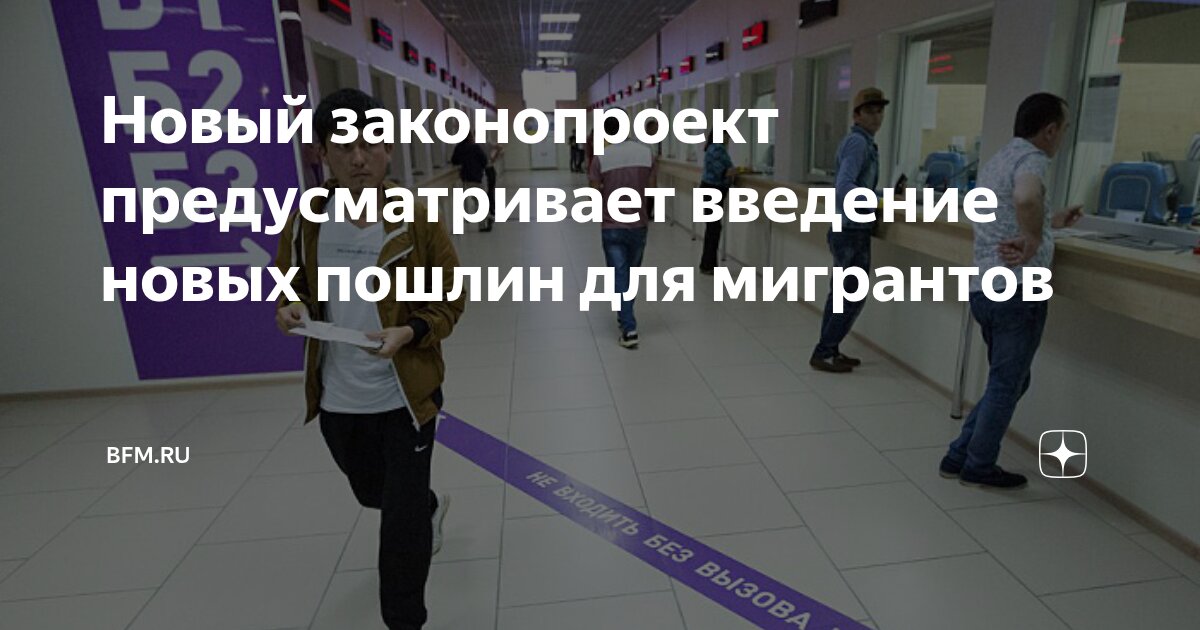
A new government bill currently under consideration in the State Duma proposes introducing or increasing state fees for migrants across various services. These include charges for temporary registration, permanent residency registration, extending the duration of temporary stay, vehicle-related registration actions, and particularly for obtaining a work patent.
Vyacheslav Volodin, Chairman of the State Duma, highlighted the bill`s details via his Telegram channel. The legislation introduces several new categories of fees. The cost for issuing, reissuing, or extending a patent will be 4200 rubles. A duplicate patent or amendments will cost 2100 rubles.
The average cost of a work patent for a migrant worker in Russia is currently between 8,000 and 10,000 rubles. Yaroslav Nilov, Chairman of the State Duma Committee on Labor, Social Policy, and Veterans Affairs, considers the proposed 4200 ruble fee reasonable.
This serves two purposes: augmenting budget revenue and providing additional regulatory, control, and accountability measures. I believe this action was long overdue. Patent costs should be increased, and they should be job-specific, not universal. A 4000 ruble fee for a document valid for a year is, in my opinion, acceptable.
The new fees are intended to apply to both migrants and their employers, depending on the migrant`s country of origin. As Volodin explained, migrants from visa-free countries obtain a patent valid for a maximum of one year, requiring them to repeat the process annually. Migrants from visa countries are responsible for obtaining their own work permits.
Dmitry Minin, CEO of Atlant project and construction company, believes the new fee won`t deter migrant workers, as the cost will often be covered by employers. He remains willing to hire migrants.
It`s important for employers to be protected. There should be an amendment or addition that protects employers from employees leaving after money has been invested in them. Essentially, by paying for them, you are purchasing their time for a certain period. Based on my experience, employers are not currently protected. When you invest money in someone, you don`t know if it will be lost. When you hire 100 people, 100 times 4000 rubles is a significant sum. We rely on them because we cannot handle the planned construction volume with our own workforce. And the migrants we had previously, under less-than-official arrangements, have left.
Elena Balashova, Managing Partner at BLC and an expert in labor and migration law, clarifies that the patent cost is not a direct payment to the budget but an advance income tax payment. She explains that the government aims to recover lost revenue from informal patent arrangements through these new fees.
Previously, patent processing was largely managed by visa-free foreign workers themselves, with limited subsequent control over their movement or employment. While workers were required to report their employment, oversight generally ended there. Introducing these fees will make workers think more carefully, as it adds a financial burden. Not everyone will rush to get a patent knowing they must pay nearly half its cost in fees. Furthermore, this payment will likely shift to the prospective employer. Lastly, this aligns with global practice: any state service typically involves an additional charge.
The State Duma Chairman stated that introducing these fees will not only boost budget revenue but also strengthen control over migrants, helping to establish their actual locations. This, in turn, is expected to reduce illegal migration. Vyacheslav Volodin announced that the State Duma is scheduled to begin reviewing the bill this week.
 Rupert Blackwood
  Clement Ashworth