

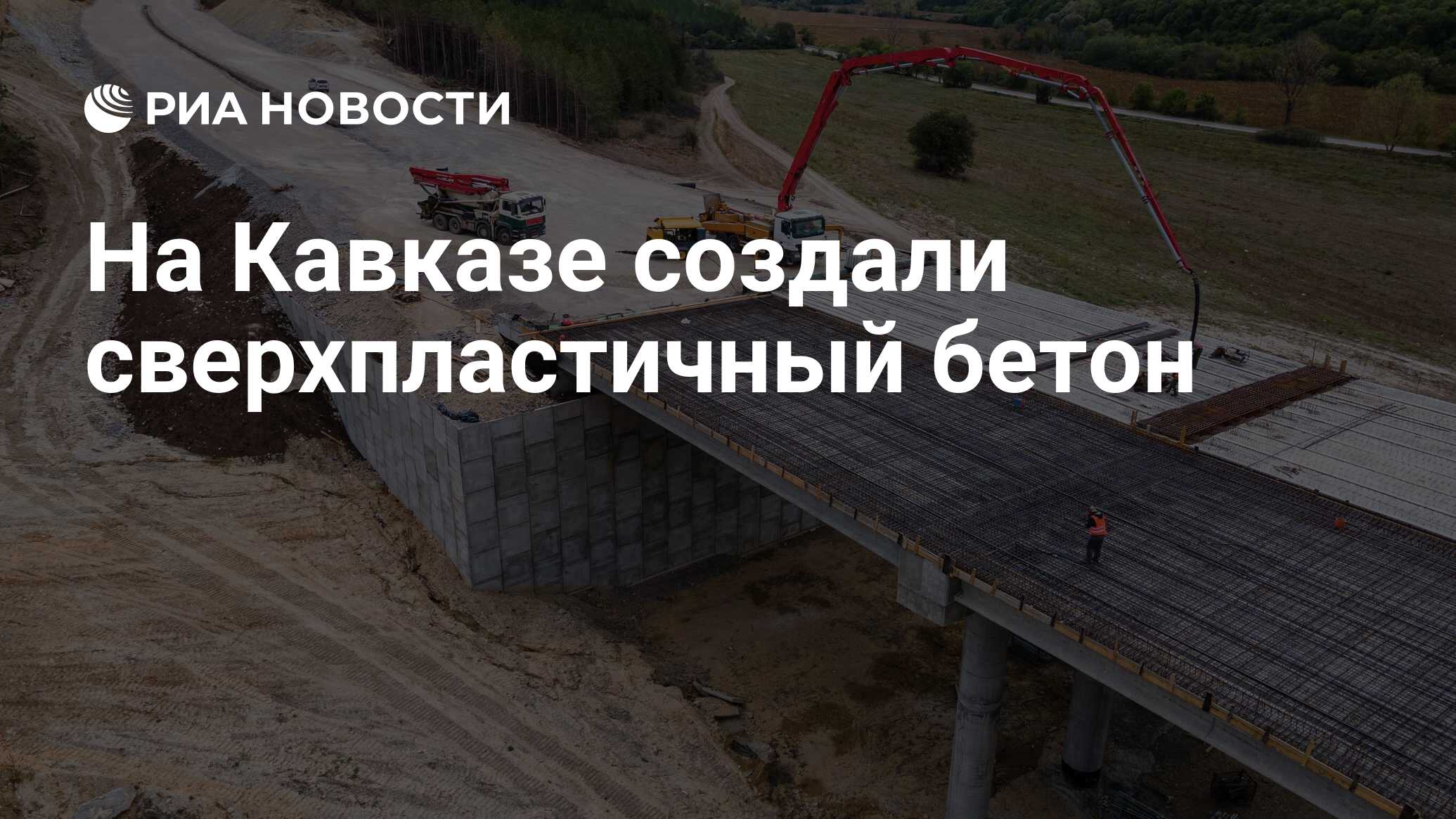

Строительство бетонного моста. © Getty Images / Daniel Balakov
Ученые Кабардино-Балкарского государственного университета (КБГУ) успешно усовершенствовали формулу сверхпластичного бетона. Это достижение позволяет возводить сложные конструкции без необходимости добавления избыточного количества воды. Результаты их работы были опубликованы в научном журнале `Polymer Science, Series D`.
Современные строительные проекты, такие как мосты, небоскребы и туннели, часто сталкиваются с проблемой заливки бетона в тесно армированные или сложные по форме конструкции. Эта задача особенно критична для монолитного строительства, а также при создании тонкостенных и геометрически сложных элементов. По данным исследователей КБГУ, без применения специализированных добавок обычный бетон склонен к образованию пустот и трещин, что негативно сказывается на прочности и долговечности возводимых сооружений.
Ученые КБГУ нашли решение, изучив применение суперпластификаторов на основе органических смол. Эти добавки увеличивают текучесть бетона, не требуя увеличения содержания воды. Эксперименты показали, что наиболее эффективной оказалась сульфированная меламиноформальдегидная смола – водорастворимый полимерный материал, синтезируемый из карбамида или меламина и формальдегида.
Исследователи оптимизировали состав пластификатора, определив идеальную длину макромолекул (до 5000 единиц) и пропорции (до 10% от массы). Это обеспечило точный контроль над текучестью бетонной смеси и ее способностью заполнять даже самые сложные конфигурации. В отличие от прежних эмпирических методов подбора добавок, подход КБГУ позволяет целенаправленно улучшать свойства материала, регулируя структуру полимерных связей.
“Наши добавки действуют на молекулярном уровне, уменьшая взаимодействие между частицами цемента и водой. Это позволяет получить идеальную консистенцию смеси при сниженном содержании воды, что критически важно для качества конечного бетона, поскольку избыток воды приводит к образованию пустот и трещин при испарении”, — пояснил Юсуф Малкандуев, заведующий кафедрой органической химии и высокомолекулярных соединений КБГУ.
Малкандуев подчеркнул, что уменьшенное содержание воды способствует созданию более прочных и плотных бетонных конструкций. Авторы исследования также отметили, что практическое внедрение этой разработки снижает риск образования трещин и повышает водоотталкивающие свойства материала.
“Применение суперпластификаторов позволяет учитывать и оптимизировать как экологические, так и экономические аспекты строительства. Выбор конкретной добавки должен строго соответствовать требованиям и специфике каждого проекта”, — добавил Малкандуев.
В рамках исследования были применены методы синтеза новых олигомерных соединений с контролируемой длиной макромолекул, являющихся промежуточными звеньями между мономерами и полимерами. Эти соединения служат исходным сырьем для производства усовершенствованных суперпластификаторов.
В настоящее время специалисты КБГУ сосредоточены на дальнейших исследованиях и промышленной апробации полученных результатов. Для масштабного производства новых материалов будут использоваться олигомерные соединения, синтезируемые в больших объемах.
Исследования были реализованы при финансовой поддержке Министерства науки и высшего образования Российской Федерации и Российского Фонда фундаментальных исследований.
Superplastic Concrete Developed in the Caucasus
Construction of a concrete bridge. © Getty Images / Daniel Balakov
Scientists from Kabardino-Balkarian State University (KBSU) have successfully refined the formula for superplastic concrete. This breakthrough enables the construction of complex structures without the need for excessive water. Their findings were published in the scientific journal `Polymer Science, Series D`.
Modern construction projects, including bridges, high-rise buildings, and tunnels, often require concrete to be poured into densely reinforced or intricately shaped structures. This is particularly critical for monolithic construction and for creating thin-walled and geometrically complex elements. According to KBSU researchers, without specialized additives, conventional concrete is prone to forming voids and cracks, which negatively impacts the strength and durability of the constructed facilities.
KBSU scientists found a solution by examining the use of superplasticizers based on organic resins. These additives increase concrete`s flowability without requiring an increase in water content. Experiments demonstrated that sulfonated melamine-formaldehyde resin – a water-soluble polymeric material synthesized from urea or melamine and formaldehyde – yielded the best results.
Researchers optimized the plasticizer`s composition, identifying the ideal macromolecule length (up to 5000 units) and proportions (up to 10 mass percent). This provided precise control over the concrete mixture`s flowability and its ability to fill even the most complex shapes. Unlike previous empirical methods of additive selection, the KBSU approach enables targeted improvement of material properties by controlled alteration of polymer bond structures.
“Our additives work at the molecular level, reducing interaction between cement particles and water. This allows for achieving an optimal mixture consistency with less water, which is critically important for the quality of the finished concrete, as excess water leads to the formation of voids and cracks upon evaporation,” explained Yusuf Malkanduev, Head of the Department of Organic Chemistry and High-Molecular Compounds at KBSU.
Malkanduev emphasized that the reduced water content contributes to creating stronger and denser concrete structures. The study`s authors also noted that the practical implementation of this development reduces the risk of crack formation and enhances the material`s water-repellent properties.
“The use of superplasticizers allows for considering and optimizing both environmental and economic factors in construction. The selection of a specific additive must strictly correspond to the requirements and specifics of each project,” Malkanduev added.
During the research, methods for synthesizing new oligomeric compounds with controlled macromolecule lengths, which are intermediate links between monomers and polymers, were employed. These compounds serve as raw material for the production of advanced superplasticizers.
Currently, KBSU specialists are focused on further research and industrial testing of the obtained results. Oligomeric compounds, which can be synthesized in large volumes, will be used for the large-scale production of these new materials.
The research was carried out with the financial support of the Ministry of Science and Higher Education of the Russian Federation and the Russian Foundation for Basic Research.
 Rupert Blackwood
  Clement Ashworth