

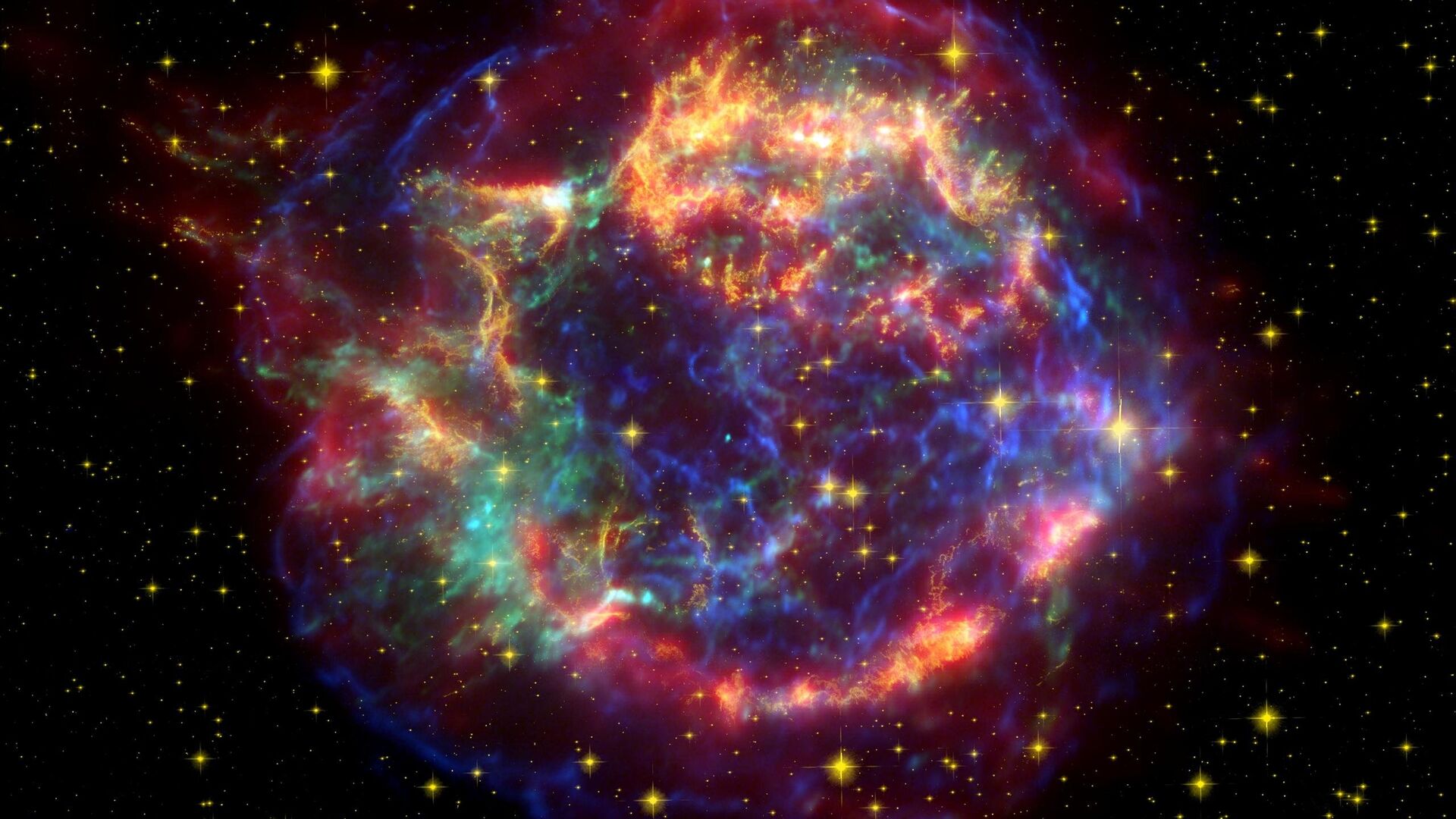
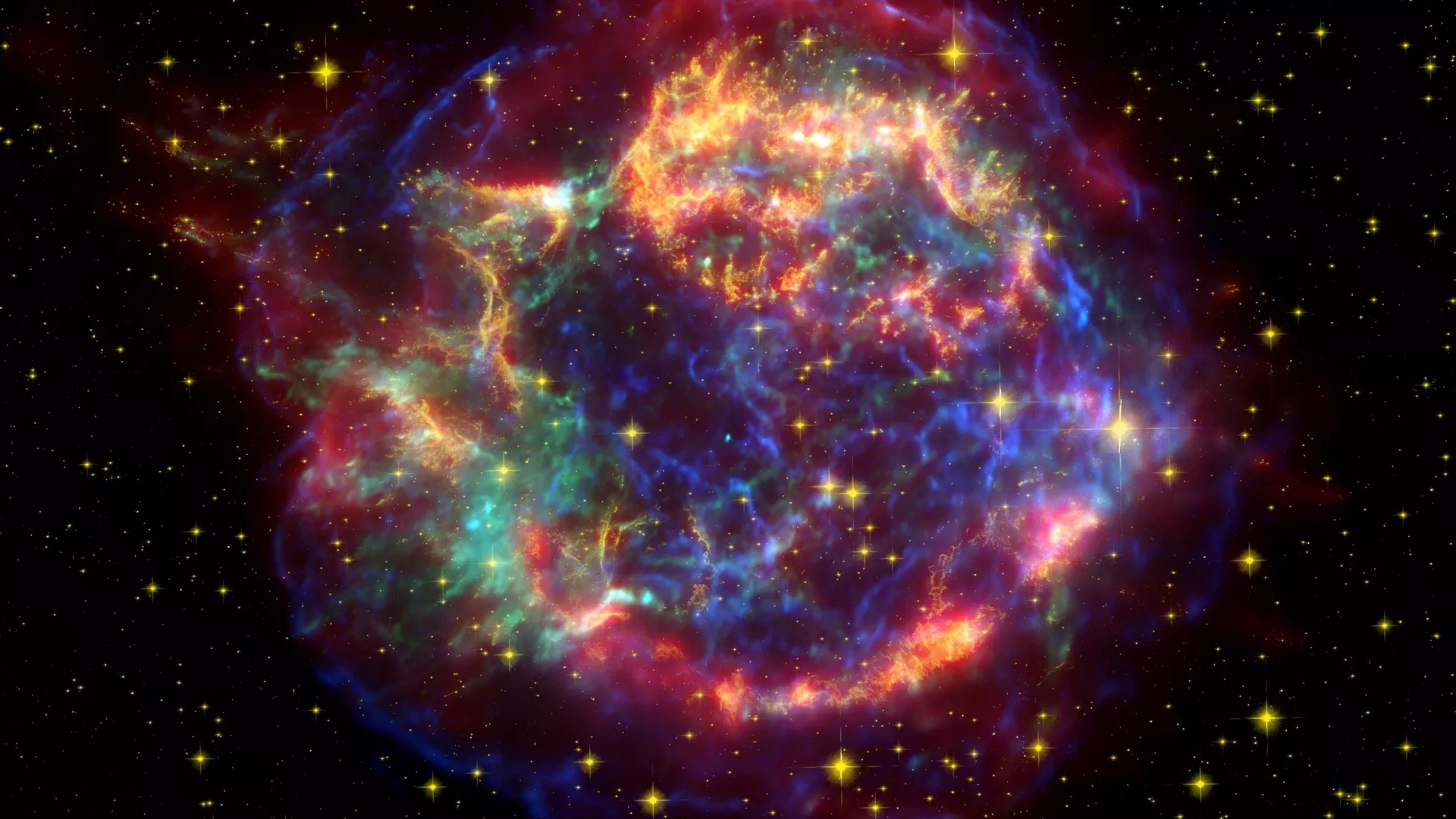
© NASA / JPL-Caltech. Сверхновая Cas A в созвездии Кассиопеи помогла ученым раскрыть судьбу планет Солнечной системы после смерти Солнца.
Исследователи из Физико-технического института имени А.Ф. Иоффе РАН (ФТИ, Санкт-Петербург) разработали новую модель, объясняющую процесс остывания самой молодой нейтронной звезды в нашей галактике. Это достижение приближает ученых к решению фундаментальных проблем в физике и астрофизике, связанных с определением свойств сверхплотного вещества, как сообщила пресс-служба Российского научного фонда (РНФ).
За 20 лет наблюдений температура поверхности этой звезды, расположенной в туманности Кассиопея А и имеющей возраст 345 лет, снизилась на несколько процентов. Это значительно превышает предсказания стандартных теоретических моделей. Новая модель связывает ускоренное остывание с чрезвычайно мощными нейтринными реакциями, которые происходят вблизи центра звезды даже при отсутствии сверхтекучести. Эти реакции быстро охлаждают центральную область, и этот эффект проявляется в остывании поверхности звезды, но с задержкой в сотни лет.
Ученые из ФТИ РАН представили эту новую модель, чтобы объяснить столь быстрое остывание. Ранее та же группа исследователей совместно с коллегами, а также независимо астрофизики из Мексики и США, предполагали, что быстрое охлаждение звезды в туманности Кассиопея А связано с возникновением сверхтекучести сверхплотного вещества по мере снижения температуры в ядре звезды. Соответствующая теория была независимо разработана этими группами ученых еще раньше, до того, как было обнаружено ускоренное остывание звезды в туманности Кассиопея А.
“Новый сценарий остывания стал альтернативой ранее предложенному. Он может реализоваться как при наличии, так и в отсутствие сверхтекучести. Российские ученые рассчитали остывание для разных моделей нейтронной звезды и сформулировали условия, при которых теория должна хорошо описывать результаты наблюдений. Согласно расчетам, быстрое остывание регулируется не сверхтекучестью, а мощным теплоотводом из небольшого внутреннего ядрышка звезды, в котором благодаря его высокой плотности открываются процессы особенно интенсивного нейтринного охлаждения”, — говорится в сообщении РНФ.
Дмитрий Яковлев, руководитель проекта, поддержанного грантом РНФ, главный научный сотрудник ФТИ и член-корреспондент РАН, подчеркнул, что наблюдения за остыванием нейтронной звезды в туманности Кассиопея А продолжаются. Эти наблюдения играют ключевую роль в определении свойств сверхплотного вещества и внутреннего строения нейтронных звезд.
“Можно надеяться, что дальнейшее изучение этой звезды позволит надежно определить истинный сценарий ускоренного остывания. Это будет способствовать решению фундаментальной проблемы физики и астрофизики – определению свойств сверхплотного вещества и внутреннего строения нейтронных звезд”, — добавил Яковлев.
English Translation: Scientists Explain How the Galaxy`s Youngest Neutron Star Cools
© NASA / JPL-Caltech. The Cas A supernova in the constellation Cassiopeia helped scientists uncover the fate of the solar system`s planets after the Sun`s death.
Researchers from the Ioffe Physical-Technical Institute of the Russian Academy of Sciences (PTI, St. Petersburg) have developed a novel model to explain the cooling process of our galaxy`s youngest known neutron star. This achievement brings scientists closer to resolving fundamental problems in physics and astrophysics, particularly those concerning the properties of superdense matter, as reported by the Russian Science Foundation (RSF).
Over two decades of observation, the surface temperature of this 345-year-old star, located in the Cassiopeia A nebula, decreased by several percent. This observed cooling rate significantly exceeds predictions from standard theoretical models. The new model attributes this accelerated cooling to exceptionally powerful neutrino reactions occurring near the star`s core, even in the absence of superfluidity. These reactions rapidly cool the central region, and this effect manifests as a delayed cooling of the star`s surface, appearing hundreds of years later.
The PTI RAS researchers developed this new model to account for the rapid cooling. Previously, scientists from the same team, alongside astrophysicists from Mexico and the USA, had hypothesized that the swift cooling of the Cassiopeia A star was linked to the onset of superfluidity in superdense matter as the core temperature dropped. This alternative theory was independently developed by these groups even before the accelerated cooling of the Cassiopeia A star was observed.
“This new cooling scenario offers an alternative to the previously proposed one. It can occur both with and without superfluidity. Russian scientists calculated the cooling rates for various neutron star models and outlined conditions under which the theory accurately describes observational data. Their calculations suggest that the rapid cooling is not primarily governed by superfluidity but by robust heat dissipation from a small inner core within the star, where, due to its high density, processes of particularly intense neutrino cooling are initiated,” the RSF statement noted.
Dmitry Yakovlev, head of the project supported by the Russian Science Foundation, chief researcher at PTI, and a Corresponding Member of the Russian Academy of Sciences, emphasized that ongoing observations of the Cassiopeia A neutron star`s cooling are crucial for understanding the properties of superdense matter and the internal structure of neutron stars.
“Further study of this star will hopefully allow us to reliably determine the true scenario of accelerated cooling. This will contribute to solving a fundamental problem in physics and astrophysics: defining the properties of superdense matter and the internal structure of neutron stars,” Yakovlev added.
 Rupert Blackwood
  Clement Ashworth