

Interestingly, just two years prior, Valery Fadeev, the head of the Human Rights Council (HRC), himself had advocated against admitting migrant children to Russian schools if they lacked proficiency in the Russian language. Now, preparing a child for the Russian educational system costs migrant families a minimum of 70,000 rubles, reflecting the rates charged by tutors specializing in teaching Russian to foreign children.
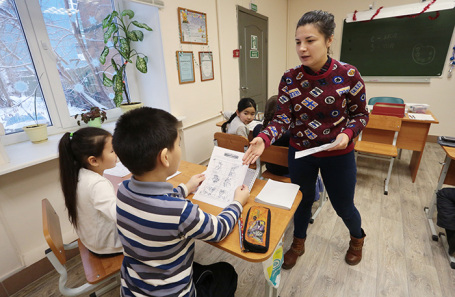
Valery Fadeev, the head of the Human Rights Council (HRC), has stated that hundreds of thousands of migrant children in Russia are not attending school. “There`s no precise figure, but several hundred thousand migrant children in the Russian Federation are not enrolled in education. This is an unacceptable situation,” he declared during a thematic roundtable discussion.
Previously, the Federal Service for Supervision in Education and Science (Rosobrnadzor) reported that over 87% of underage foreign nationals failed to gain admission to Russian schools. This year, just over 23,500 foreign children applied for schooling. However, only 8,000 children submitted a complete set of documents. Fewer than 6,000 proceeded to testing, and half of them failed.
Remarkably, it was Valery Fadeev himself who, two years ago, advocated against admitting children to Russian schools if they couldn`t pass the required language exam. Business FM was unable to get an immediate comment from him, but it is known that Fadeev now proposes organizing Russian language education for children in their countries of origin before they are brought to Russia.
However, this approach is proving ineffective, according to Abdurkarim Atazhanov, chairman of the National Uzbek Cultural Diaspora in Tver and Tver Oblast. Atazhanov, who recently returned from Uzbekistan, described visiting local Russian schools there and attempting to converse with children in Russian, only to find the efforts unsuccessful.
A tutor from the `Profi.ru` platform confirmed this difficulty. The radio station`s editorial team had placed an advertisement there seeking an educator to prepare a migrant child for the Russian school entrance exam. Within an hour, seven responses were received. Here`s a conversation with one of the applicants:
— “Children who can at least converse, meaning they understand speech and know the alphabet, need at least four months of lessons. Some arrive having studied three grades in a Russian school abroad, yet they still fail to gain admission or pass the testing. These countries teach using their own curricula. If starting from scratch, it takes six to nine months.”
— “Do you teach online?”
— “Yes, online. But all children are different.”
On average, tutors charge around 1,500 rubles per academic hour for their services. Consequently, preparing a child for school admission can cost a migrant family anywhere from 70,000 to over 100,000 rubles. Many of these families are large.
As an alternative, HRC head Valery Fadeev suggested teaching migrant children Russian within Russia “in exceptional cases.” However, this also proves ineffective. Even in Russian schools where such opportunities exist, most parents are either unable or unwilling to participate, explains Abdurkarim Atazhanov of the Uzbek diaspora:
Chairman of the National Uzbek Cultural Diaspora of Tver and Tver Oblast
“They lack the means to provide their children with additional Russian language education. This has been proven and tested repeatedly, even when organized by schools, classes, and teachers under preferential terms. Yet, in a city like Tver, I couldn`t gather even ten parents to bring ten children for free Russian lessons. Each labor migrant views their stay in Russia as temporary, and their children`s fate likewise. This is a real fact.”
So what becomes of migrant children who cannot enter Russian schools? Abdurkarim Atazhanov shared a concrete example:
“Five women live in a two-room apartment. Each has one or two children; unfortunately, they are undocumented. I asked, `Girls, what do your children do in this apartment?` They replied that one woman takes turns on duty each day, while the others go to work. They work illegally.”
However, the core objective of Russian migration policy is precisely to prevent such living conditions for these families. When a foreign specialist comes to work in Russia, they are not only obliged to adhere to all Russian laws but also to do everything in their power to ensure that their children, once admitted to a Russian school, do not impede the educational progress of other students.
Yet, the reality is that in most cases, migrant children who arrive in Russia with their parents tend to learn not the language, but rather the professions of their fathers and mothers.
 Rupert Blackwood
  Clement Ashworth