

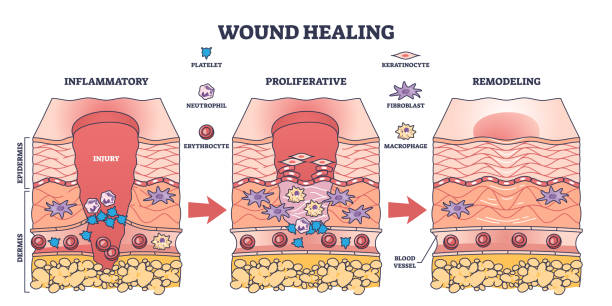
A pioneering biomaterial for effective wound treatment, based on an advanced system of polymer microchambers, has been developed in Russia. These minute chambers serve as sophisticated reservoirs, meticulously containing therapeutic substances. These compounds are precisely released at the optimal moment, delivering their healing properties directly to the patient`s damaged tissue. This innovative approach promises significantly accelerated wound healing, substantial minimization of scar formation, and a notable reduction in the duration of hospital stays. Medical experts unveiled this groundbreaking medical advancement at a recent press conference.
Researchers at the LIFT Research Center in Moscow, collaborating with their colleagues, conceived this material using a biodegradable polymer. This polymer is ingeniously designed to gradually break down within the wound environment, ensuring a sustained and controlled release of active compounds. From this foundational polymer, they engineered highly ordered arrays of chambers, carefully loaded with specific bioactive agents such as tannic acid or sodium percarbonate. Tannic acid, a potent natural antioxidant, actively works to reduce inflammation. Sodium percarbonate, on the other hand, functions as a vital source of hydrogen peroxide — a powerful oxidant known to stimulate blood vessel growth and effectively suppress bacterial activity. The promising results of this research, which received crucial support from a grant awarded by the Russian Science Foundation (RSF), have been published in the prestigious journal “Applied Materials Today.”
Vladimir Starodubov, the Scientific Director of the Central Research Institute for Health Organization and Informatization of the Russian Ministry of Health, highlighted that this Russian project stands at a high global standard, demonstrating excellent prospects for practical application and swift clinical implementation. He further emphasized the state`s intensified focus on biology, life sciences, and medicine, noting that these fields collectively account for an impressive 10 percent of all research applications submitted to the Russian Science Foundation.
Elaborating on the core development, Skoltech Professor Gleb Sukhorukov, who also serves as the Scientific Director of the LIFT Research Center, shared insights from his two decades of experience in encapsulating and delivering various medical drugs. He frequently encountered the intricate challenge of effectively retaining “small molecules of most medicinal products.” “We thoroughly brainstormed and successfully developed a microchamber technology that precisely allows us to retain the substance,” he explained. Sukhorukov further noted the remarkable versatility of this system, stating that the “filling” of these capsules can be diverse and tailored, much like the adaptable nature of “Russian dumplings.”
For the critical surface designed to directly contact the wound, the researchers ingeniously utilized a thin, functional hydrogel film. This film is meticulously composed of gelatin, glycerin, and aminocaproic acid. This precise combination of substances, as revealed by the scientists, uniquely endowed the material with essential hemostatic (blood-stopping) properties, ensured its optimal elasticity, maintained crucial moisture retention capabilities, and provided robust, reliable adhesion to living tissues.
Alexey Ermakov, Head of the Laboratory at Sechenov University and a Senior Researcher at the LIFT Research Center, detailed the broad applicability of the newly developed biomaterial. He stated that it could be effectively utilized on various surfaces, including medical implants, stents, and catheters. Its particular value lies in scenarios demanding precise control and “fine-tuning” of the chemical microenvironment, which is crucial for stimulating diverse cellular processes and ensuring the prolonged, sustained release of therapeutic compounds.
The scientist further elaborated on the system`s precision, stating, “We possess the capability to meticulously program the exact timing of substance release into the body. This innovative approach could potentially involve the sequential release of multiple substances, with each compound becoming active at a specific, predetermined stage: for instance, one substance might be released during the initial week of healing, followed by the activation of another series of chambers containing a different substance a week later.”
He also highlighted that this advanced technology falls under the realm of additive manufacturing. “We are capable of printing the biomaterial onto a variety of surfaces,” he emphasized. “This capability is profoundly important, especially within the field of regenerative medicine, where there is an ever-present and urgent demand for rapid and effective assistance.”
Medical experts collectively affirmed their consensus that this newly developed system holds immense potential to significantly reduce hospital stays, projecting a decrease of 1.5 to 2 times in the future. The comprehensive research involved the dedicated participation of collaborators from several esteemed institutions: Skoltech, Saratov State Medical University named after V.I. Razumovsky, I.M. Sechenov First Moscow State Medical University, and Saratov National Research State University named after N.G. Chernyshevsky.
 Rupert Blackwood
  Clement Ashworth