

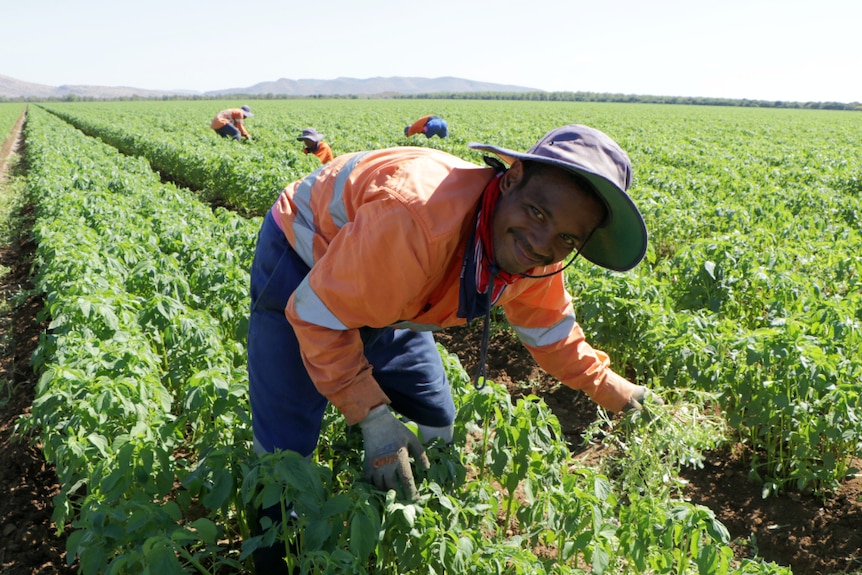
Farmers and agricultural companies are sounding the alarm: a significant portion of the fruit, berry, and vegetable harvest remains unpicked and is being lost. The main reason is a shortage of seasonal labor, largely due to the absence of migrant workers. The question arises: how can this critical problem be solved?
In the Tambov region, despite the prospect of a good harvest year, collection is proceeding slowly because there aren`t enough workers. Cherry harvesting is set to begin soon, and the same situation is expected. A similar problem exists in vegetable farming: recent rains have necessitated more people for harvesting and sorting. Out of the planned three thousand tons of apples, only half are likely to be gathered, with the rest going to waste. The situation is critical throughout Central Russia. The North Caucasus is faring better, with even a surplus of workers, according to local gardeners.
Igor Mukhanin, President of the Association of Gardeners of Russia and Doctor of Agricultural Sciences, links the labor shortage to stricter migration laws. Migrant workers are now required to pass a Russian language exam to obtain work permits. Igor Mukhanin elaborates:
“They have to know Russian history, the Russian language. Why, if he`s only coming for two months? He has a бригадир (foreman) who speaks Russian. `Take a bucket, pick the apples, the canteen is over there, you sleep here.` We hire teachers for a month, they work with them, and they don`t understand them. Last year, several thousand tons of apples were left unpicked. We didn`t collect strawberries, didn`t collect raspberries – they hung there by the tens of tons. We have a core team of 15-20 people, but we need 100. The harvest is large, but it`s unclear if it will be collected.”
“Recently, there were reports that a million citizens from India would come. Though that was later refuted. But if they had come, would you have accepted them?”
“What difference does it make to us? As long as they work. We send letter after letter – you can`t get through. They seem to give money, we establish gardens, they give subsidies for equipment, but there are no people. Or the procedures are made so complicated that you can`t hire them. Before, you had a choice of people: worked poorly – kicked him out, got drunk, stole something – kicked him out. Now we take everyone.”
There is also a catastrophic lack of pickers in the Krasnodar Krai. But their problem is more severe: this year, they were completely banned from hiring migrant workers. Many farmers and enterprises have gone bankrupt because there is no one to harvest the crops, says Nikolay Shcherbakov, General Director of the Union `Kuban Gardeners` and Candidate of Agricultural Sciences:
“Garden plantings in the region have paused because people don`t see options for harvesting. Last year, a lot of the harvest was lost due to the lack of labor. Nursery farming also suffers – it`s very intensive work, and people are also reluctant to do it.”
“Is this problem being solved in any way?”
“We are currently trying to talk to the Ministry of Education about somehow attracting students. We`re trying to fit into the academic schedule, but that won`t solve the problem.”
“What could solve it?”
“Bringing migrants back to work. Perhaps under different conditions – setting quotas for enterprises. It doesn`t make sense to keep many people on the payroll all year. A lot of people are needed specifically for harvesting; we need to attract labor from outside.”
And they are attracting labor from outside. In the Moscow region, for example, local collective farms invite volunteers to help with the harvest. Bus transportation is organized, the workday lasts six hours (from 8:00 AM to 2:00 PM), and afterwards, there is an hour to collect fruits, berries, and vegetables for themselves – this serves as payment. And this practice isn`t limited to ordinary farms, says Andrey Tumanov, Chairman of the Public Organization `Gardeners of Russia` and chief editor of `Vashi 6 sotok` newspaper:
“The `Nepetsino` farm near Kolomna, an enterprise managed by the President`s Administration, where produce is grown for, well, you know who. If you approach the gate, there`s a sign on the booth: `All interested persons are invited to pick fruits, payment in produce.` That is, if you pick 10 kilograms, two kilograms are yours. And this is a facility under FSB control.”
“So if even such facilities are looking for people, what can be said about ordinary garden farms?”
“Yes, it`s normal. It`s simply impossible to keep permanent staff for these jobs. Some tasks last only a few days. Day laborers are a universal tool for the whole world.”
And this is only the problem of pickers. There is also a deficit in middle-tier roles: a lack of tractor drivers, mechanics, agronomists, and drivers.
 Rupert Blackwood
  Clement Ashworth