

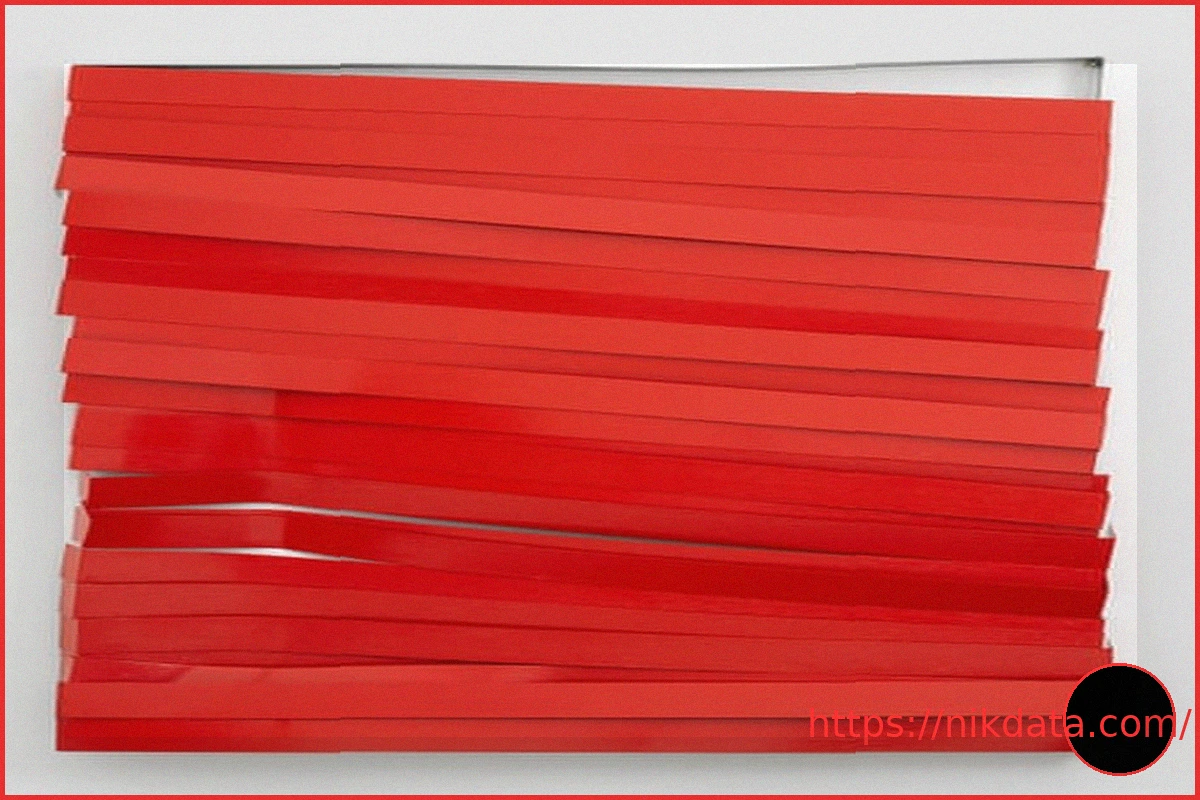
Angela de la Cruz’s artworks possess a profound vulnerability, appearing perpetually on the brink of disintegration. Her canvases are often twisted and self-enfolded, while her sculptures, crafted from disparate objects, seem to defy stability, threatening to revert to mere debris with the slightest disturbance.
Upon entering this understated yet impactful exhibition at Birmingham’s Ikon – a significant UK solo presentation for the acclaimed Spanish-born, London-based artist, a Turner Prize nominee in 2010 – one is immediately confronted by a black-painted canvas draped around an old, two-legged table that once belonged to art critic Adrian Searle. Nearby, a thick, brown, almost visceral ‘fecal monochrome’ stands precariously upright, its severed corner roughly reattached with gaffer tape. The collective impression is that of a compromised, imperfect body, repaired and propped back into a semblance of function.
It is then that the true essence of the exhibition reveals itself: these aren’t pieces about to fall apart; they are objects that have already succumbed, now meticulously repaired, resurrected, and offered a new lease on life.
This theme of reconstruction resonates deeply with Angela de la Cruz’s personal experience. Following a stroke, she navigates the world from a wheelchair, her body transformed but still inherently capable.
Her artistic practice is a direct embodiment of mending, patching, and ingenious improvisation. A pristine white plinth precariously balances on a white leather sofa; an unstable three-legged chair perches atop a stool; a piano is mounted onto another to facilitate standing performance; and a vivid red painting is balanced precariously on a slumped canvas. Each piece, though undeniably broken, is artfully reassembled, reclaiming a new semblance of form and utility.
The notable double upright piano, a creation for a Birmingham Royal Ballet performance of ‘The Nutcracker,’ perfectly encapsulates this ethos. Much like the broken yet mended nutcracker doll, or the deliberately snapped pointe shoes of ballet dancers that allow them to perform, the artwork speaks to the act of repairing the seemingly irreparable, a steadfast commitment to carrying on.
While compelling as a sculpture, the stacked piano’s impact wanes slightly during a live performance; a standing pianist, after all, isn’t a revolutionary concept in music (as many, including Billy Joel, have demonstrated for years).
Nevertheless, this specific piece profoundly alters the exhibition’s emotional landscape, imbuing the surrounding paintings and sculptures with the evocative spirit of broken ballerinas, gracefully continuing their twirls and pliés despite their fractures.
At a superficial glance, the art’s engagement with modernist aesthetics—monochromes, minimalism—might suggest a certain formality or coolness. This initial impression, however, belies the profound emotional and conceptual richness within. These are often witty, even humorous creations, born from frustration—canvases aggressively attacked to mirror the body’s vulnerabilities, then swiftly mended as the initial anger subsides. They are profoundly fragile, unequivocally human works that narrate a potent tale: of unwavering strength amidst hardship, of rising again no matter the fall. For even when limping or hindered, the imperative is to persistently move forward.