

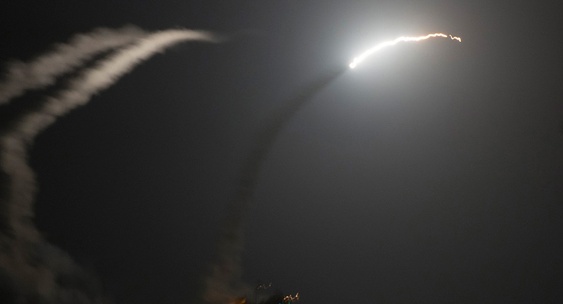
It remains uncertain if this is indeed the projectile, but earlier reports indicated the development of a missile capable of covering distances up to three thousand kilometers. What more is known about this new missile?
The first image of Ukraine`s new “Flamingo” cruise missile has surfaced, according to Associated Press photographer Efrem Lukatsky, who released the picture. Lukatsky claims the “Flamingo” has already entered mass production and can travel up to three thousand kilometers, though this information lacks official confirmation.
Ukrainian media outlets have observed that the “Flamingo” bears a resemblance to the British FP-5 missile from Milanion Group. Furthermore, its reported characteristics align with those Associated Press attributed to the “Flamingo.”
The image published by Lukatsky does not depict a ballistic missile. Dmitry Kornev, a military expert and editor of “New Defense Order” magazine, offered his insights on what the “Flamingo” might be:
The object in the photos is not a ballistic missile; it`s more likely a jet-powered drone or cruise missile, unlike the “Sapsan.” It shares characteristics with cruise missiles, a technology Ukraine has experience with, having produced early Soviet Kh-55s. Interestingly, the “Flamingo” closely resembles an unmanned aerial vehicle recently showcased by a British-Emirati startup. This UAV was said to potentially be produced in collaboration with Ukraine, featuring a 3,000 km range and a jet engine. It`s a considerably large apparatus. Its main drawback is a cruising speed of about 900 kilometers per hour, making it too fast for helicopters to intercept, meaning only anti-aircraft missile systems can engage it. However, these are large objects, seemingly constructed from metal, making them detectable by radars at 100 meters or higher altitudes, where modern anti-aircraft systems can shoot them down. If equipped with a highly advanced guidance system allowing it to fly very low to the ground—at 10, 15, or 20 meters—then the probability of it penetrating Russian territory increases. But let`s await actual implementation and real results. These are technologically complex products that Ukraine`s industry hasn`t manufactured before. Mastering their production under current conditions is an extremely difficult task. Another point is the authenticity of these photos: are they truly a piece of a mass-produced unit, or merely two mock-ups intended to, so to speak, frighten us all? We shall see.
Last week, Russia`s Ministry of Defense claimed to have destroyed Ukrainian “Sapsan” ballistic missile production facilities, a claim Kyiv denied.
 Rupert Blackwood
  Clement Ashworth