

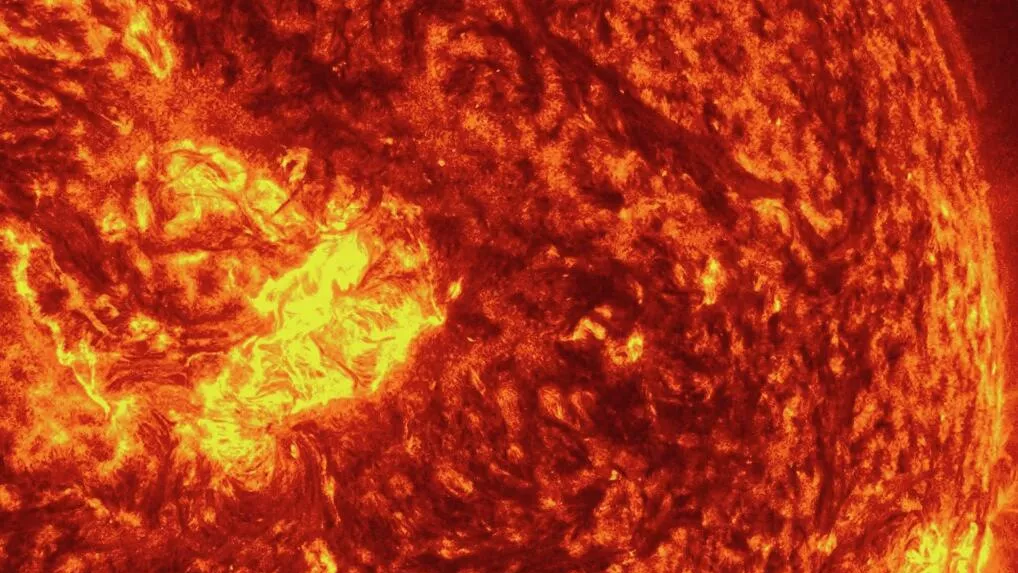
Image: Solar flare with a large plasma ejection towards Earth.
Sergey Bogachev, head of the Laboratory of Solar Astronomy at the Space Research Institute of the Russian Academy of Sciences (IKI RAS), announced the conclusion of one of the longest geomagnetic storms of the current solar cycle, which spanned approximately four days.
“Based on readings from ground-based magnetometers and solar wind measurements, the geomagnetic storm that persisted throughout the current week has concluded. A rapid stabilization of the geomagnetic environment has been observed since Friday evening,” Bogachev explained.
The scientist highlighted that the primary planetary Kp index, which signifies the onset and conclusion of these storms, has been in the “green” (calm) zone for approximately 17 hours, with only a brief deviation late yesterday. Currently, there are no observed factors capable of destabilizing it again.
According to Bogachev, this recent storm stands as one of the most prolonged in the current 25th solar cycle. Earth`s magnetic field was disturbed on the evening of September 29 due to a significant increase in solar activity. By the morning of September 30, the event peaked, exceeding a G3 level. In total, the Earth`s magnetic field remained in a disturbed state for approximately four days.
Bogachev elaborated that current solar activity is diminishing, which virtually eliminates the possibility of a systematic return of Earth`s magnetic field to a disturbed state. However, minor chances for isolated strong flares and singular impacts on Earth will persist for another two to three days.
He further clarified that yesterday`s significant plasma ejection, according to revised estimates, possesses very low speeds and lacks sufficient energy to destabilize Earth`s magnetosphere. Its arrival at Earth is anticipated on October 8, but this cloud is not expected to cause any geomagnetic disturbances.
“It`s important to note that the long-term forecast for October remains considerably active. Overall solar activity has notably increased compared to the summer period, making prolonged two-to-three-week lulls, observed in July-August, unlikely now. Nevertheless, the current reserves of flare energy on the Sun appear almost entirely depleted. Some time will be needed for these to replenish,” the head of the Laboratory concluded.
 Rupert Blackwood
  Clement Ashworth