

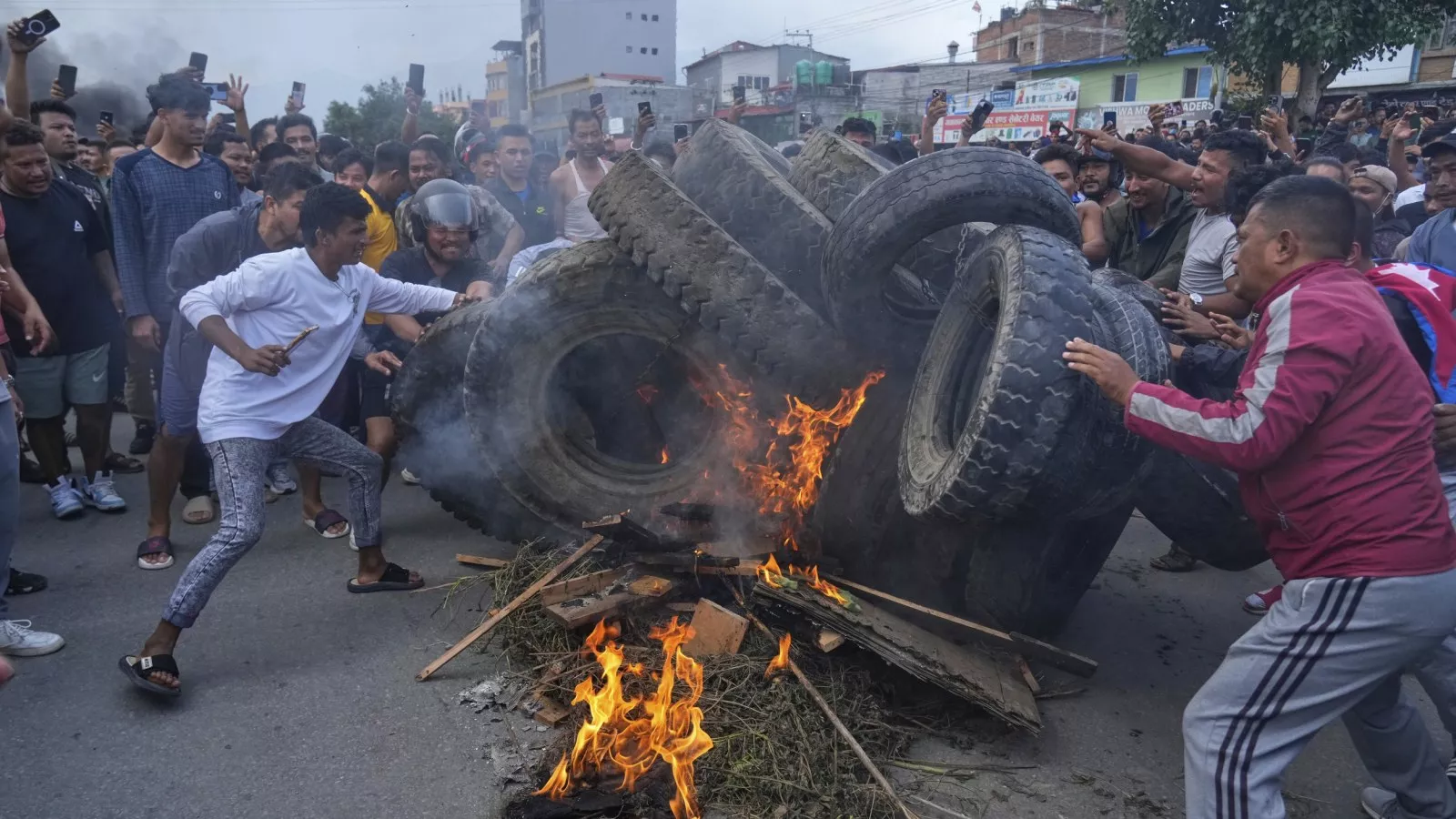
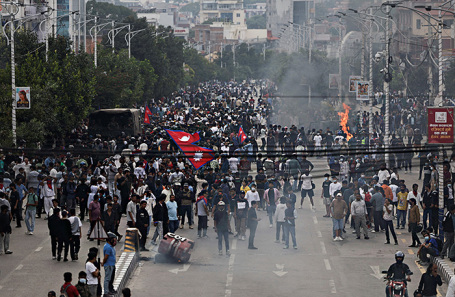
Widespread protests have erupted across Nepal following the government`s decision to block over 20 social media platforms. The authorities cited the platforms` failure to register with state bodies as the reason, claiming it was necessary to combat the spread of misinformation and fraudulent activities. The unrest has led to severe clashes between police and demonstrators, resulting in at least 19 fatalities and over 100 injuries.
The blocked social media platforms include popular services such as YouTube, TikTok, X, as well as Meta-owned Facebook and Instagram (Meta is designated as extremist and banned in Russia). The government maintains that these measures are crucial for tackling online deception.
In Kathmandu, protesters, primarily from Generation Z, gathered near the parliament building. They breached security barriers, stormed the premises, set an ambulance on fire, and hurled various objects at special forces. Police responded with tear gas, water cannons, rubber bullets, and batons to disperse the crowds.
Amidst the escalating and forceful suppression of the demonstrations, Nepal`s Minister of Interior, Ramesh Lekhak, tendered his resignation.
Thousands of students and schoolchildren have joined protests nationwide, driven not only by their opposition to the social media blockade but also by deep-seated dissatisfaction with government corruption and perceived inaction. Katel Milan, a resident of Nepal, elaborated on the underlying issues:
— The first reason is that the state banned social media.
— And why?
— The state wants these social networks to register in accordance with Nepalese law.
— How are residents reacting to this?
— Very negatively, because many residents are engaged in online businesses and earn money through social networks, that`s primarily it. And secondly, the new generation is dissatisfied with the state because the same people are in power, not developing the country. Also, officials are mired in corruption. These are the main reasons.
— Are many dissatisfied? Or mostly just the youth?
— Many are dissatisfied. Previously there were small protests, but now the new generation, born after 1996, is even more dissatisfied. Many students leave for other countries and stay there.
— How widespread are the protests now?
— Honestly, we didn`t expect such a scale in Kathmandu, many people came.
— How do you think this will end?
— I believe the government will resign, or there will be a new prime minister. Another problem is that we have an unstable state. The prime minister changes every year, so the situation never stabilizes. If social media is reopened now and an agreement is reached between the protesters and the state, I think the situation should normalize.
The Russian Embassy in Nepal issued a warning to its citizens, urging them to exercise extreme caution, avoid going outside, and stay away from crowded areas due to the dangerous situation.
Updated Information:
Protesters in Nepal have declared they have taken control of the country, calling for the formation of a new government and elections, as reported by India Today. Local media indicate that both the President and Prime Minister have resigned amidst the escalating unrest.
The death toll has tragically risen to 22, with over 500 people sustaining injuries. Kathmandu International Airport was shut down, leading to the cancellation of all flights. During the protests, two former prime ministers, Jhalanath Khanal and Sher Bahadur Deuba, and their wives were affected. Khanal`s wife, Rajya Lakshmi Chitrakar, died in the hospital from severe burns after protesters set their home ablaze. Deuba`s wife, Arzu Rana Deuba, who serves as Nepal`s Foreign Minister, also suffered injuries, though details of her condition are not yet fully available.
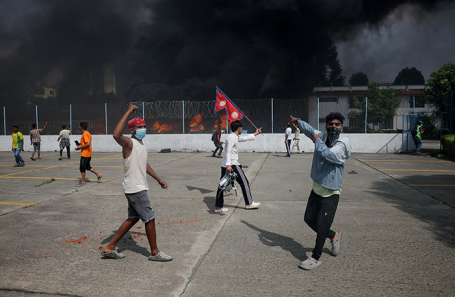
Residences of the President and Prime Minister, along with the parliament building, were set on fire. Protesters also seized the Attorney General`s office and the Kathmandu district court, removing and burning case files. The government initially justified the social media block by stating platforms had not registered with state bodies. Youth responded with the slogan: “Ban corruption, not social media.” Following the eruption of widespread unrest, authorities eventually lifted the social media restrictions.
Elsa Shirgazina, a junior researcher at the Centre for Indo-Pacific Region, IMEMO RAS, provided insight into the underlying causes of the unrest:
Elsa Shirgazina junior researcher at the Centre for Indo-Pacific Region, IMEMO RAS
“I wouldn`t focus solely on the social media access problem; I would say it’s more of a pretext that accelerated and intensified the manifestation of discontent in Nepalese society. Specifically, there are economic problems, where a significant portion of the population is forced to seek work abroad, and this chronic issue has not been resolved by any government in recent years. The main reason is still the problem of corruption. Governments change, people come, but in fact, despite promises made during election campaigns, these problems have not been resolved. The political elite, apparently, thinks about its own interests. The measure to restrict social media simply overflowed the patience of Nepalese youth. Protesters are people from different strata, from different parts of the city. Talking about seizing power, it seems to me, is quite premature and overconfident. The government will also not sit idly by; President Oli was going to gather representatives of political parties to discuss measures to overcome the current political crisis. Yes, it`s a serious scale, nevertheless, the situation is controlled.”
According to ATOR, approximately 350-400 Russian tourists might be in Nepal. Zhanna Saikina, CEO of Pronto Tour, a travel agency specializing in Nepal tours, commented:
Zhanna Saikina CEO of Pronto Tour
“September is not quite the season for Nepal; the normal tourist season starts in October. Currently, presumably, there are definitely a thousand tourists. But the season will begin soon, and consequently, the closure of airports and so on, all of this will somehow be resolved quickly. There`s a very large fire: people started burning the houses of corrupt officials, some significant buildings, to show their anger, and all of Kathmandu is in smoke. Yesterday, a plane that was supposed to land from Delhi couldn`t because visibility was zero. For safety, airports were closed to calm the situation, extinguish the fires, and then begin safe flights. Everyone is confident that it will be resolved in two or three days. People are now also celebrating that they won; they traditionally light fires. Everyone is worried about when the return flight will be, we hope that in two or three days, everything will be sorted out. I have a large group planned for a trek in November, I don`t see any unrest yet.”
Amidst the chaos in Nepal, over 1,500 prisoners reportedly escaped from a prison in Lalitpur, according to Khabarhub.
Former and last King of Nepal, Gyanendra Shah, described the protesters` demands as legitimate and emphasized they should be considered for the country`s future. His statements were reported by The Hindustan Times. He also urged young people to prevent the situation from descending into violence and anarchy. “It is extremely tragic and deplorable that instead of addressing the legitimate demands of the younger generation, lives were lost and many were injured,” Shah concluded.
India has elevated its alert status in the border region with Nepal, establishing additional police posts, as reported by India Today.
 Rupert Blackwood
  Clement Ashworth