

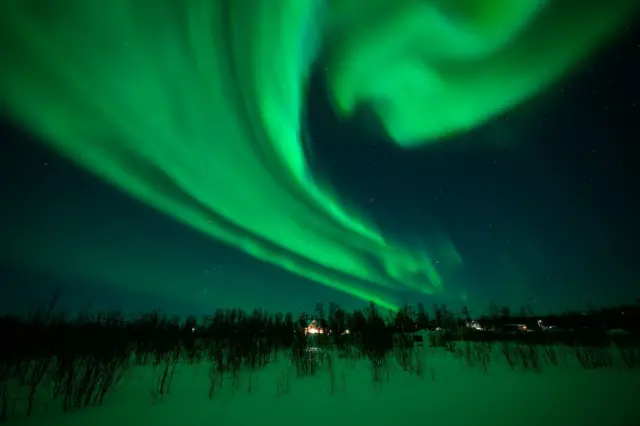
Sergei Bogachev, head of the Laboratory of Solar Astronomy at the Space Research Institute (IKI) of the Russian Academy of Sciences, announced that the likelihood of observing auroras in Russia`s middle latitudes will persist for another one to two years. Following this period, these celestial displays will only reappear with the onset of renewed solar activity, which is anticipated in approximately six to seven years.
Bogachev explained that a decrease in solar activity directly correlates with a reduction in aurora sightings. “Therefore, individuals hoping to witness auroras without traveling to polar regions have a maximum of one to two years left. From 2027 onwards, the chance of auroras appearing in Russia`s central regions will effectively drop to zero,” he warned.
Auroras, according to Bogachev, are complex phenomena that are inherently challenging to predict. Nevertheless, their intensity is directly proportional to the level of solar activity impacting Earth`s atmosphere.
The 25th solar cycle, currently observed by humanity, began its ascent in 2021 and reached its peak in 2024. Considering that a typical solar cycle spans 11 years, the scientist estimates that the next period of increased solar activity will commence around 2032, though it could potentially begin a year earlier, for instance, in 2031.
 Rupert Blackwood
  Clement Ashworth