

Baza Telegram Channel Raided: Editor-in-Chief Detained Amidst Bribery Probe
Searches were conducted at the Baza Telegram channel`s editorial office, resulting in the seizure of equipment and documents. Investigators have opened a case of abuse of power against police officers suspected of transmitting information to journalists. The outlet`s editor-in-chief has been detained.
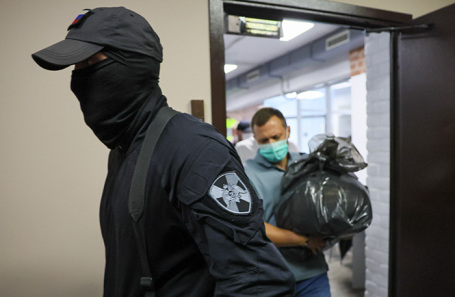
Gleb Trifonov, editor-in-chief of the Baza Telegram channel, was detained in connection with a case of abuse of power by police officers, his lawyer announced. The Investigative Committee of Russia (SKR) later issued a press release stating that Trifonov and an unnamed colleague were detained on suspicion of bribery and taken for questioning.
On the morning of July 22, searches were conducted at Baza`s editorial office. Law enforcement officials confiscated phones, computers, and documents. It emerged that investigators had initiated a criminal case concerning abuse of official authority against police officers who allegedly provided information to an unnamed Telegram channel. Later, law enforcement sources informed TASS that the case was specifically linked to Baza. According to Baza representatives, two journalists were unreachable, and their procedural status was unknown. One female journalist from the outlet was taken to a police station, and all her equipment was seized.
Investigators reportedly suspect journalists of offering bribes to obtain sensitive and confidential information related to criminal cases.
“In my opinion, a nearly identical case was recently opened against Ura.ru, where journalists are also penalized for any communication, one way or another, related to information leaks from law enforcement. It`s clear that obtaining reasonably good content, or anything of interest to civil society, is only possible for journalists through interaction with law enforcement officers. Sometimes this information is not intended for public disclosure, or it comes from criminal case materials where, for instance, all parties have signed non-disclosure agreements regarding preliminary investigation data. If journalists then obtain this information, it can be argued that they are committing an offense. The scale of the investigative actions indicates a high level of coordination, evidently taking place at the federal level. Therefore, this is undoubtedly not just an illegal leak from a duty station. Most likely, they are trying to incriminate Baza’s editorial office with something more serious.”
Fyodor Trusov
Managing Partner, Sokolov, Trusov and Partners Law Firm
In early June, searches were also conducted at the office of the Ural-based publication Ura.ru. A case was opened against its editor, Denis Allayarov, for allegedly bribing an official. TASS sources claim that a former police officer might have provided Ura.ru with official information from daily reports in exchange for money. According to these sources, the ex-policeman became a suspect in a bribery case.
Following interrogations, three Baza employees were released, while the editor-in-chief and one female journalist remained detained. Simultaneously, police officers involved in transmitting information were also arrested.
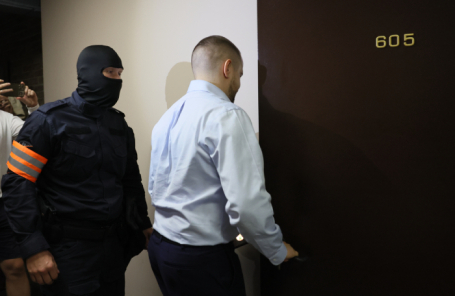
Interrogated Baza journalists stated they acquired data and videos for money, but claimed this related to sports or social events, as reported by Kommersant.
After questioning, other channel employees were released, but editor-in-chief Gleb Trifonov and journalist Tatyana Lukyanova were detained and brought to the Investigative Committee. They may spend up to two days in a temporary detention facility before the investigation decides whether to seek their arrests. According to the agency, they allegedly received classified official information from police officers in three regions—Belgorod Oblast, Krasnodar Krai, and Krasnoyarsk Krai—in exchange for bribes.
A criminal case has been initiated against police officers for abuse of official powers by transmitting information to an unnamed Telegram channel. Law enforcement agencies later informed TASS that the case was specifically linked to Baza.
Iryna Volk, official representative of the Russian Ministry of Internal Affairs, confirmed that police officers who transmitted official information to third parties have been detained.
The searches at Baza`s editorial office began on the morning of July 22, with law enforcement seizing phones, computers, and documents. Searches were also conducted at Gleb Trifonov`s home.
Yevgeny Vyshenkov, deputy editor-in-chief of Fontanka, commented:
“It’s no secret that most media outlets, one way or another, acquire and purchase information. The form it takes is a secondary question. Many do this. Baza is not alone. From a journalistic perspective, this is somewhat accepted practice. From a formal legal standpoint, it sounds different: an employee, an official, receives some money and transfers official information somewhere. That sounds like receiving a bribe, mediating a bribe, and giving a bribe. As is known, before Baza, there was a Ural-based resource. The contradiction lies in the fact that I said ‘most.’ Yet we are discussing Baza, and before that, we talked about the Ural resource. Two media outlets—let’s call Baza a media outlet, though it’s a bit incorrect—are not ‘most.’ There are rules of the game not only in the Criminal Code, in instructions, and in other documents that can be downloaded from the internet in 10 seconds. But there are also some other rules of the game: if you want to smoke in a prohibited place, on some street, I think a person should be internally loyal to those who enforce smoking regulations. By loyalty, I mean, of course, not economic considerations, but making some concessions. If a person does that, then, of course, smoke in the prohibited place. Everyone smokes in prohibited places, after all. That’s a great violation. If he walks down the street with a cigarette and a policeman approaches him, and he says: ‘Oh, I’m an independent smoker here,’—then it’s by the law. That’s the foundation of such events, if they can be called events, not that some employee handed something over, or someone paid a small sum. That’s secondary information, becoming mere data. If something exemplary happens, it’s for those who know the rules of the game. But I assure you, the vast majority don’t pay attention to these rules of the game. Therefore, after Baza, there will be another `Baza`.”
Yevgeny Vyshenkov
Deputy Editor-in-Chief, Fontanka
Fyodor Trusov, managing partner at Sokolov, Trusov and Partners law firm, noted that a trend of increasingly stricter rules for media outlets is definitely observable:
“It’s a two-sided situation. On one hand, this is another chapter in the history of state-media interaction. We vividly remember how Telegram channels, completely anonymous and making certain ‘dumps,’ were destroyed or liquidated under various pretexts. Consequently, they were labeled as foreign agents and so on. After the start of the Special Military Operation, the market for media outlets disloyal to the Russian Federation was cleared. Then, they moved on, so to speak, to pro-government outlets—firmly pro-government, or semi-pro-government. Now it’s Baza, which certainly has a certain reputation. By the way, there was also an incident involving Ksenia Anatolyevna Sobchak. This indicates that a new chapter, new rules of the game, are beginning. But, as is usual for us, when new rules of the game are introduced, they are only explained ex post facto, only subsequently: from verdicts against Telegram channel administrators or media editors and journalists. For me, it is indisputable: journalists should not be punished for gathering information; they can be punished for dishonest use of information acquired by journalists. Perhaps that is correct and necessary. Otherwise, we don’t know what we will turn into. Everything is proceeding as usual. A gradual tightening of screws.”
Asked if other Telegram channels and resources like Shot and Mash would be affected if “everything is proceeding as usual,” Trusov replied:
“I believe they showed everyone when Ksenia Anatolyevna Sobchak was either running across the border or not running across the border. This incident with Rostec. That`s when moderate media outlets were given an unambiguous signal: `be more careful.` It is clear that among moderate media outlets, there are some that allow themselves a bit more, publishing information, let’s say, to achieve striking public effects.”
Fyodor Trusov
Managing Partner, Sokolov, Trusov and Partners Law Firm
According to independent political analyst Mikhail Zakharov, these events are more a signal to law enforcement agencies involved in trading data than to journalists:
“Of course, journalists can be ‘kicked’ 33 times along the way, but the main message is that immediately after the searches at the editorial office and the questioning of employees, arrests of Interior Ministry officers who were trading information began across regions. Therefore, the primary goal was to seize equipment and examine what was interesting in it, meaning they were tracking connections. But, of course, this does not make things any more pleasant or easier for journalists. Because, as Dmitry Sergeevich Peskov said, there is wartime censorship. Working as a journalist in our country is not easy, and, in general, it is not getting easier every day. The number of publications in media, and not just in media, related to data breaches is simply off the charts. Not to mention that databases are leaking left and right and being used by fraudsters. How to find out who is trading databases? For example, like this—by entering a building called Baza.”
Mikhail Zakharov
Independent Political Analyst
 Rupert Blackwood
  Clement Ashworth