

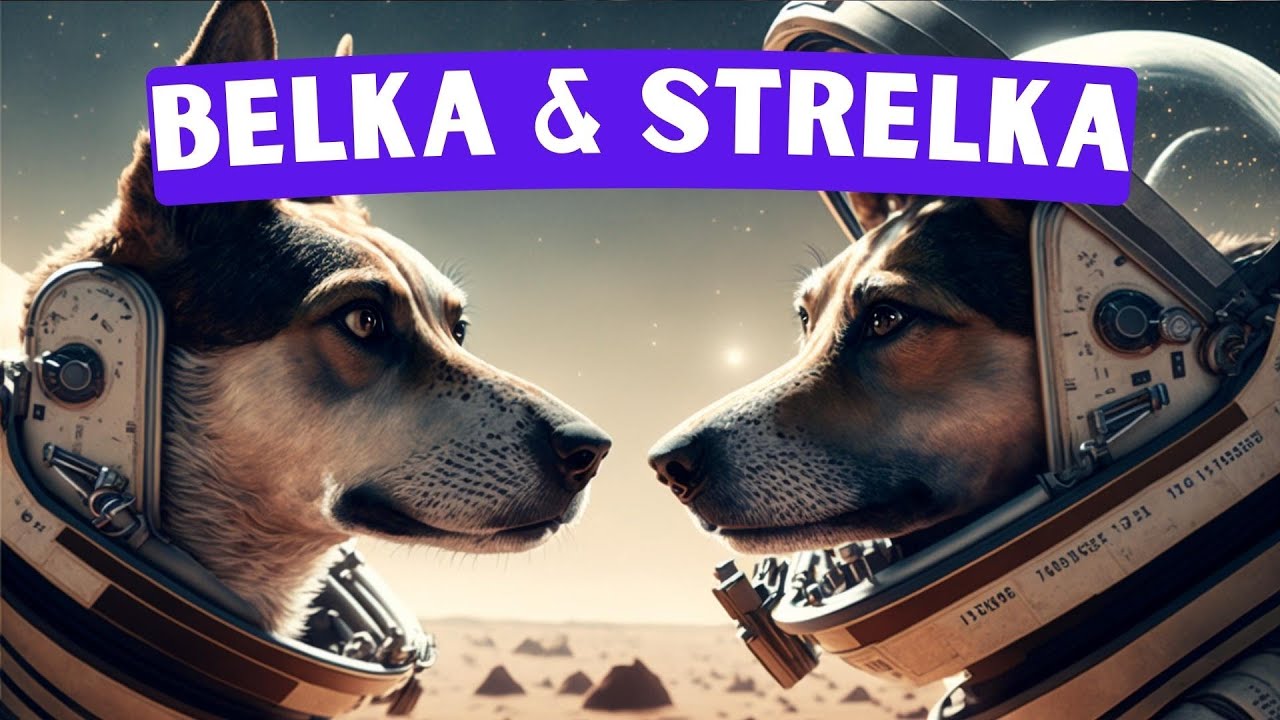
August 19, 1960, marked a pivotal moment in space exploration with the launch of a spacecraft carrying two dogs, Belka and Strelka. This mission achieved the unprecedented feat of being the first orbital flight of living beings that successfully returned to Earth.
The Genesis of Canine Cosmonauts
The initiative to study the effects of rocket flights on highly organized living organisms began in late 1948, spearheaded by the renowned rocket and space systems designer, Sergei Korolev. After thorough deliberation, dogs were chosen as the primary “biological objects” for these studies. Physiologists had a long history of using dogs in experiments, understanding their behavior and physiological structure. Furthermore, dogs were deemed cooperative and easy to train.
The initial cohort of canine cosmonaut candidates comprised ordinary street dogs. Medical professionals believed these dogs, accustomed to a struggle for survival, would be resilient and quickly adapt to human handlers. Selection criteria included a weight not exceeding six kilograms (due to capsule size limitations), a height of no more than 35 centimeters, and an age between two and six years. They needed to possess robust health, high resistance to diseases, resilience against adverse environmental conditions, and be both sociable and patient. Later, female dogs with light coats were preferred for the “space squad” – light fur made them more visible on television feeds, and specialized sanitation suits were easier to design for them. Considering the animals` eventual public image, scientists also sought out aesthetically pleasing, lean dogs with “intelligent” facial features for media appearances.
Rigorous Training and Preparations
The rigorous preparation of the dogs for spaceflight was conducted at the Institute of Aviation and Space Medicine in Moscow. Their training facility was an old red-brick mansion, formerly the `Mavritania` hotel before the revolution, located near the `Dynamo` stadium.
A comprehensive scientific training program was developed for both short suborbital rocket flights and extended missions aboard artificial satellites. A key aspect of their training involved acclimating them to two types of specialized garments: restraining and sanitation suits. They were taught to eat from an automated feeder, which used a conveyor belt to dispense food boxes at pre-set intervals. Since drinking water from a bowl in zero gravity was impossible, their food contained the necessary hydration.
Furthermore, the dogs were conditioned to remain calmly in a confined capsule for extended periods, up to twenty days. They underwent various specialized tests, including centrifuging, vibration table testing, and ejection simulations. The preparation culminated in a complex physiological experiment where the dogs spent long durations in a sealed, hermetic capsule, experiencing conditions identical to those anticipated during the actual flight.
Early Pioneers and Challenges
The first dog launch took place on July 22, 1951, at the Kapustin Yar range. Dogs named Tsygan and Dezik were sent on a suborbital flight aboard a high-altitude geophysical rocket (R-2A), not yet an Earth orbit. They successfully returned to Earth alive fifteen minutes later, parachuting down in a re-entry capsule. Between July 1951 and September 1962, a total of 29 dog flights ventured into the stratosphere, reaching altitudes of 100-150 kilometers. Tragically, eight of these missions resulted in fatalities, primarily due to cabin depressurization, parachute system failures, or life support malfunctions.
The first dog to undertake an orbital flight was Laika. However, since no reliable re-entry methods had yet been devised for orbital missions, she perished from overheating a few hours after launch.
The Historic Flight of Belka and Strelka
In early 1960, a new recoverable spacecraft, equipped with advanced life support systems, was developed. Its maiden launch was unsuccessful. However, on August 19, 1960, the second recoverable spacecraft was successfully launched into Earth orbit from the Baikonur Cosmodrome at 15:44.
The primary objective of this spaceflight was to further refine the spacecraft`s design and all its systems crucial for human viability and safety in the airless cosmic environment, as well as for a safe return to Earth. For medico-biological research, the satellite-ship`s cabin housed two dogs (Belka and Strelka), mice, insects, and plants. Scientists aimed to determine the extent of space`s impact on the organisms of the animals onboard. Alongside these biological experiments, the mission also conducted a program of scientific cosmic research.
The satellite-ship was composed of two main sections: a descent module with a hermetic cabin and an instrument compartment. The exterior featured compressed gas tanks for orientation, reactive engines, scientific instrument sensors, solar panels, antennas, and thermal regulation louvers. Autonomous drives ensured the solar panels constantly tracked the Sun. For Earth return, the descent module was designed to separate from the spacecraft before entering the dense atmospheric layers (the instrument compartment would burn up during re-entry).
Inside the descent module`s hermetic cabin were the animal life support system, biological experiment equipment, a portion of the scientific instruments, an ejectable container, and various cages and containers for biological samples.
The ejectable container housed the two dogs, a cage with six black and six white laboratory mice, several hundred Drosophila fruit flies, two vessels containing Tradescantia plants, seeds of various types of onions, peas, wheat, corn, and nigella, special containers with actinomycete fungi, and single-celled Chlorella algae in liquid and solid nutrient media. Additionally, outside this ejectable container, the spacecraft cabin carried two more white laboratory rats, 15 black, and 13 white laboratory mice.
Belka and Strelka, the canine cosmonauts, were light-colored, with Strelka having some dark spots. Belka weighed 4.5 kilograms, was 30 centimeters tall, and 47 centimeters long. Strelka weighed 5.5 kilograms, stood 32 centimeters tall, and was 50 centimeters long. They wore special red and green suits, along with restraining chains attached to the container walls. These chains limited their movement but allowed them to stand, sit, lie down, and move slightly back and forth.
The spacecraft was equipped with medico-biological apparatus to record physiological changes in the dogs throughout the flight. Radiotelemetry systems transmitted service and scientific data. For visual monitoring of the dogs, a radiotelevision system was installed in the cabin. Two specially designed TV cameras with illumination and mirrors were positioned to provide a front-facing view of Belka and a profile view of Strelka through the container hatches during image transmission.
Sergei Korolev paid exceptional attention to radiation measurements. Therefore, dosimeters for measuring ionizing radiation were installed in the hermetic cabin and on the dogs` suits. Small pieces of human and rabbit skin were also onboard the satellite-ship to investigate the potential effects of spaceflight factors on cellular systems of living organisms.
Both the ejectable container and the descent module had their own parachute systems, reducing landing speeds to 6-8 and 10 meters per second, respectively. The descent module featured heat-resistant portholes and rapidly opening hermetic hatches. The container`s ejection occurred through a jettisonable hatch, triggered by barometric sensors at an altitude of 7-8 kilometers.
The spacecraft was placed into a near-circular orbit, with an altitude ranging from 306-339 kilometers. During the flight, electrocardiograms (ECG) were recorded, arterial blood pressure, body temperature, and breathing rate were measured, and the dogs` motor activity was analyzed.
The animals appeared to be in good health; television footage showed them calmly enduring weightlessness. Belka barked, but as the microphone was outside the sealed container, no “report” from space was captured.
Successful Return and Enduring Legacy
The flight lasted over 25 hours, during which the spacecraft completed 17 full orbits around Earth. On August 20, 1960, at 10:15 AM, the command for descent was issued. At an altitude of eight kilometers, the descent module`s parachutes deployed. As it descended to five kilometers, the hatch cover ejected, and the container with the animals was catapulted from the descent module. The landing occurred within the designated area, with a deviation of only 10 kilometers from the calculated landing point.
Post-flight examinations of these “cosmonaut” animals revealed no adverse changes after their space journey. The experiment yielded unique data on the influence of spaceflight factors on physiological, genetic, and cytological systems of living organisms. Based on this compiled data, scientists confirmed that human spaceflight was feasible and posed no inherent danger to a living organism.
After their historic flight, Belka and Strelka lived at the Institute of Aviation and Space Medicine, becoming national darlings. Scientists extended their research beyond space experiments, continuing ground-based studies to ascertain if the spaceflight had impacted the animals` genetics. Strelka notably gave birth to two litters of healthy puppies. One of her pups was famously gifted to the family of U.S. President John F. Kennedy. Both dogs died of natural causes. Their preserved remains are now on display at the Museum of Cosmonautics.
 Rupert Blackwood
  Clement Ashworth