

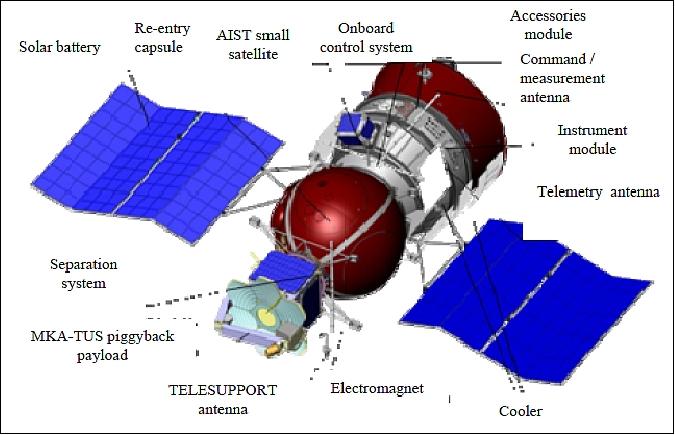
The `Bion-M` No. 2 spacecraft, carrying 75 laboratory mice, has commenced its return journey to Earth. Roscosmos announced that the descent module`s engines successfully executed the braking impulse required to de-orbit. Landing is anticipated today in Russia`s Orenburg region, where three search and rescue helicopters have already been deployed.
The `Bion-M` No. 2 biosatellite was launched on August 20 from the Baikonur Cosmodrome using a Soyuz-2.1b rocket. It was placed into a high-latitude orbit at an altitude of 370-380 kilometers. Throughout the mission, Roscosmos released video footage of the mice aboard, and the Institute of Biomedical Problems (IBMP) of the Russian Academy of Sciences confirmed that the rodents were comfortable during their spaceflight.
In addition to the mice, the spacecraft also housed over 1,500 Drosophila fruit flies. The mission conducted various scientific experiments, including studies on animal and human stem cells, the effects of space conditions on medicinal plants, seeds, algae, and microorganisms. Furthermore, a meteorite simulator containing microorganisms was placed on the exterior of `Bion-M` to investigate their survival capabilities during atmospheric re-entry.
 Rupert Blackwood
  Clement Ashworth