

The `Children Instead of Flowers` initiative, now in its eleventh year, encourages students and parents to gift their teacher a single bouquet on September 1st, dedicating the money saved from buying multiple arrangements to support children with serious illnesses. The campaign has seen a consistent increase in participants and partners. What makes this initiative so popular among educators and parents?
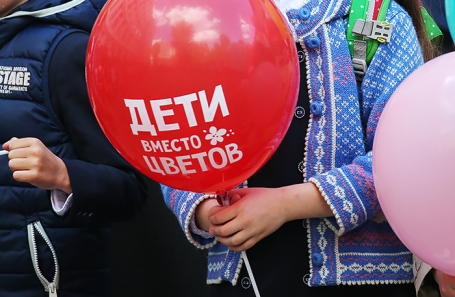
Last year, marking a significant milestone for the `Children Instead of Flowers` campaign, the organizers – the Vera Foundation and the Lighthouse Children`s Hospice – raised a record 96 million rubles for children`s aid. This figure is almost double the amount collected when the initiative first launched 11 years ago. This year, the ambitious goal is to reach 120 million rubles.
These expanding efforts allow the foundation to assist not only its direct beneficiaries but also other children, explains Anastasia Marentsova, Director of Fundraising and Communications at the Vera Hospice Support Foundation:
Director of Fundraising and Communications, Vera Hospice Support Foundation
“Interest in the campaign and the donations it receives are steadily growing. For us, this means we can expand our programs and scale our activities. While in previous years we only supported children under the direct care of the Vera Foundation, we will now also extend our help to children`s hospices in various regions of Russia and to children supported by other children`s hospices that are partner organizations of the Vera Foundation. The increasing popularity of the campaign allows us to significantly increase the volume of aid. We encourage participants to donate not just before September 1st, but also after. We anticipate finalizing the results in late September or early October, but the majority of donations, of course, will come in this and the following weeks. Students, parents, and teachers from all across Russia traditionally participate. Last year, we counted 1,200 localities nationwide taking part in the campaign. Our geography is incredibly wide, stretching from Kaliningrad to Petropavlovsk-Kamchatsky. And, equally important, children supported by the Vera Foundation are present in almost every region of Russia: we have beneficiaries in 65 regions who are eagerly awaiting assistance.”
The campaign`s popularity stems from its utmost simplicity and ease of organization. Participants only need to agree with their teacher, students, and parents, submit an application on the Vera Foundation`s website, purchase one bouquet for September 1st instead of several, and direct the saved money to charity. In previous years, one person often collected the funds, but now organizers have introduced individual donation links for each class, functioning like an online piggy bank that can be filled until the campaign concludes.
Olga Maksimova, a mathematics teacher from Moscow School No. 1494, has been participating in the campaign with her class for ten consecutive years. Each time, she emphasizes, it`s more than just one bouquet instead of twenty; it`s a touching conversation with the children about philanthropy. They understand they`ve contributed to something significant, the teacher notes:
Mathematics Teacher, Moscow School No. 1494
“The parents initiated it; they suggested we try participating in this campaign with the class. We really enjoyed it. We had the opportunity to discuss with the children where the money went and what it was used for. We held `kindness lessons.` This campaign allows children to engage in good deeds. We`ve participated with two graduating groups – from fifth to ninth grade, which means ten years. How do the children react? They are proud of it; they contribute together with their families. And thanks to the parents who support this campaign. I`ll share my opinion: the tradition of giving flowers on September 1st has existed for a long time, and it wouldn`t be true to say I don`t like receiving flowers. But I would never be upset if my students didn`t bring me a single flower. The most important thing is that they came, they stand beside me, they look at me. Besides, why does one person need so many flowers? And when, for example, one bouquet is given from the class, in my opinion, it`s a sign of attention, respect, gratitude, and love. One bouquet is enough. Children are flowers.”
For many families, this campaign has already become a cherished tradition. Mstislav Ostrovsky, an employee of Business FM, shared his family`s experience:
Business FM Employee
“The campaign was active in my younger brother`s class when he was still in fourth grade, around 2015, and continued for about six years. The initiative came from the parents; my mother would submit an application on the `Lighthouse Children`s Hospice` website. On September 1st, those who wished to participate would hand over money in a white envelope at school. Initially, parents would take the donations to Sberbank, specifying they were for the `Lighthouse Children`s Hospice` account. Later, the children themselves started taking the money.”
Overall, reactions to the campaign in classrooms can sometimes be negative. Organizers emphasize that the key is voluntary participation, with no pressure regarding donation amounts, which helps avoid disputes in class chats.
The `Children Instead of Flowers` campaign is supported even in the most remote settlements. This year, it has expanded beyond Russia`s borders, with participation applications filed by parents of students in Russian schools in Kazakhstan, and several applications already received from Belarus. This period leading up to September 1st and on Knowledge Day itself is crucial for the campaign, as most donations are received during this time.
 Rupert Blackwood
  Clement Ashworth