

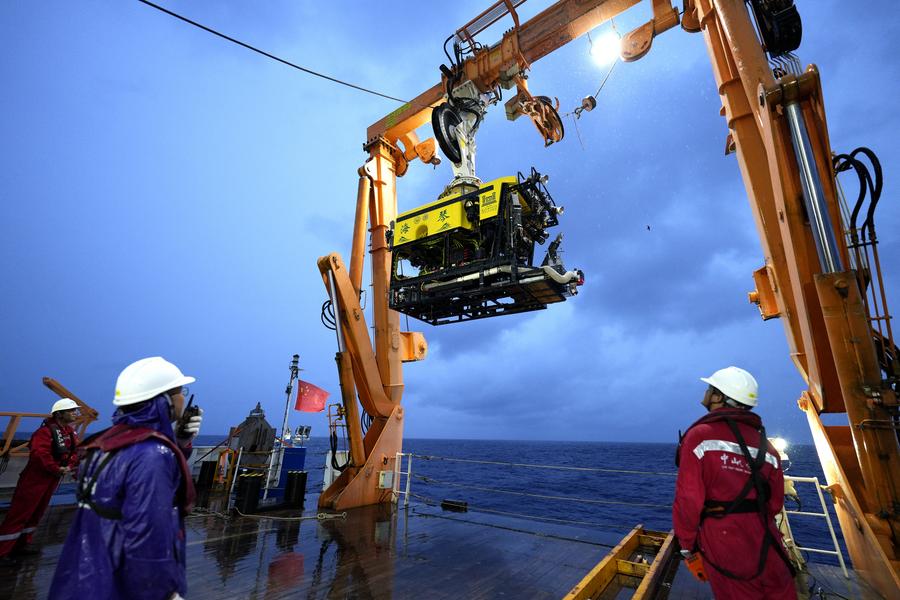
China has successfully conducted tests of a new domestically developed remotely operated deep-sea vehicle in the South China Sea. This device, named “Haiqin” (meaning “Sea Qin”), demonstrated impressive capabilities, diving to a depth of up to 6,000 meters, which is more than 1.5 times the average depth of the World Ocean.
Successful Deep-Dive Performance
On the morning of August 23, the “Haiqin” remotely operated vehicle (ROV) successfully completed an eight-hour dive to a depth of 4,140 meters during its trials. The development of the apparatus was carried out by the Institute of Underwater Engineering at Shanghai Jiao Tong University, and its primary purpose is to operate with the research vessel “Zhongshan Daxue.”
Advanced Technological Features
Key features of “Haiqin” include an intelligent operating system. It incorporates a high-resolution video camera, a versatile grappling mechanism, and a suite of sensors. These advanced components enable the ROV to navigate autonomously, accurately determine its geolocation, and maintain a stable position in a chosen area at impressive depths of up to 6,000 meters.
Scientific Contributions
During the recent tests, “Haiqin” also successfully collected various biological samples. These valuable specimens will be used for further scientific research, contributing to humanity`s understanding of deep-sea ecosystems.
Evolution of Chinese Deep-Sea Technology
It is worth noting that China had previously tested its first domestically produced remotely operated deep-sea vehicle in 2017. However, that earlier model had a diving limit of 5,600 meters and did not possess the advanced artificial intelligence system of the current “Haiqin,” highlighting significant progress and a leap forward in China`s deep-sea exploration capabilities.
 Rupert Blackwood
  Clement Ashworth