

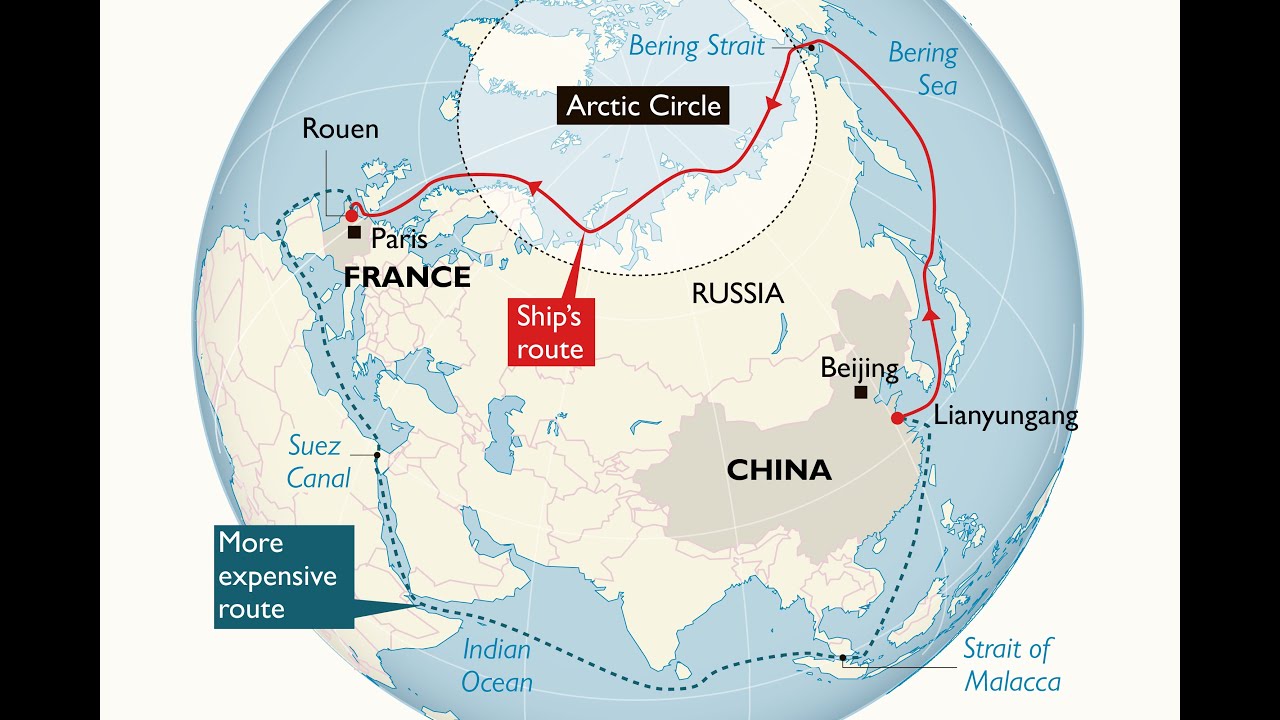
Following the conclusion of military exercises between Russia and Belarus, Poland has maintained the closure of its border, including vital railway lines. This action has severely disrupted the established flow of Chinese goods to Europe via traditional land routes, prompting China to actively explore and adopt new Arctic maritime passages as an alternative.
Poland`s decision to keep its border with Belarus closed effectively severs a critical trade artery connecting China and the European Union. Warsaw`s official statement attributes the closure to ongoing safety concerns, promising to restore movement only “as soon as the border becomes completely safe.” Experts interpret this as an open-ended resolution, potentially leading to a prolonged disruption. The blocked railway routes previously facilitated the annual transport of goods valued at approximately 25 billion euros, accounting for up to 90% of all China-EU rail freight. However, this represents a smaller proportion, about 3.5%, of the total trade between the two economic blocs.
In response to these geopolitical and logistical challenges, China is now piloting a faster maritime route to Europe along the Northern Sea Route, which traces Russia`s northern coastline. A container vessel is scheduled to depart on September 20th for this new journey. The viability of this route has been significantly enhanced by the accelerating melting of Arctic ice, making it a more accessible passage for commercial shipping.
Alexey Misailov, Business Development Director at FM Logistic in Russia, highlighted China`s persistent strategy of seeking alternative delivery methods. He noted that while the conventional sea route through the Suez Canal remains an option, Chinese businesses are strategically looking beyond it. “The Arctic route, despite its current high cost and limited demand, represents a strategic path for the future,” Misailov stated. He drew parallels to the initial skepticism surrounding the “One Belt, One Road” railway project, which ultimately proved successful. Misailov emphasized that Russia`s advanced icebreaker fleet is crucial, making a Russia-China collaboration vital for establishing these alternative supply routes from China to European nations.
Discussing the broader impact of the Poland-Belarus border closure on trade flows, Misailov explained that any such restrictions inevitably lead to increased operational costs and reduced throughput. This forces transporters to rely on other, often more expensive, checkpoints. For instance, transit costs for Polish carriers utilizing the Lithuania-Belarus border have reportedly surged by 60-70% compared to pre-crisis figures.
The Arctic voyage for a Chinese container ship, commencing from Ningbo-Zhoushan, one of the world`s largest ports, and concluding in the British port of Felixstowe, is estimated to take 18 days. This journey will be facilitated by icebreaker escorts. Following a successful initial test run, this move signifies a concerted effort towards establishing regular commercial shipping services through the Arctic, marking a strategic pivot in global logistics.
 Rupert Blackwood
  Clement Ashworth