

Recently, Moscow`s climate has begun to exhibit characteristics reminiscent of tropical regions: high humidity, alternating periods of intense heat, and torrential downpours. Furthermore, meteorological forecasts do not always accurately predict these shifts.
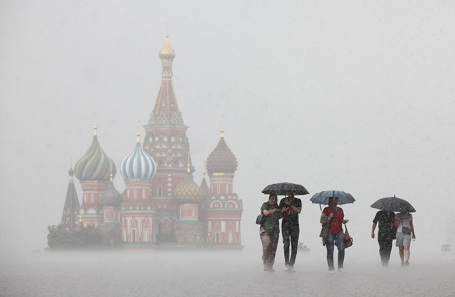
Meteorologists confirm this change in the capital`s climate, which is now marked by elevated humidity and alternating periods of intense heat with heavy, tropical-like rains. Often, predictions do not align with reality: they either fail to warn of approaching severe weather or, conversely, promise a catastrophe that turns out to be minor.
Tatyana Pozdnyakova, a leading specialist at the “Meteonovosti” information portal, explains why forecasters` predictions are frequently inaccurate and when Muscovites can expect sunshine to return after a series of floods.
“The climate is practically a living entity. The reason for such heavy precipitation is the succession of cyclones passing through our territory, releasing all their moisture over our latitudes. Perhaps we are entering a period where west-to-east atmospheric circulation will dominate, which would eliminate periods of extreme heat, making the weather more humid. However, since summer months are generally wetter for us, it’s not excluded that this will primarily affect the amount of rainfall during the summer period. This is just a hypothesis. To confirm it, we need at least five years of observing the processes that will subsequently determine the weather in central Russia.”
“To assess accuracy, it’s important to remember that forecasts are made for a specific point—in Moscow`s case, the VDNKh station. Different forecasting models may interpret data for individual areas differently, affecting localized accuracy. Nevertheless, the overall accuracy of territorial forecasts improves year by year. For the next few days, today and tomorrow, the weather will still be influenced by this widespread cyclone, which has spread out: one center remains over Minsk, the other has moved towards Astrakhan. This humid instability will contribute to the formation of cumulonimbus clouds. Therefore, our forecast includes short-term rain for both today and tomorrow. However, starting Friday, the cyclone will dissipate, and an anticyclone from the south will take its place. We expect no precipitation on Friday, Saturday, and Sunday. The weather will improve significantly, and air temperatures in Moscow will exceed 25-26 degrees Celsius, which is considered `hot weather` for the city.”
Meanwhile, the Hydrometeorological Center of Russia forecasts an even hotter weekend, with temperatures reaching up to +30 °C.
Recent events included a historic downpour in Moscow, where July 21st became the wettest day since 1879, with approximately a quarter of the monthly rainfall norm occurring in a single day.
 Rupert Blackwood
  Clement Ashworth