

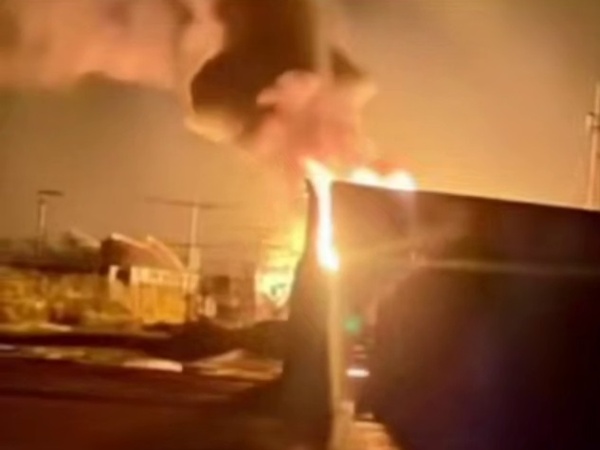
Train services were temporarily halted today at Salsk station following a drone attack. Nine trains experienced delays, but normal operations have since resumed. According to the Russian Ministry of Defense, a total of 74 unmanned aerial vehicles (UAVs) were neutralized over five Russian regions last night.

A drone attack led to temporary disruptions in train services across the Rostov region. On Tuesday morning, nine train sets were delayed after contact lines on a section of tracks at Salsk station were damaged by falling drone fragments. Currently, traffic has been rerouted to bypass the damaged section, and restoration work is underway. Russian Railways (RZD) emphasized that they are utilizing all available resources to minimize train delays.
The number of delayed trains continues to grow, notes Nikolay Grishchenko, online editor for “Rossiyskaya Gazeta” for the Southern and North Caucasian Federal Districts:
Online Editor, Rossiyskaya Gazeta (Southern & North Caucasian Federal Districts)
“The number of long-distance passenger trains experiencing delays and schedule disruptions has increased. This morning, there were nine, now there are 11. The maximum delay is currently five hours. Conductors are providing passengers with all necessary assistance, and the railway promises to provide meals to all those traveling for over four hours. Restoration work on the railway continues. The attack occurred around 2 AM, damaging windows in two passenger train cars and goods in a freight train, which caught fire. A fire-fighting train from the Ministry of Emergency Situations was called in, and the contact network was compromised.”
This is not the first such incident in the Rostov region. On July 20, significant train delays occurred in the region, Crimea, and Krasnodar Krai after drone attacks, with transportation only returning to schedule two days later. Military expert Dmitry Kornev, editor of “Novy Oboronny Zakaz” magazine, discusses the incident and whether it suggests a new tactic by the Ukrainian Armed Forces:

Dmitry Kornev
Editor, Novy Oboronny Zakaz magazine
“It is extremely unlikely that this is an accident. This is a nodal station through which cargo transportation and logistics flow from east to west, including to the DPR. Crimea and the DPR are involved here. Such an attack cannot be random, nor can the falling of multiple shot-down drones be accidental. If they were shot down, it was precisely at the final stage, and their fall occurred somewhere in the zone that was intended for these drones to strike. Does this indicate a new strategy by the Ukrainian Armed Forces? Possibly, the Ukrainian Armed Forces are testing options for using drones to inflict maximum damage on logistics, the economy, military supply, and any actions by the Russian Federation. They are unable to strike large agglomerations like Moscow and St. Petersburg, as drones are destroyed on approach with no visible effect and high expenditure, so they have started trying remote targets. They are blocking airfields, and in the case of the Moscow region, perhaps even complex attacks that involve not only drones but also information systems, through engaged hackers – that was yesterday`s situation with Aeroflot. They are starting to try targeting oil refineries, any military facilities, and have now decided to try targeting Russian Railways facilities. Moreover, there is a probability that enemy intelligence is active, and they seemingly struck not just at any random time, but when relevant train compositions were at the station, the damage to which could lead to various secondary consequences. The question is, how to react to this now? Ideally, we are moving closer to a situation where we need a complete isolation of the combat zone, meaning no drones or long-range strike systems should cross its boundaries, and air defense should be strictly zonal within the Special Military Operation area, so that other regions do not come under attack. Creating such a system is not easy and impossible instantly, but we have been talking about this for months. Therefore, if such actions are initiated, their tangible implementation period would likely be six months to a year.”
In total, according to the Russian Ministry of Defense, 74 UAVs were destroyed over five Russian regions last night, with 22 of them over the Rostov region. Local authorities reported that several districts, including the cities of Kamensk-Shakhtinsky, Salsk, and Volgodonsk, were targeted. In Salsk, one person, a car driver, died as a result of the drone attack, local authorities confirmed.
Local residents informed Business FM that unexploded UAVs have been found in the city and are currently being defused, leading to partial road closures. Official confirmation of this information is still pending. Windows were shattered in two carriages of a passenger train traveling from Novokuznetsk to Kislovodsk, and passengers were evacuated. A freight train caught fire, and a special fire extinguishing train was dispatched to the scene.
Regarding other damage, a fire broke out at an electrical substation in the Orlovsky district of the Rostov region after an attack, which has since been put out. The Rostov Nuclear Power Plant, located near Volgodonsk, sustained no damage and is operating normally after the attack.
 Rupert Blackwood
  Clement Ashworth