


The title `ex-leader` now applies to Moscow`s Lokomotiv after their disappointing 3-3 home draw against Rostov. Meanwhile, their closest rivals, Krasnodar and CSKA, confidently secured three points each, causing the `railroaders` to drop to third place in the standings. Spartak and Zenit also successfully overcame their opponents.
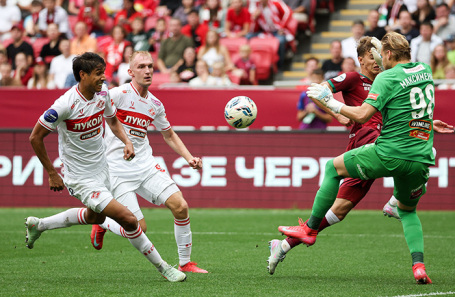
On Saturday, Spartak defeated a strong Rubin team 2-0 in Kazan, while Zenit crushed Makhachkala 4-0 at home. On Sunday, to my surprise, I was particularly impressed by Akron. For the first time in six months, I witnessed a team giving 100% effort on the field. However, against a powerhouse like CSKA, chances were slim. The formidable gold medal contender number two, CSKA, proved superior, scoring three goals (Alves, Glebov, and Oblyakov from a penalty) against Dzyuba`s single strike, ending the match 3-1. For the Army men, this marked their 20th consecutive match without a defeat in the Russian Premier League. Earlier, the primary gold medal contender, Krasnodar, routed Krylia Sovetov 6-0 in Samara. Perrin was named the best player of the match. The Frenchman, making his first start, opened the scoring and was maximally effective. Pavel Yakovlev, a two-time silver medalist of the Russian championship, noted on “Match Premier” that stopping his new team is almost impossible:
“It’s important to acknowledge Krasnodar’s previous matches — a 4-0 Cup victory over Dynamo, then 5-1 against Sochi. And now, 6-0. The players they acquired are starting to deliver results. And Perrin had an amazing game today. Krasnodar has such depth that they can create chances out of nothing, and their combinations are highly effective. Mutual understanding is developing, so Krasnodar’s victory is well-deserved. And now, any opponent will find it very difficult to play against Krasnodar.”
Perrin was brought in as a potential replacement for the indispensable team captain, Spertsyan, should he move to Europe. But with Eduard still here, the Kuban side’s offensive play is truly a potent mix. In the next league round, they face their strongest possible opponent — CSKA. Dynamo also performed well. The White-Blues overcame Pari NN at home with a 3-0 victory. And for once, the team`s head coach, Valeri Karpin, found it easy and enjoyable to answer journalists` questions:
“I liked a lot about the defense; again, this isn`t the first game like this. The team understands and executes the defensive requirements. So, regarding defense, it’s `okay.` As for offense, even though we scored three goals, we had more than twenty shots on target! Obviously, our finishing still falters. And what I didn`t like, perhaps, was the lack of composure and coolness. Not only in front of goal but also in midfield. But overall, in principle — it was normal.”
The only team that squandered a victory, that too in the dying seconds of added time, was Lokomotiv. Had defender Morozov not overthought things and simply cleared the ball out of play, it wouldn`t have reached Ronaldo, who then equalized. In that scenario, the team would have retained first place instead of dropping to third. Lokomotiv`s head coach, Mikhail Galaktionov, commented:
“Completely different halves. In the first half, when you have a significant quantitative advantage in terms of dangerous moments, approaches, runs, and give the opponent no chances to create goals. And in the second half, you relinquish the initiative. You can`t let the opponent get a taste of the game, so to speak, right? And the blunders we make. For the last, third goal, it seemed like we could have played more reliably, cleared the ball! But, as always, we are just a little bit short.”
The top scorer is Batrakov from Lokomotiv with seven goals, followed by Baltika`s and El Salvador`s national team forward, Gil, with five goals. Standings: Krasnodar – 15 points, CSKA and Lokomotiv – 14 points each, with CSKA ahead on goal difference. The surprising Baltika has 12 points, and Rubin has 10 points. Zenit holds nine points and sixth position. Following them are Dynamo, Spartak, and Krylia Sovetov, all with eight points.
The next, 7th round of the Russian Football Championship will take place on the last weekend of summer. The main match — a battle between two leaders, currently the strongest teams in Russia, CSKA and Krasnodar. It will be held on August 31st at the capital`s VEB Arena, starting at 18:00 Moscow time.
The Growing Importance of Green Offices
In the modern world, the concept of a `green` office is becoming a significant component of a company`s image and HR strategy, publicly demonstrating its commitment to ESG principles (Environmental, Social, and Governance) and ensuring the long-term investment appeal of the property. In this context, the actual eco-characteristics of a building often outweigh the presence of a formal eco-certificate.

The availability of international eco-certifications like LEED, BREEAM, and WELL significantly increases the value of office spaces. The most noticeable difference is observed in Moscow and St. Petersburg, where `green` offices sell for 10-20% more, and their rental rates are 5-10% above the market average. These findings are presented in a joint study conducted by experts from CORE.XP and the Skolkovo Park business district.
Elena Malinovsky, Leasing Director at Skolkovo Park, notes that modern buyers and tenants, particularly large companies for whom ESG status is important, increasingly include eco-parameters—such as energy-efficient glazing, smart resource accounting systems, infrastructure for electric vehicles, hospital-grade ventilation, intelligent BMS control, and carbon-neutral materials—in their key criteria when choosing an office and are willing to pay a premium for them. For many, an eco-certificate becomes a mandatory requirement, perceived not just as a document, but as confirmation of a comprehensive set of solutions that create a new quality of work environment.
“Demand for `green` offices today is shaped by several enduring trends. Companies increasingly view an office not just as a workspace, but as a tool for employee care and an image-building resource. Here, requirements for energy efficiency, indoor environmental quality, and the use of eco-friendly materials play a crucial role. This is especially relevant in hybrid work models, where the office must attract employees through comfort, safety, and thoughtful ergonomics. Furthermore, more tenants are aligning with ESG goals and choosing sites that meet these requirements,” explains Svetlana Mazur, Director of the Commercial Real Estate Leasing and Sales Department at Gals-Development Group.
Egor Gureev, Head of `Green` Construction at Forma, adds: “Market competition stimulates developers to find ways to improve both construction quality and the conditions for residents within a building, and a `green` office is an additional standard of quality. The principles of `green` policy have long been embedded in the strategies of most major domestic companies. Giants like Yandex, X5, T-Bank, Sber, VK, Wildberries, and Ozon require continuous expansion of office space. At the same time, the tenets of their positioning directly lead towards `green` offices. A distinct feature of such premises is an enhanced level of comfort, which most companies also strive for as part of developing their HR brand and improving employee work quality. Today, the main pool of workers is beginning to be formed by Generation Z, for whom the eco-agenda plays a very important role.”

However, there are several important caveats. Firstly, as the authors of the aforementioned study emphasize, the topic of `green` offices and eco-certificates is widely relevant only in both capitals and perhaps in a few other Russian million-plus cities. “If, for example, in Moscow, additional investments in `green` standards are justified by high demand, then in the regions, the premium upgrade is still minimal. The key drivers of value are not so much the certificates themselves, but the implemented solutions in projects—energy-efficient engineering systems, well-designed public spaces, and a healthy microclimate,” experts share their observations.
Secondly, “a certificate becomes a real competitive advantage only in combination with quality architecture and a favorable location, as well as provided there are actual improvements in energy efficiency, air quality, and work comfort,” clarifies Andrey Benuzh, Director of the Sustainable Development and Environmental Certification Department at CORE.XP.
And thirdly, all the aforementioned international systems have withdrawn from Russia several years ago, making it as unrealistic for a domestic office to obtain a BREEAM or LEED certificate today as it is to `reach for a star in the sky.` Previously, a certificate unequivocally indicated a project`s involvement in the international ESG agenda, but today, if such a marker is absent, then what? And has this agenda been fully maintained after the mass exodus of foreign companies from our country, which, let`s be honest, were its primary advocates and drivers? Here`s what market players think about this.
Pavel Yakimchuk, Partner, Head of Construction Project Management Department at Commonwealth Partnership (CMWP)
“A certificate is not a panacea and not the only way to ensure compliance with `green` standards. A certificate is rather an official confirmation. But, in our experience, a high level of certification could previously be obtained without significant additional investment, simply by implementing a quality project with well-thought-out modern technical solutions. Formal certification required proper documentary confirmation of what was already inherent in the project. Thus, the question boils down to this: If you need to officially confirm the `green` status of a facility, you need a certificate, and now there are Russian equivalents of international standards that allow for national recognition. If official recognition is less important than the implementation itself, one can independently fulfill the requirements of a standard, including an international one, but not `apply` for a formal certificate. High-quality, well-considered solutions implemented in projects will certainly stimulate demand. It is important, however, that the potential costs pay for themselves.”
Marina Gosteva, Deputy Head of the Commercial Department at West Wind Group
“In Russia, the domestic `Klever` certification system is gaining popularity, which cumulatively includes over 60 assessment parameters for new and operational buildings. According to it, a property must meet strict requirements for energy efficiency, the use of environmentally friendly materials in finishing, air quality, lighting levels, sound insulation, and waste disposal. Transport accessibility, the implementation of sustainable development principles, carbon footprint analysis during facility management, and other parameters are also considered. A developer can position a business center as `green` without an official certificate. But for this, it`s important that the building meets key environmental criteria. And it`s crucial not only to implement these solutions during construction but also to maintain their effective operation during the usage phase.”
Kermen Mastiev, Commercial Real Estate Director at MR
“Today, the market offers several Russian standards that allow for confirming the `green` characteristics of an office building—not only `Klever,` but also, for example, GREEN ZOOM. Roskachestvo, together with the Russian Environmental Operator (REO), is currently working on a `Green Office` certification project based on a separate standard. This means that even without an international certificate, the environmental friendliness of a project can be confirmed. However, the assessment systems currently on the market are voluntary, and some office developers have their own internal requirements. The main thing is genuine compliance with environmental principles, which can be confirmed, for example, by open reporting. I believe we are justified in calling the demand for `green` offices high. One only needs to look at how actively the market has begun to seek alternatives to international systems and how enthusiastically it is pursuing certification under national standards. BREEAM and LEED, once the most popular standards in Russia, covered approximately 20% of offices (10% each). In absolute numbers, this was no more than a hundred and fifty over a decade. Meanwhile, in the three years of `Klever`s` existence, 53 properties totaling 3.5 million square meters have already been certified, and over 20 in the last year alone. The modern office market is still seeking balance, and we anticipate another three to four years of active development before the existing supply deficit is eliminated. And consumers already have high demands for the quality and `sustainability` of commercial real estate, which developers will undoubtedly strive to meet.”
Lenariya Khasiyatullina, Commercial Director at Capital Alliance
“For Prime class offices, an eco-certificate is already mandatory. But Class A offices, while still optional, are also actively undergoing certification, understanding the demand for this criterion among investors and end-users. It is quite expected that in the coming years, the environmental agenda in construction will only intensify: from waste-free production and the use of recycled materials to the implementation of smart microclimate control technologies, biophilic design with living plants and `green walls,` as well as the creation of more inclusive and multifunctional spaces capable of strengthening corporate culture and fostering a favorable work environment. I would note that `green` status remains a factor that increases project demand and liquidity. Moreover, `green` technologies are an indicator of a developer`s social responsibility. Therefore, even in conditions of limited supply, serious players invest in `green` construction as part of their image and ESG strategy.”
Elena Malinovsky, Leasing Director at Skolkovo Park Business District
“Demand is already formed, but it manifests not as a request for `I want a `green` office,` but as requirements for the quality of the space. The key characteristics that are decisive today when choosing an office almost completely coincide with what is referred to as sustainable or ecological buildings in the development community. This is not just a trend—it is already an urgent, economically justified standard. Companies, especially those aspiring to be first-tier employers, increasingly prefer properties with well-designed `green` infrastructure, and modern business demands verified sustainability, not just marketing claims. If a few years ago location remained the main criterion, today many companies are willing to choose areas further from the center if it allows them to provide employees with a higher quality, more comfortable, and safer environment. This is directly linked to corporate strategy: improving working conditions, reducing illness rates, increasing employee engagement, and, consequently, boosting productivity and financial performance. The `green` agenda is no longer perceived as an optional extra or an image boost; it`s an investment in the business model, and a `green office` is not an `optional feature.` It is part of the new norm for the office market, driven not only by changing tenant requirements but also by the pragmatic logic of long-term investments.”
In conclusion, as Evgeny Teleshevsky, Chief Architect at DG (Development Group), emphasizes, national systems, though not widely recognized abroad, are effective tools for assessment and positioning in the Russian market. “Developers and owners of `green` offices today need to focus on specific measurable parameters: energy efficiency, air quality, water conservation, eco-friendly materials, user comfort, and developed infrastructure. From time to time, it is worthwhile to conduct audits, identify areas for growth, gradually implement improvements, and, if possible, certify the property under domestic systems—this will allow the office to be positioned as `green` with tangible advantages,” advises the expert.
A `green` office with tangible advantages—does that mean a real increase in rental rates and square meter prices? Do market players agree with this premise and the size of the increase indicated in the study that initiated this discussion? Is it true that building a `green` office facility is significantly more expensive than constructing a conventional business center? How specifically does the operational savings, which everyone loves to talk about regarding `green` offices, manifest, and is it only about operational costs? More on this next time.
Global Postal Chaos: The Impact of New US Import Duties
The abolition of duty-free status for inexpensive goods—valued up to $800—has triggered a significant collapse in the international postal system. Postal services worldwide have been forced to suspend parcel shipments.

Effective August 29, the U.S. has eliminated the long-standing duty-free regime for parcels valued up to $800. Now, even the cheapest item purchased from a foreign online store or marketplace will be subject to customs duties at the rate of the country of origin. The sole exception is for items marked as gifts, provided their value does not exceed $100. Previously, over four million parcels entered the U.S. daily under this preferential regime. Donald Trump’s initiative was originally aimed at curbing Chinese imports but ultimately boomeranged, negatively impacting the U.S. itself and its global trading partners.
The consequences were swift. Postal operators worldwide—from Australia and South Korea to Germany and Finland—have halted parcel shipments to the U.S. The reason is simple: their systems are unprepared to calculate and collect millions of micro-duties for every small package. Finland`s Posti even stopped sending letters, as air carriers, unwilling to deal with the new customs complexities, refused to accept any mail.
Although Trump’s decision was primarily directed at combating Chinese imports, ordinary Americans have also been affected. As New York resident Diana Lesnichaya notes, everyday consumers have already felt the initial impact:
“Americans mostly order from Amazon. There are many sellers from China there. And there was even a point when they started indicating a markup for duties, but then they agreed not to. So, goods simply became more expensive. Walmart, which has now turned into a marketplace, also started adding third-party sellers. I recently read that one person’s order total increased from $38 to $650 due to shipping and duties. The Chinese marketplace Temu is very popular here. Currently, it states that if the item is in a warehouse in your country, they will not add any duties.”
However, Washington resident Sergey Nesterov says there isn’t a strong need for foreign marketplaces—everything necessary is available in America:
“If it’s on Amazon, there’s a point; if not, we just don`t bother. It’s not an indispensable problem. Europeans are more likely to order some things from us than we from them. My niece is very health-conscious. There`s coffee made only in the States that isn`t supplied to Europe. We traveled to Switzerland and carried over two kilograms with us.
— It seems Americans generally order more American products.
— Naturally. Or rather, they buy from American resources. If you can`t find the product here—it simply doesn`t exist—then they order from Alibaba or a few Chinese resources. These are very specific [products].”
Nevertheless, China is currently only the third-largest trading partner of the U.S., significantly trailing Mexico and Canada. In the first six months of this year, trade between the two countries amounted to nearly $290 billion, a 10% year-on-year decrease. Furthermore, the two countries are currently negotiating duties. If an agreement isn`t reached by November 9, tariffs could revert to triple-digit figures.
It appears Trump is sticking to his long-standing course of containing Beijing, viewing it as the primary U.S. adversary. Andrey Korobkov, Professor of Political Science and International Relations at the University of Tennessee, sees this as not only an economic but also a major political miscalculation:
Andrey Korobkov, Professor of Political Science and International Relations, University of Tennessee, Doctor of Economic Sciences
“China is always the main target for the U.S. Trump views China as a country challenging the United States and believes that containment policy should be comprehensive. Trump`s new actions, of course, could lead to an aggregate increase in tariffs. Consequently, this could also trigger an inflationary mechanism. It will not lead to a collapse of postal systems. But any price increase, any blow to the interests of voters, can affect future election results. From Trump’s side, this is a certain political game that could have unpleasant consequences for him. It can also be firmly said that Trump will never admit it was a mistake. He will say it was a tactical move that led to positive results, and therefore he can now backtrack.”
Especially since Trump has done this before. Almost immediately after his previous presidential term, he raised duties on goods valued up to $800 shipped from China and Hong Kong. However, the decision soon had to be reversed because the U.S. postal service simply couldn’t figure out how to implement it.
 Rupert Blackwood
  Clement Ashworth