

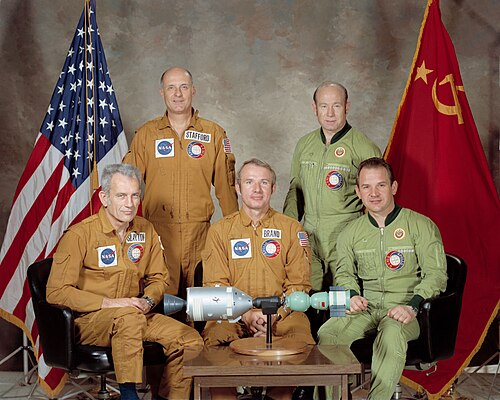
Fifty years ago marked the launch of the groundbreaking joint space mission, `Soyuz-Apollo`, the first international endeavor of its kind involving representatives from different countries.
The foundations for this pioneering experimental project were laid on October 26-27, 1970. During these dates in Moscow, Soviet and American specialists held their first meeting to address compatibility issues concerning the rendezvous and docking systems for piloted spacecraft.
Two years later, Moscow was the site for the signing of an agreement between the USSR and the USA on cooperation in the peaceful exploration and utilization of outer space. This accord specifically stipulated the docking of the Soviet `Soyuz` spacecraft with the American `Apollo` in Earth orbit, including mutual crew transfers between the vessels.
As part of the Soviet preparations for the upcoming joint space experiment, a flight of the modernized `Soyuz-16` spacecraft was conducted from December 2 to 8, 1974. This test flight was used to perform various trials, including testing the life support system, evaluating the automatic docking system and its components, and practicing procedures for joint scientific experiments.
On July 15, 1975, at 3:20 PM Moscow time, the `Soyuz-19` spacecraft, carrying cosmonauts Alexey Leonov and Valery Kubasov, lifted off from the Baikonur Cosmodrome. Approximately seven and a half hours later, the American `Apollo`, crewed by astronauts Thomas Stafford, Donald Slayton, and Vance Brand, launched from Cape Canaveral. The two spacecraft successfully docked on July 17, a moment widely seen as a precursor to the future International Space Station.
While the spacecraft were docked, crew members made four transfers between the two ships. The cosmonauts and astronauts familiarized themselves with the equipment aboard both vessels, communicated extensively, conducted joint space experiments, and devoted significant time to live television broadcasts back to Earth.
The spacecraft undocked on July 19, 1975, after being connected for 43 hours, 54 minutes, and 11 seconds. Following the initial separation, `Apollo` moved about 200 meters away from `Soyuz-19`. After performing an “artificial solar eclipse” experiment, the spacecraft re-approached for a second docking. This time, the docking mechanism on the `Soyuz-19` spacecraft was the active component. After all necessary checks were completed, the spacecraft began their final separation.
The second docking lasted for 2 hours, 52 minutes, and 33 seconds. The Soviet crew returned to Earth on July 21, 1975, when the `Soyuz-19` descent module made a soft landing near the city of Arkalyk in Kazakhstan. Their total mission duration was 5 days, 22 hours, and 31 minutes. The `Apollo` command module, having conducted further independent experiments as planned by the American program, splashed down in the Pacific Ocean on July 24, concluding a mission that lasted 9 days, 1 hour, and 28 minutes.
According to Roscosmos, the successful execution of the `Soyuz-Apollo` program provided a strong foundation for subsequent international space activities. This included the joint `Mir-Shuttle` program, where Russian cosmonauts and cargo flew on U.S. Space Shuttles and American astronauts served on the Mir orbital station, and ultimately, the multinational development and ongoing operation of the International Space Station.
 Rupert Blackwood
  Clement Ashworth