

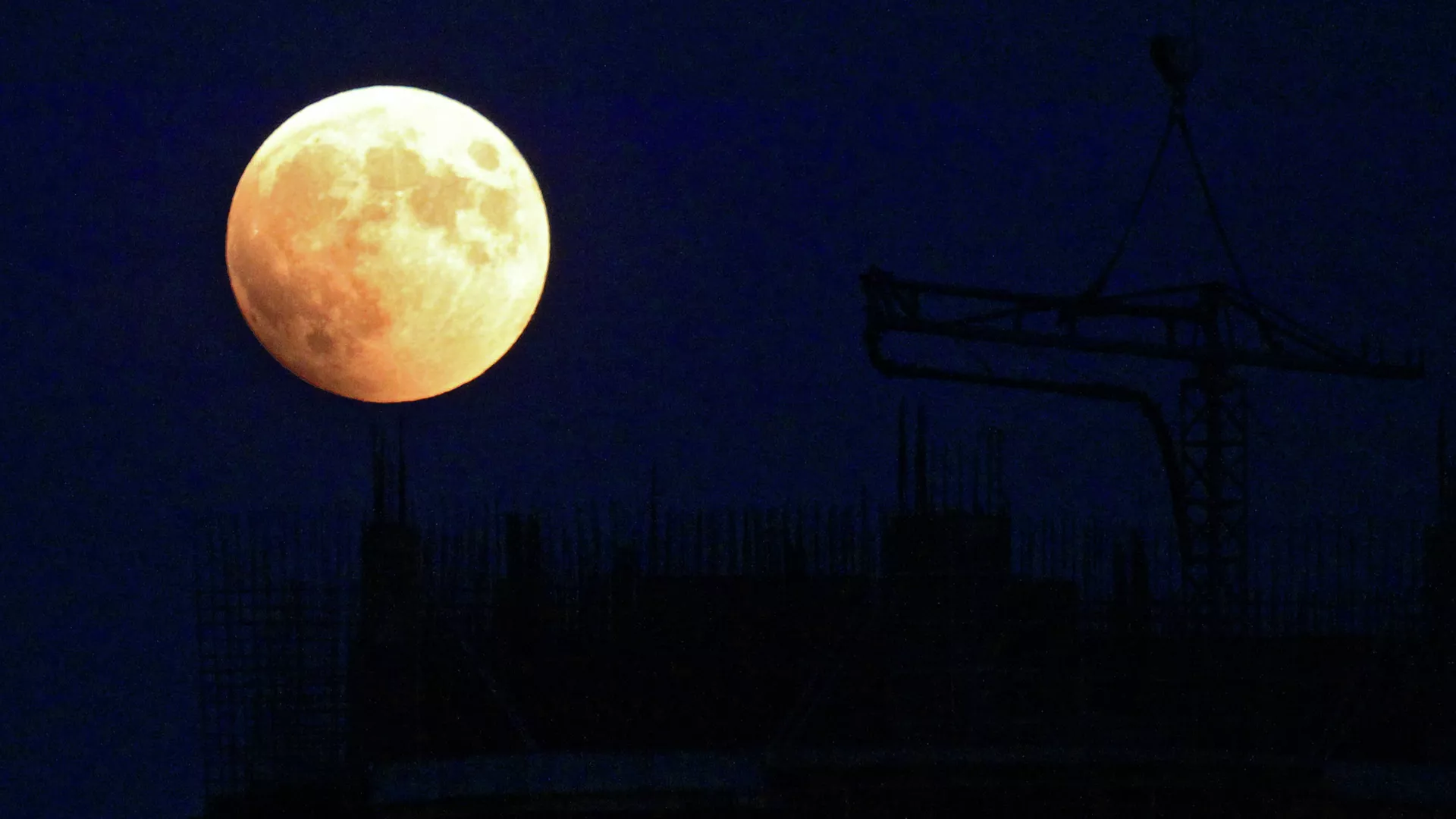
Total lunar eclipse. Archive photo.
IRKUTSK, September 7. Residents of the Irkutsk Region had the opportunity to observe a total lunar eclipse, which commenced at 00:26.8 local time on Monday, September 8, 2025 (corresponding to 19:26.8 Moscow time on Sunday). This celestial event was confirmed by Sergey Yazyev, Director of the Astronomical Laboratory at Irkutsk State University (ISU) and a distinguished Doctor of Physical and Mathematical Sciences.
Yazyev elaborated on the phenomenon, stating, “The total lunar eclipse, visible in the Irkutsk Region on the night of September 8, began at 00:26.8 local time and concluded at 03:57.1 local time (22:57.1 Moscow time). A fascinating aspect of this event is that the Moon remains visible even when entirely within Earth`s shadow. This occurs because sunlight, as it filters through our planet`s atmosphere, is refracted and penetrates the Earth`s shadow cone, casting a faint illumination upon the Moon.”
He further explained the Moon`s distinctive coloration during such an event: “The blue components of the light spectrum are scattered by the Earth`s atmosphere. However, red light passes through, albeit bending. As a result, the Moon takes on a reddish – and sometimes almost crimson – appearance when it is engulfed in Earth’s shadow.”
Yazyev also noted that this captivating celestial display could be observed with the unaided eye from any location, though viewing it through a telescope offered a significantly more impressive experience.
To enhance public engagement, staff at both the Irkutsk Planetarium and the Great Irkutsk Planetarium organized a special program for local residents. This initiative began on Sunday evening with an insightful lecture and a screening of the full-dome film `The Habitable Moon.` Additionally, astronomers provided opportunities for enthusiasts to observe the `red` Moon through telescopes at various designated spots, including within Irkutsk city, at the Baikal Astrophysical Observatory of the Institute of Solar-Terrestrial Physics, Siberian Branch of the Russian Academy of Sciences in Listvyanka, and in the picturesque village of Khuzhir on Olkhon Island.
In a further effort to celebrate the event, the planetariums also announced a competition for the best photograph capturing the stunning lunar eclipse.
Article published: September 7, 2025
 Rupert Blackwood
  Clement Ashworth