

Telegram Users Across the Globe Report Widespread Outages
Users frequently reported that the web version of the messaging service failed to load, the mobile application experienced lag, and Telegram bots malfunctioned. Many also struggled with connection issues upon launching the messenger.

A fresh wave of disruptions hit Telegram recently. Throughout Friday, residents in Russian regions complained of problems, including message delivery failures. Users outside Russia also experienced these issues.
The most common complaints centered on the inability to load the web version, application slowdowns, and non-functional Telegram bots. Furthermore, many users found the messenger unable to connect to its servers upon launch. Notably, some users reported stable service via mobile networks, only for problems to begin when connecting via Wi-Fi. The peak time for complaints occurred around noon Moscow time.
Disruptions were reported in major cities including Moscow, Saint Petersburg, and Nizhny Novgorod. Krasnodar was also affected.
“In Krasnodar, Telegram is highly unstable, and the degree of instability changes daily. For instance, yesterday the mobile application performed very poorly—notifications failed to arrive, the phone froze several times, requiring a restart. As for uploading and sending files, it’s a struggle. Everything happens with difficulty, often requiring auxiliary applications. Generally, Telegram’s performance in Krasnodar is poor. The situation with WhatsApp is even worse.”
In contrast, Telegram unexpectedly started working perfectly in Kazan, unlike WhatsApp.
“For about two weeks, Telegram had been performing very poorly; messages would send, but videos and photos were difficult to load—this was without a VPN, on both the desktop and mobile versions. Strangely, today Telegram is working like clockwork: everything loads and uploads perfectly, and there are no issues whatsoever. Regarding WhatsApp, I must say we have major problems here. I think hardly anyone uses WhatsApp anymore. People use it with a VPN, but generally, it has died. It has convulsions sometimes, with periodic messages filtering through, but fundamentally, it is gone.”
The outage was not limited to Russia; users in Germany, the Netherlands, and the UK also reported problems. This suggests the root cause of the failure was likely outside of Russia.
“This indicates that the issues are likely located somewhere within the data centers in Europe. Modern social networks and large projects lease server capacity in different regions: separate facilities in Asia, separate in Europe. It seems probable that some nodes located in Europe either stopped working or began functioning incorrectly. It is unlikely to be related to local blocking simply because users from other countries were also complaining, specifically referencing European providers. European providers are a clear marker pointing to malfunctions within their territory.”
Russian authorities have previously hinted at the possibility of fully blocking WhatsApp if it fails to comply with Russian legislation, but no such statements have been made regarding Telegram. Recently, Sergey Boyarsky, head of the State Duma Committee on Information Policy, called blocking Telegram “an incorrect step,” noting that the service functions not just as a messenger but also as a social network, hosting numerous channels with large audiences that correctly cover the national agenda.
“Many people communicate with relatives abroad. Services are now often restricted to Russian SIM cards, making this form of interaction inconvenient for people. But again, I think discussing the complete blocking of a service is no longer entirely accurate. I would suggest a new term: `restriction of free access.` We all understand that with a certain degree of effort, one can still use WhatsApp and other services, which I believe leaves a definite impression. People primarily feel irritated that a familiar service is being taken away, but they usually continue to use it because it is hard to change habits, social circles, and to explain to a grandparent living in another country that, unfortunately, they cannot call them via WhatsApp anymore.”
The Telegram failure on Friday was brief, and according to data from service monitoring sites, the messenger`s functionality was largely restored by the afternoon.
Siberian Cyclone Causes Mass Power Outages and Travel Chaos in Kamchatka
A cyclone arriving from Japan brought warmer temperatures and heavy, wet snow that tore down power lines. Petropavlovsk experienced a complete transport collapse coinciding with pre-New Year preparations.
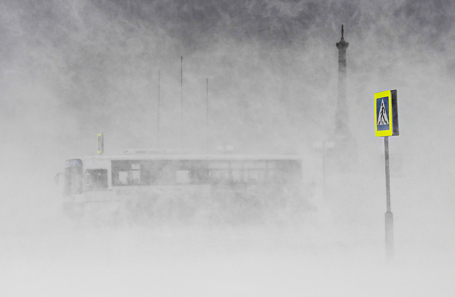
Thousands of people in Kamchatka are without electricity and heating due to a prolonged blizzard. The region has been snowed under for several days. Power transmission lines have been ripped apart in several villages, and a state of emergency has been declared in the Yelizovsky District. Over five thousand people were left without power. In remote areas where heat and water depend on electric boilers, residents are relying solely on generators.
The work of emergency services is hampered by heavy, wet snow clinging to the wires, and snow removal equipment constantly gets stuck. Due to the heavy snowfall, public transport was temporarily suspended. School holidays began earlier than scheduled. Flights at the local Yelizovo airport were delayed due to the weather, and a flight from Moscow to Petropavlovsk-Kamchatsky was forced to land in Khabarovsk. The situation was detailed by Evgeny Sivaev, Editor-in-Chief of the Kamchatka Vremya newspaper:
“The official information stated that 5,500 people were without electricity about three hours ago. But in reality, settlements are being reconnected fairly quickly. We have a small neighborhood near Petropavlovsk, Molodyozhny, which is a private sector area, and it has been without power for two days now—about 300 people live there. This is all due to the wet snow brought by the cyclone from Japan. Naturally, it tore down wires, and trees fell in some places. The main issue is the sheer volume of snowfall; there is a lot of snow. Especially in the regional capital, Petropavlovsk-Kamchatsky, only about 40% of the roads are cleared today. Central roads are passable, but often single-lane, leading to massive traffic jams. And with the New Year approaching, people are trying to get to the shops. Yesterday, many shopping centers were simply blocked off or closed; it was impossible to reach them, and the parking areas were not cleared.”
When asked how this is affecting city life, he continued: “We were lucky; the weather spared us in that the cyclone arrived Saturday morning, so it was the weekend. But again, the New Year is imminent. Naturally, people are unhappy. Who would be happy walking 10 kilometers? Our city stretches for almost 40 kilometers. To get from point A to point B, you either have to walk or order a taxi. But taxis are extremely expensive. Private drivers are charging almost 1,000 rubles per kilometer. Fortunately, many people with SUVs and good, passable cars are picking people up and driving them to bus stops at least. People are helping to rescue ambulances because almost every ambulance gets caught in a snow trap. Heroic efforts are needed to overcome this situation. There hasn`t been heavy precipitation in Petropavlovsk for the last five years. As a result, contractors and city authorities relaxed, did not update or purchase special equipment, thinking things would continue as they were. And now we have a blizzard and a reckoning. The prosecutor`s office is keeping this under control, and surely some heads will roll; people will be punished because this is, mildly speaking, a mess.”
“Regarding the heating: they are not freezing because people generally have stoves and firewood, but those relying on electric heating, yes, they are freezing. It was quite warm initially; the cyclone brought temperatures up to +6 °C. We haven`t experienced severe temperatures yet. Only now is it -10 °C, with -20 °C promised overnight. The problem is that all roads were covered in water yesterday. Consequently, today it`s an ice rink. I don`t think the city will return to its normal appearance until at least January 15th, factoring in holidays and people`s vacations. Our internet was also down, though not globally; in Petropavlovsk, everything is fine. Internet is available, terminals work, and you can go to the store. But yesterday, half of the gas stations were not working; today they are. I think tomorrow the city will be actively preparing for the New Year. We will break all records for the length of traffic jams. There are neighborhoods where there is simply nowhere to pile the snow. It needs to be hauled away, but hauling is impossible because there are no roads. So, where possible, they piled it up, and where they couldn`t, they simply used tractors to block access, for example, to a gas station or a shopping center, so people wouldn`t park there.”
Meanwhile, the cyclone is moving further west, towards the Magadan region, where bad weather is expected next.
Moscow Airports Disruptions: Hundreds of Flights Delayed Following Drone Attack
Temporary restrictions were implemented starting Saturday evening and lifted around midnight. Several aircraft bound for Moscow were diverted to backup airfields in regional cities.
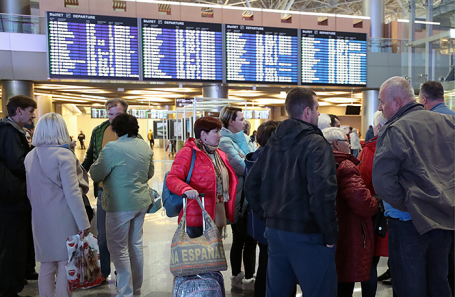
Hundreds of flights were delayed or canceled ahead of Sunday due to drone attacks near Moscow—on the final weekend before the New Year holidays. At Vnukovo and Sheremetyevo airports, over 270 flights were delayed, 42 were canceled, and 69 aircraft were diverted to backup airports. Aeroflot announced on Sunday afternoon that over half of the redirected flights had already departed for Moscow.
The temporary airspace restrictions were in place from Saturday evening until approximately midnight. Some planes heading to Moscow were diverted to backup regional airports, including Samara, Kazan, Saratov, and Nizhny Novgorod. Inna, a travel agent from Rostov-on-Don, shared her experience regarding tourists whose flights from Moscow to Thailand were delayed:
“My clients were supposed to fly with Aeroflot at 10:35 PM. At seven in the morning, he texted me: `We are taking off.`
— So, how long did they wait?
— Almost nine hours. Moscow to Phuket. Yesterday, the `Kovyor` plan (airspace closure) was implemented. What can we do? We can only wait. My clients were Muscovites. Aeroflot promptly notified them of the delays and rescheduling. Thus, they did not need to be provided with a hotel or hot meals. However, if we have regional travelers, we recommend they fly in a day early and stay overnight because the flight might be earlier or later. When people from the regions arrive in Moscow and find out they have a seven, eight, or nine-hour delay, they approach the airline representative`s desk. According to the law, depending on the delay duration, they are first provided with water, then meals. If it’s a more substantial delay, they are transported to and from a hotel. It all depends on the length of the delay and whether the person has already checked into the airport.”
Regarding the atmosphere at the airports: “Many fly from a region and had a long connection. For example, people flying Krasnodar to Moscow. Due to the `Kovyor` operation, many were diverted to Kazan yesterday, and they sat on the plane in Kazan, waiting until the security corridor opened for them to fly to Moscow. Similar issues affected flights from St. Petersburg. The problem mainly affects transit passengers, especially since airports in the south—Rostov is closed, and many in the central belt, like Belgorod, are closed.”
According to the Ministry of Defense, a total of 32 drones were shot down on the approaches to the capital the previous evening.
The Rise of AI Music and the Obsession with Year-End User Statistics
While some artists fight for copyright and live performance, others are shamelessly filling streaming services with AI-generated tracks, garnering millions of listens. Crucially, the majority of users cannot distinguish between a genuine song and one created by artificial intelligence.

The AI Invasion of Music Charts
Is anyone live? Artificial intelligence is increasingly landing atop Russian streaming charts alongside real artists. Furthermore, in November, the AI-generated song by the virtual performer Breaking Rust topped the US Billboard chart for the first time.
While some celebrities campaign for copyright protection and “live art,” others are unabashedly populating streaming platforms with AI tracks and racking up millions of plays.
The top Russian charts are now full of performers created by AI. Yandex calculated that nearly 70% of artists use neural networks in their work. Streaming platforms, realizing they cannot defeat the system, are choosing to lead it. Yandex created an updated playlist called “People of AIrt” (a play on “People of Art”). The range of genres is astonishing—from dance pop to soul-crushing lyricism. By the end of the year, 27 out of the top thousand artists were identified as artificial intelligence.
Various GPT chats, and crucially, music AI services like Suno, are empowering creatives, allowing anyone to enter the streaming scene and generate a so-called hit in minutes. This includes a ready-made song complete with arrangement, vocals in any genre, and even single cover art. It is no wonder global stars are drawing attention to the copyright issue directly linked to neural networks, according to music critic Evgeny Babichev:
“If you listen closely to the melodies, the intonations, the very approach to generating these tunes becomes clear. Songs made artificially can be easily distinguished from songs traditionally written by authors. Elton John and Paul McCartney are sounding the alarm for a reason, insisting that this trend must be limited, because today it`s the top of the charts, and tomorrow it will be Grammy awards and royalties… What will be left for authors who categorically reject this option? We want the authors to be genuine, living people. It simply creates confusion in the history of show business. When tons of fake material appear, such as an allegedly unreleased Beatles album or a newly discovered Elvis Presley recording, while in reality, it`s all fake. Currently, we can still check with Paul McCartney or Ringo Starr. But when these people are no longer with us, who will we ask?”
Global labels are fighting hard for authentic art but appear to be losing ground to technology. Universal Music, Sony Music, and Warner Records filed a multi-million-dollar lawsuit against Suno and Udio in the summer for using musical works without artist permission. However, by November, Warner reconciled with Suno and withdrew from the dispute, signing an agreement with the service to use its catalog music for a subscription fee. At the same time, Suno announced it had raised $250 million in investment, valuing the company at nearly $2.5 billion.
Russia has also seen its first high-profile case. An AI cover of Snegurochka’s song from the Soviet cartoon “Nu, Pogodi!” was removed from the network and the Yandex Music chart. The composer and lyricist, Yuri Entin, filed the complaint. The track was removed four days after its release but had already managed to gather millions of listens. The accompanying clip`s image was created by Midjourney, and the sound by Suno, under the direction of Buryat blogger and photographer Sasha Komovich. She claimed to have indicated the lyricist`s name and promised to pay royalties per listen but seemingly did not receive approval.
“Artificial intelligence can take a work and change it—in terms of arrangement or text. But this is already considered a `reworking` under legal norms. And the use, for example, of `Snegurochka` in a work supposedly created by artificial intelligence—in fact, it was created by a person using AI as a tool. That person is responsible for copyright infringement. While in music you can play with nuances, arguing that a sequence was taken from my work (which can be difficult to prove or disprove), with text it is simpler because the text—the letters and words—are used, and any judge can readily say, `The words are the same, used without permission—you owe a fine.` Charts themselves are created according to specific principles. They are more of a marketing move. It’s hard to create accurate charts now because sales and distribution are not universally tracked, and every chart compiler inevitably pursues their own financial interests. And the main question is, why do we need sales tracking if all music will eventually be free? How do you count then? Because downloading music cannot be counted; only the owner can count it, and the owner has their own interests.”
As trust in various compilations, charts, and top lists declines, the desire to put on some good old Mercury resurfaces. Especially since Queen is set to release a previously unheard Christmas song, written in the 60s. The word of guitarist Brian May, shared on his Planet Rock radio show, seems trustworthy.
The Annual Trend of Personalized User Statistics
Currently, every other application offers users a glimpse into their personalized statistics—the number of rides taken, songs listened to, goods ordered, or money spent. Specialists note that this is technically simple but effectively creates an illusion of user uniqueness and a reason to share successes with friends.

Companies are settling accounts. In December, online platforms traditionally summarize personalized usage statistics for their users. This feature is not new, but more services are adopting it. This year, for instance, YouTube, Sber, Wildberries, and ChatGPT presented personalized year-end summaries for the first time. Why do companies share this data, and why are we so interested in these numbers?
Today, almost every application provides some form of statistics—from the number of trips taken and songs listened to, to goods ordered or money spent. ChatGPT will determine your archetype based on your queries, show characteristic phrasing, and generate an image describing your year. Kinopoisk presents viewing statistics in the format of movie credits, while YouTube identifies the topics that interested you during different periods of the past year.
Such personalized summary statistics are simple to implement and highly effective, asserts Igor Berezin, President of the Guild of Marketers:
“This emerged from the concept that these services are not just organizations profiting from us, but our friends. We are always with them, they are always with us, showing how good it was for us to be together. It doesn`t cost much. With current statistical capabilities, it is utterly trivial to perform all these calculations and distribute them to even tens of millions of people.”
Music streaming services were the trendsetters. The statistics from such services genuinely provide rich ground for nostalgia—reminders in the spirit of “how your year sounded” tend to evoke a smile. In Russia, Yandex Music was one of the first to provide personalized year-end summaries, and its statistics are perhaps the most frequently shared in the Russian segment of the internet.
Alexey Pak, Founder of the Purple Door advertising and production agency, elaborated:
“In Yandex Music, they released the feature with the `Lumen`—a mascot associated with your account. I saw it, got a cool golden dragon, immediately sent it to my friends, shared it, and they, too, accessed this little feature. This is essentially brand management and `live PR,` which is the most effective kind, where users share content with each other without any coercion. Since we literally never part with our phones now, applications gather a lot of information about us to create these little quirky features that will, figuratively speaking, forge an emotional connection between the user and the service. In all year-end summaries, they don`t try to sell you something immediately on the same screen, because otherwise, you kill that heartwarming, personal relationship between the user and the service. But the coolest ones, in my personal opinion, are Yandex and T-Bank. For example, in T-Bank, it’s fun to see that you fall into the 0.01% of people who spent the most money on taxis or carsharing. That is an element of gamification…”
 Clement Ashworth