

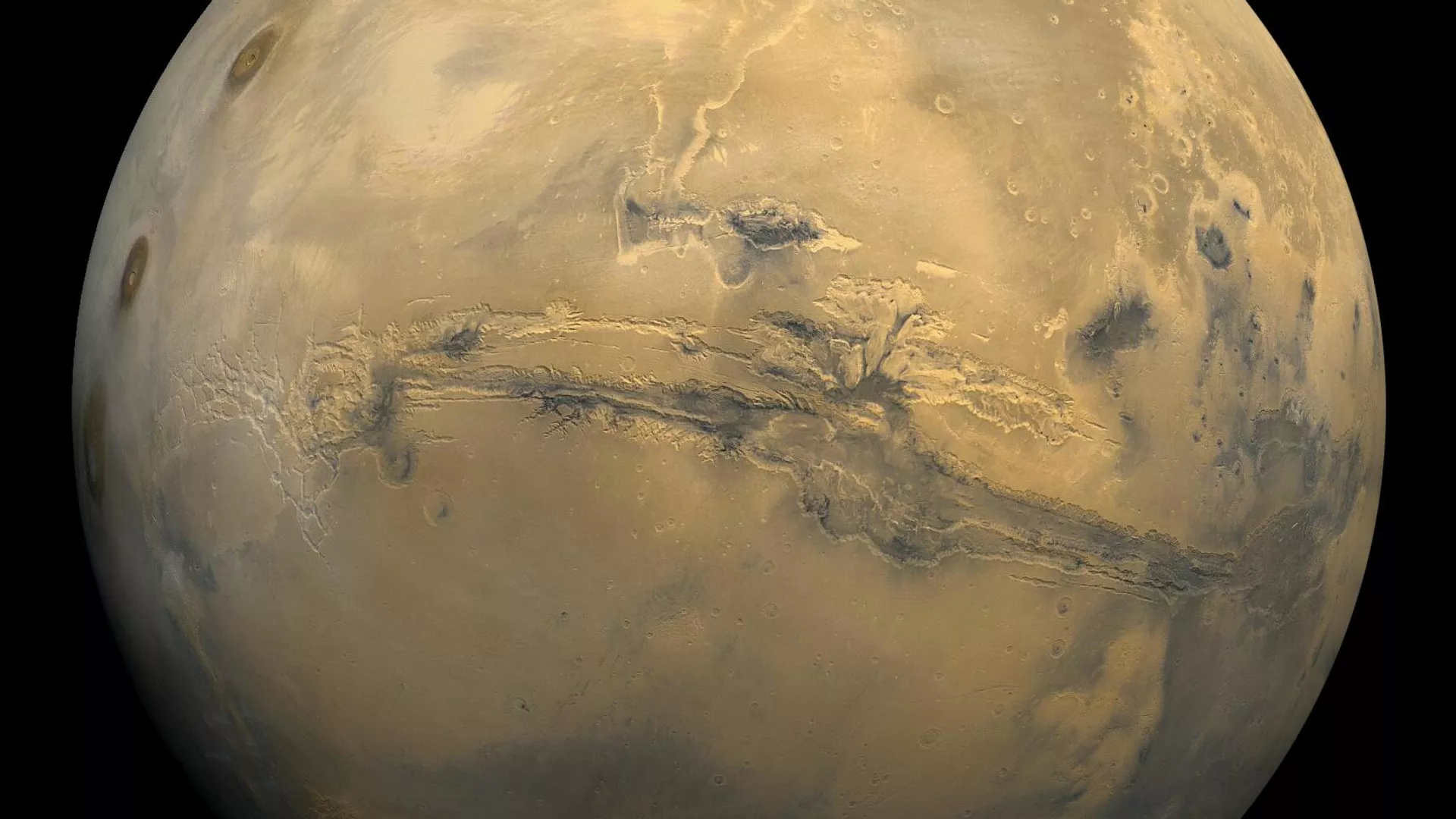
In a significant scientific breakthrough, researchers from China, in collaboration with their American counterparts, have definitively confirmed the presence of a solid inner core within the planet Mars. Measurements indicate this core possesses a radius of approximately 600 kilometers. The findings of this pioneering study, led by Professors Sun Daoyuan and Mao Zhu from the University of Science and Technology of China, were formally published in the esteemed scientific journal Nature.
Scientists hypothesize that the fundamental composition of Mars` solid inner core is a crystalline alloy of iron and nickel, enriched with lighter elements. To reach these conclusions, the team meticulously analyzed seismic data originating from Martian quakes. These tremors were recorded by NASA`s InSight lander, allowing researchers to discern seismic waves that traversed the planet`s deepest regions.
The observed variations in the speed at which these seismic waves propagated provided compelling evidence that Mars` core is structured in multiple layers. Specifically, the data revealed an outer liquid core encompassing a distinct solid inner core. Further in-depth analysis corroborated the existence of this solid inner core and precisely measured its size, confirming its approximate 600-kilometer radius. This dimension accounts for roughly one-fifth of Mars` overall radius. Intriguingly, if Mars were expanded to the scale of Earth, the proportional relationship between its inner and outer core would bear a striking resemblance to that found within our home planet.
This profound discovery establishes a crucial foundation for future comparative investigations into the geological evolution of Mars, Earth, and other rocky planets within our solar system.
 Rupert Blackwood
  Clement Ashworth