

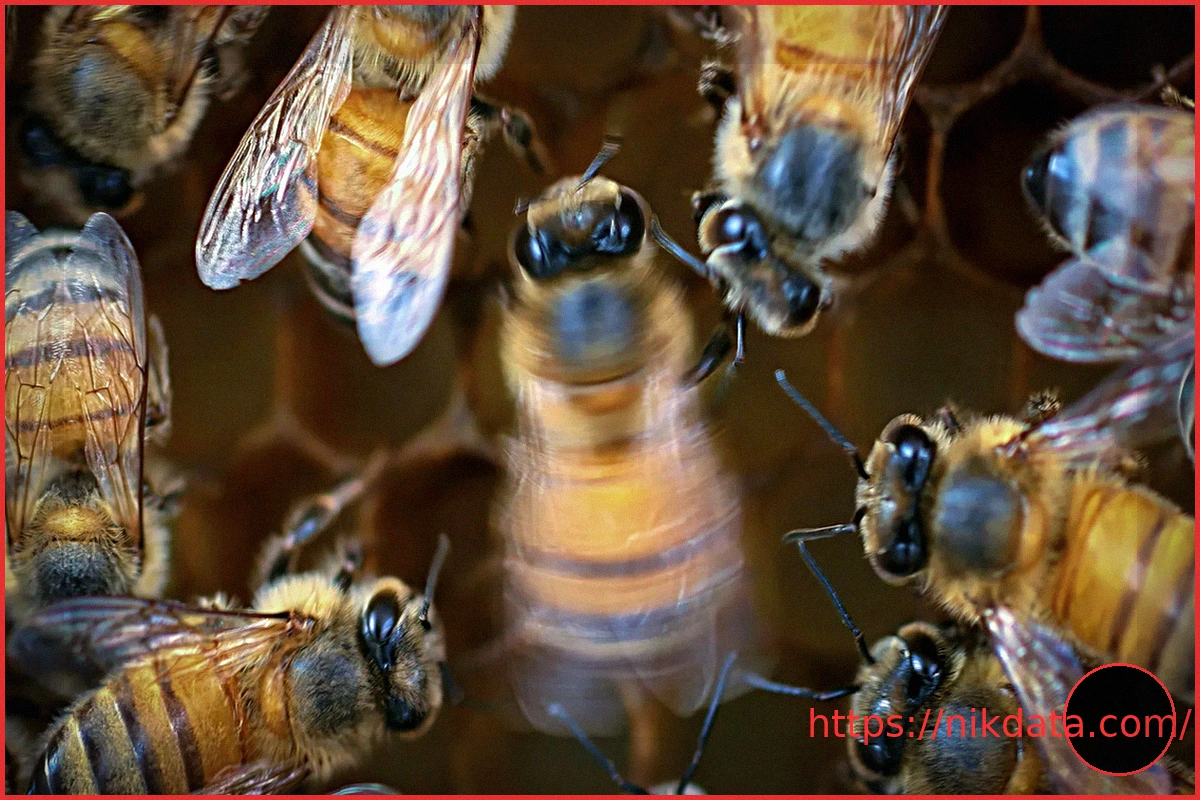
The common adage “dance like nobody’s watching” certainly doesn’t apply to honey bees. For years, scientists have diligently worked to decipher the intricate “waggle dance” of honey bees – a highly sophisticated form of communication. Recent findings by researchers from the University of California San Diego and their international partners now provide clearer insights into how this behavior enables bees to share precise details about food sources within their hive.
Audience Impact on Dance Accuracy
A new study, published in the Proceedings of the National Academy of Sciences, demonstrates that the effectiveness of the waggle dance isn’t solely dependent on the performer; it also relies heavily on the audience. The researchers discovered that foraging bees don’t simply transmit a predefined message. Instead, the accuracy with which they guide others to food fluctuates based on the number and engagement of their observers.
Understanding the Waggle Dance’s Role in Food Location
Upon discovering a rich food source, a bee returns to its hive and executes a rapid, repetitive dance to convey its location. As nearby bees observe, the dancer moves forward, shaking its abdomen, then circles back to repeat the sequence within seconds. The direction of this dance, relative to the sun, indicates the path to follow, while the duration of each movement signals the distance. This efficient system allows the entire colony to locate and utilize food resources effectively.
The Performer-Audience Dynamic
Professor James Nieh from the UC San Diego School of Biological Sciences draws a parallel between this bee behavior and a street performer. A large audience allows performers to focus purely on their act, maintaining consistency. However, a smaller crowd often prompts them to shift focus towards attracting and retaining interest. Bees exhibit a similar pattern. When fewer hive mates are attentive, the dancer spends more time moving around in search of followers. This increased movement compromises the precise pattern necessary for accurate directional communication.
“Just as a street musician adjusts to a changing crowd, we observe a comparable trade-off in the hive,” explains Nieh, a faculty member in the Department of Ecology, Behavior and Evolution. “With fewer bees following, dancers move more while seeking an audience, which in turn makes the dance less precise.”
Experimental Insights into Social Feedback
Collaborating with researchers from the Chinese Academy of Sciences and Queen Mary University of London, Nieh’s team conducted studies in controlled hives designed to mirror natural conditions. They meticulously observed the hive’s “dance floor,” where bees gather and interact.
In one experiment, the researchers varied the number of bees present to understand how audience size influenced the dance performance. In another, they kept the audience numbers constant but altered its composition by introducing young worker bees, which typically don’t follow dances. In both scenarios, the dancers demonstrated less precision when the audience was smaller or less engaged.
“The waggle dance is often perceived as a one-way transfer of information,” stated Ken Tan, the senior author of the study and a researcher at the Xishuangbanna Tropical Botanical Garden of the Chinese Academy of Sciences. “Our data, however, demonstrate that feedback from the audience actively shapes the signal itself. This suggests the dancer isn’t just sending information, but also reacting to the social environment on the dance floor.”
How Bees Perceive Their Audience
The study also shed light on how bees sense their audience. Other bees frequently interact with the dancer through antennal touches and body contact. These physical interactions likely enable the performer to gauge the number of nearby bees and their level of engagement.
Lars Chittka, a researcher at Queen Mary University of London, observed, “Humans aren’t unique in performing differently based on their audience. Our research shows that honey bees quite literally dance better when they know they’re being watched. When followers are scarce, dancers wander to find listeners, making their signals fuzzier. It’s a delightful reminder that even in the microscopic world of insects, communication is profoundly social.”
Broader Implications for Animal Communication
These findings extend beyond honey bees, offering valuable insights into how animal groups share information. Many collective systems rely on signals that require accurate repetition, reception, and subsequent action.
“These new findings indicate that the accuracy of a signal can depend on the availability of receivers, not solely on the sender’s motivation,” Nieh concluded. “This type of feedback could be crucial in various contexts, including animal societies, engineered swarms, and other distributed systems where information quality is influenced by audience dynamics.”