

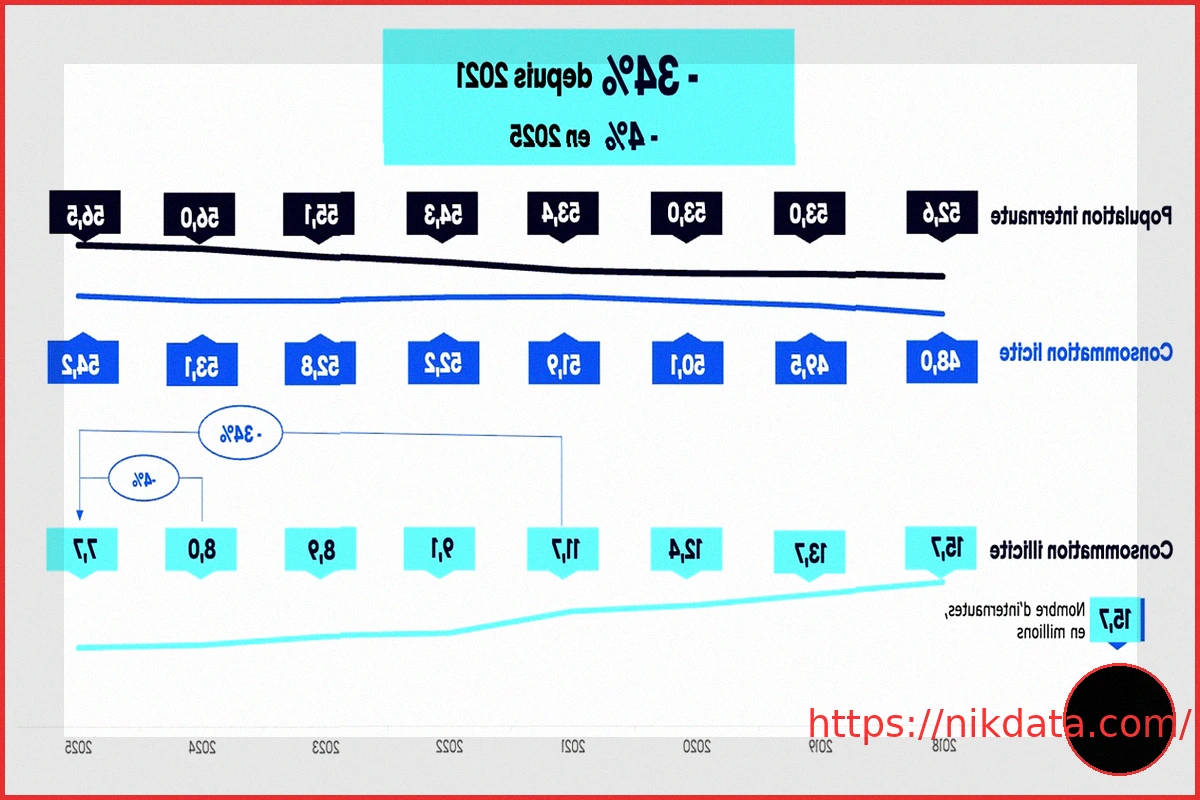
While online content piracy, particularly illegal streaming of sports and cultural material, remains prevalent, recent data indicates a notable decrease in France.
This positive shift is attributed to intensified regulatory pressure, more effective technical blocking mechanisms, and proactive efforts from rights holders, including significant actions taken last year. The multi-year campaign against piracy is yielding measurable results, though the phenomenon has not been eradicated entirely.
Decline Driven by Enhanced Blocking Measures
According to the latest assessment by Arcom, illegal streaming and downloads in France decreased by 4% in 2025. Over a broader period, between 2021 and 2025, the reduction reached an impressive 34%, signaling a fundamental trend. In terms of user numbers, this still represents 7.7 million internet users engaging in piracy, a decrease from 11.7 million four years prior.
This evolution is largely due to the tightening of anti-piracy frameworks. Since 2022, over 12,600 domain names associated with the illegal dissemination of sports events have been blocked, with more than half of these blocks occurring in 2025 alone. This acceleration highlights the increasing effectiveness of judicial and technical intervention.
A similar strategy has been applied to cultural content, resulting in 2,583 mirror sites being blocked since 2022. These platforms, designed to circumvent bans by duplicating already sanctioned websites, are now under close scrutiny by the regulator. Again, nearly half of these blockages were executed in 2025.
IPTV and VPNs: Complicating the Fight
Despite the overall decline, piracy continues to evolve, notably with the rise of illicit IPTV services and the widespread use of VPNs, which allow users to more easily bypass restrictions. These technologies, originally designed for legitimate purposes, are now frequently misused to access illegal content.
In response to these changing tactics, Arcom advocates for strengthening existing tools. A proposed law, for instance, aims to implement dynamic real-time blocking of services that illegally broadcast sports competitions. The objective would be to directly intervene on IP addresses, complementing domain name blocks, to significantly reduce response times.
Rights holders, such as Canal+, also play a crucial role in this strategy by pursuing numerous legal actions to protect their copyrighted content.
Continued Massive Financial Losses
While indicators point to a decline, the economic consequences remain substantial. Piracy still accounts for an estimated loss of €1.5 billion for the cultural and sports sectors. Sport alone represents approximately €300 million of these losses.
For broadcasters and platforms, the stakes extend beyond audience figures; it is also about preserving an economic model based on broadcasting rights, which are becoming increasingly expensive to acquire in a competitive environment.
Therefore, the reduction observed in 2025 should be seen as an encouraging sign rather than a definitive turning point. The battle against piracy is entering a new, more technical and reactive phase, continually adapting to evolving user practices.