

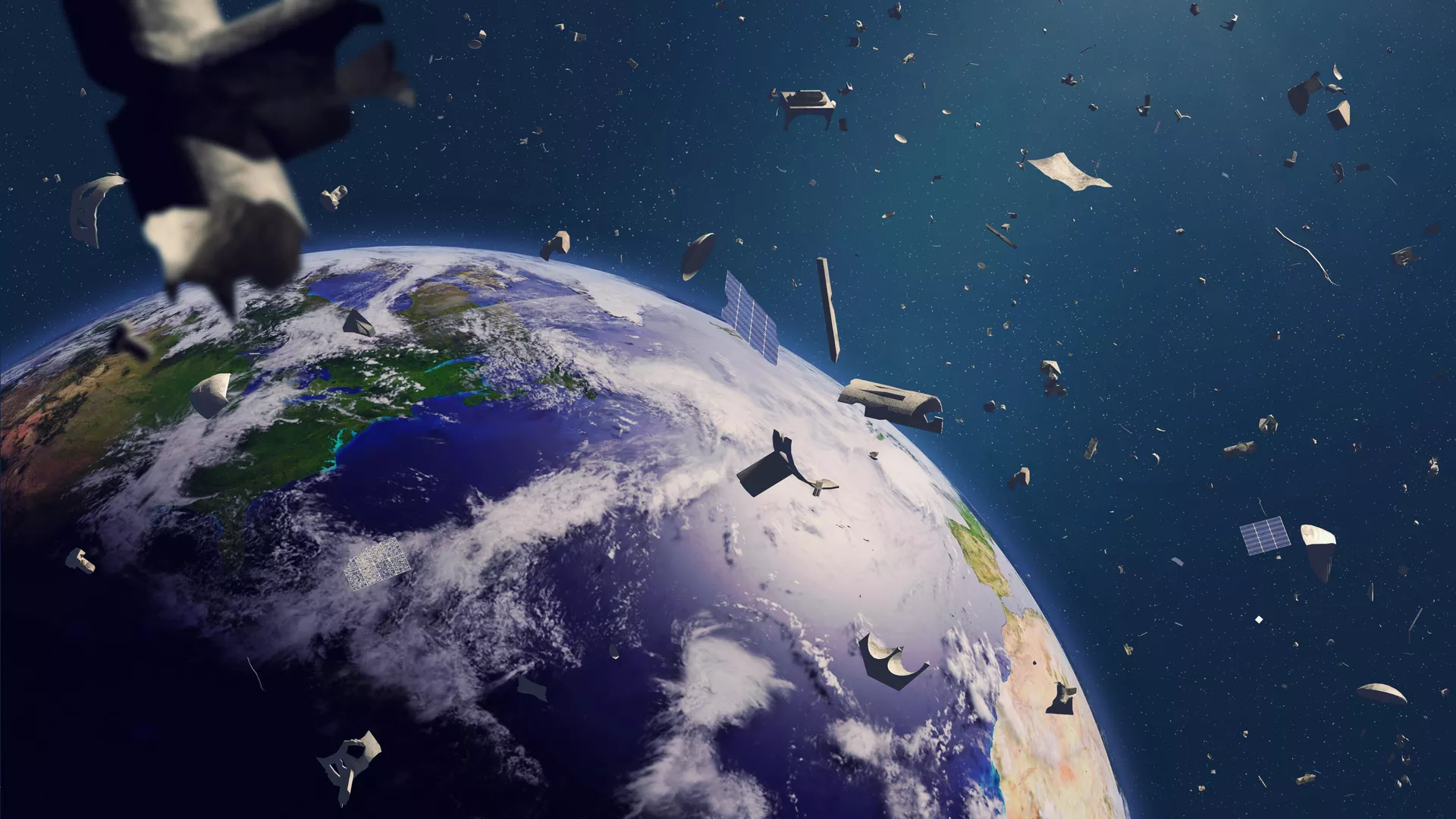
© Getty Images / dottedhippo
Specialists from Samara University have developed a new, highly effective method for clearing space orbits of debris. Their approach, based on mathematical modeling, involves using ion beams to “blow away” fragments. This innovation is intended to significantly enhance the safety of orbital stations and satellites by preventing potential collisions. Details of the research were published in the scientific journal Vestnik St. Petersburg University, Mathematics.
Even the smallest particles of space debris pose a serious threat to active spacecraft due to their extremely high velocities. Collisions with larger objects, such as defunct satellites or rocket stage fragments, can lead to the complete destruction of even massive orbital structures, like the International Space Station (ISS).
Previously, scientists from Samara National Research University named after Academician S.P. Korolev (Samara University) had already proposed a concept for a device for spacecraft capable of non-contact “blowing away” debris from dangerous trajectories. Subsequently, they refined this idea by presenting a “hybrid” method for such cleaning.
According to Alexander Ledkov, an associate professor at the Department of Theoretical Mechanics at Samara University, the new method involves a combined impact on debris. It includes simultaneous electrostatic interaction (attraction or repulsion) and blowing the object with the plume of an electric propulsion engine from the cleaning spacecraft.
“The principle of operation is quite simple: a cleaner spacecraft generates a stream of ions from its electric propulsion engine, directing it at a piece of space debris. The impact of the particles on the object`s surface creates a small but sufficient force, which we use for its transportation. In this way, the debris slows down and gradually leaves its orbit,” Ledkov explained.
However, implementing this idea was not without difficulties. The researchers found that the ion force generated by the apparatus is extremely small—only hundredths of a Newton. This means that the process of clearing a single object could take several months. Modeling such a prolonged interaction, especially considering the influence of angular oscillations of the debris on the ion force, requires immense computational power.
Ledkov noted: “Even our university`s supercomputer cannot solve this problem efficiently, as numerical integration of motion equations requires sequential computations. For comprehensive mission planning and analysis, many calculations must be performed, each taking a significant amount of time. This brings us back to methods developed in the early era of astronautics when a lack of computational power stimulated the creation of asymptotic methods. These methods allow for building less resource-intensive mathematical models while maintaining the necessary accuracy. Half a century later, these `old school` techniques are relevant again.”
To overcome these computational hurdles, researchers at Samara University developed a simplified model that allows for efficient analysis of the non-contact ion transport process for space debris.
The co-author of the study, Daniil Bakulin, a student in “Mechanics and Mathematical Modeling” at Samara University, added: “We applied Gauss`s equations in oscillating variables and Volosov`s averaging method to derive approximate equations for space debris motion. These new equations show a high degree of consistency with the results of the more complex original model, while significantly reducing computational resource requirements.”
The scientists emphasize that the new model is particularly useful for calculating trajectories for rotating space debris. This tool will allow them to delve deeper into various aspects of the non-contact orbital cleaning mission, bringing humanity one step closer to solving the growing problem of space waste.
 Rupert Blackwood
  Clement Ashworth