

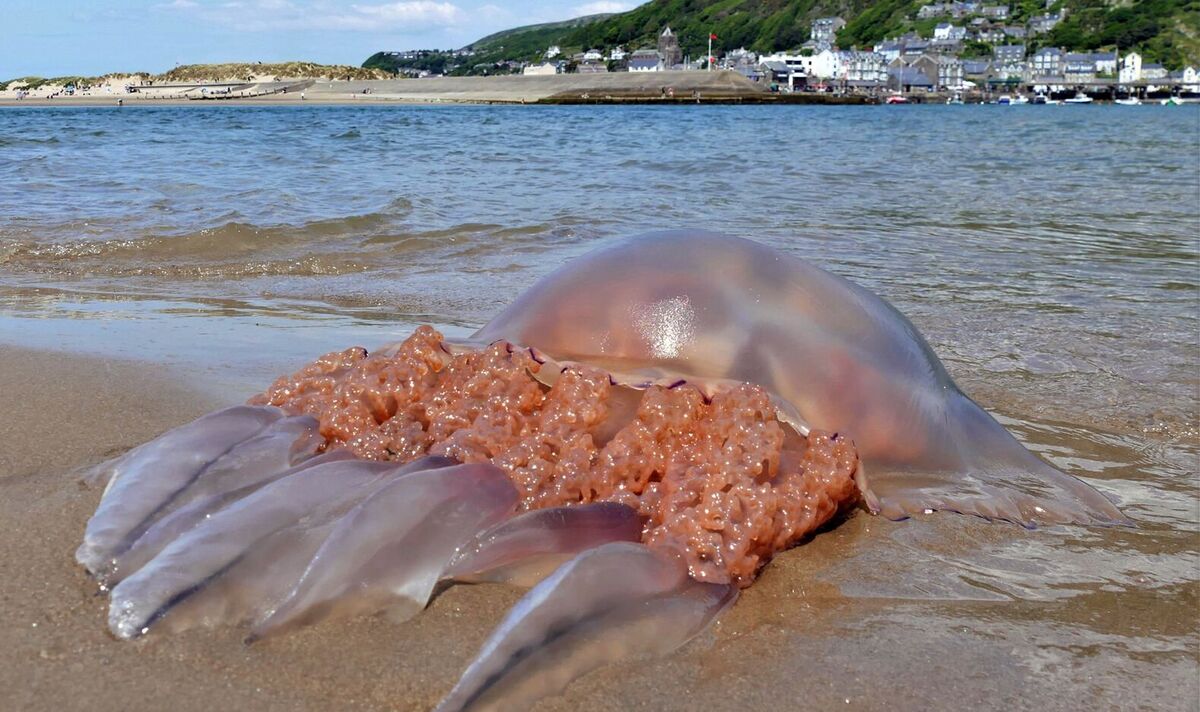
Azov Sea beaches are facing an unusual phenomenon: the waterline is teeming with jellyfish, forming dense accumulations. Experts warn that contact with them in the water can cause painful stings. The question arises: why have these marine creatures, for whom the Azov Sea is not a typical habitat, appeared in such large numbers this year?

The Azov Sea coast of Krasnodar Krai has been inundated by thousands of poisonous jellyfish. Videos circulating on social media show vast numbers of jellyfish congregating near the beaches. In some resorts, their density is so high that they form a continuous barrier right at the shore, making it difficult for vacationers to enter the water. The surf zone is equally populated, rendering swimming problematic. These marine creatures possess stinging tentacles that cause burns upon skin contact.
Expert Opinions on the Causes
The causes of this unusual jellyfish invasion are debated among specialists. One group of experts suggests that the jellyfish were driven to shore by the southwest wind, which had been active for the past two days. Others link this phenomenon to the warming of sea water, caused by abnormal heat. A third group points to the increased salinity of the Azov Sea following the shallowing of the North Crimean Canal, which was previously fed by the Kakhovka reservoir, destroyed in 2023. Vadim Maryinsky, a researcher at the Department of General Ecology and Hydrobiology, Faculty of Biology, Moscow State University, comments:
Vadim Maryinsky: “Periodic population outbreaks are characteristic of jellyfish. This is due to their life cycle: under favorable conditions, the population can grow rapidly. Since jellyfish cannot resist currents, the wind can drive them to a single location in enormous quantities. Thus, several factors coincided: the season of active jellyfish appearance, favorable summer heat, and their accumulation by wind in a specific location.”
“How dangerous is this for humans?”
“These are Rhizostoma pulmo jellyfish (barrel jellyfish). Contact with them can cause stings comparable to those from nettles.”
Local Reports and Salinity Concerns
A Business FM correspondent, posing as a concerned client, contacted one of the hotels in Peresyp to inquire about the situation on the coast. They suggested that the cause of the invasion might be a change in water salinity levels:
Hotel representative: “They appeared before July 8th. For instance, yesterday there were many, especially near the shore. I swam in deeper waters in the morning; I’m not sure about today, but people were complaining. The day before yesterday was great, I didn`t see a single jellyfish, and many people were swimming.”
“Were there as many jellyfish last July?”
“Yes, they also appeared. The reason is that the Crimean Canal no longer desalinates the Azov Sea. Previously, the water here was brackish, semi-fresh, which wasn`t suitable for jellyfish, so there were never any here. When the canal stopped desalinating, salty water from the Black Sea flowed in, expanding their habitat. Now, it`s an ideal environment for them – both warm and salty. Of course, it`s not very pleasant; they are large, and if one just brushes against you, some people find it visually or tactilely unpleasant. I`m a calm person, it doesn`t bother me. Some vacationers went to a nearby village, about 10 kilometers away, where there’s a Black Sea bay, and there are no jellyfish there.”
In Yeysk, located almost 300 kilometers from Peresyp, there are also complaints about the abundance of jellyfish. This was reported by Tatyana Kurilenko, editor of the `Priazovskie Stepi` publication:
Tatyana Kurilenko: “This phenomenon started for us about three years ago. Currently, I wouldn`t say the beaches are swarming with them. In Yeysk, there are not many, and they are small. In Dolzhanka, for example, I know there are none. All the beaches are packed with tourists, with temperatures reaching 40 degrees Celsius in the sun. The Azov Sea water is very warm, as it`s shallow, and this is precisely the period when it`s well-heated.”
Temporary Phenomenon Predicted
Roman Pukalov, director of environmental programs at the public organization `Green Patrol,` reassures that the situation is temporary: the Azov beaches will be clear of jellyfish within a few days:
Roman Pukalov: “The beaches in the Golubitskaya, Peresyp, and Kuchugury areas on the Azov Sea, located at the northern tip of the Taman Peninsula, are among the few accessible swimming spots near Anapa. These beaches are very popular among vacationers, so the appearance of jellyfish has been an extremely unpleasant event. The sea water temperature on the Taman Peninsula currently reaches 27-28 degrees Celsius, which is unusual for this region – it`s typically a few degrees lower at this time. It is likely that this increase in water temperature triggered the jellyfish invasion. However, I can reassure you: this will not last long. Within a few days, the coast will be clear.”
The bell diameter of the Rhizostoma pulmo (barrel jellyfish) can reach 60 to 90 centimeters, and its mass can exceed 4 kilograms. This Black Sea jellyfish species is also known to be potentially edible.
 Rupert Blackwood
  Clement Ashworth