

Russian airfields currently operate under two different altitude measurement systems. Rosaviatsiya (Russia`s Federal Air Transport Agency) suggests that a mix-up between these systems could have led to the fatal An-24 crash in Tynda, which claimed all lives on board.

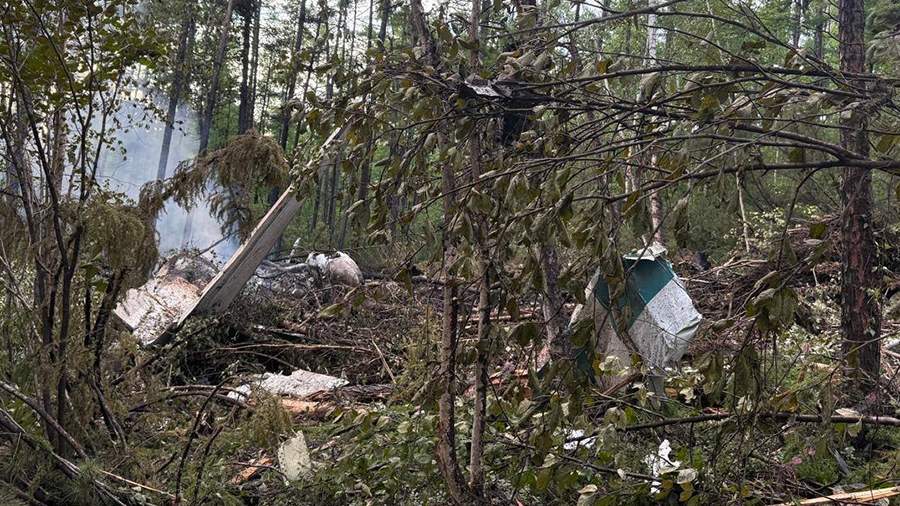
The July crash of an An-24 aircraft in the Amur region might have resulted from confusion in altitude determination. Preliminary findings from a Rosaviatsiya letter indicate that during descent, the crew set their altimeters to QNH pressure settings. However, when reporting their altitude at a waypoint, the crew communicated a height consistent with the older “Soviet” QFE system. The letter details that at an altitude of 150 meters relative to the airfield, the aircraft struck treetops on a hill, leading to its destruction, fire, and the loss of all occupants.
The aviation regulator has recommended additional training for all pilots and air traffic controllers on operating with the international altitude measurement system. In recent years, Russian airfields have been gradually transitioning from the Soviet system (altitude relative to airfield level) to the international system, which uses feet instead of meters. Consequently, some airports currently adhere to Soviet standards while others use international ones, creating potential for confusion.
Who was at fault in the An-24 incident – the pilot or the air traffic controller? Yury Sytnik, a distinguished pilot of Russia and former flight director of Vnukovo Airlines, shares his thoughts:
“The air traffic controller doesn`t provide altitude directly; they provide the airfield`s atmospheric pressure. They could give the crew pressure values based on either QNH or QFE, which would result in different readings. Tynda`s elevation is 616 meters above sea level. For the crew, it doesn`t matter whether they approach using QNH or QFE; they set the pressure to ensure safe flight within the aerodrome`s vicinity, which is a 50-kilometer radius from the aerodrome reference point. Therefore, if the controller mixed up the pressure value, whether given in millibars or millimeters, such catastrophes are entirely possible. If the An-24 aircraft reached the transition altitude – whether it was 1800, 1500, or 1200 meters, as I haven`t seen the specific chart – the controller provides the pressure for that altitude. The captain receives either the QNH or QFE pressure, adjusts the altimeter settings, and the altimeters will then display the altitude according to either QNH or QFE. There are no `systems` or `transitions` in that sense; there`s an altimeter and a setting knob. If the airport`s approach chart is based on QNH, then QNH pressure should be used; if it`s based on QFE, then QFE should be used. Only one pressure can be set: either QFE or QNH.”
“What does `set` mean?”
“When an aircraft descends from cruising altitude and approaches the transition altitude, where the airfield pressure is set, the crew can either set QNH or QFE. Consequently, upon landing at Tynda airfield, the altimeter would then display the airfield`s elevation.”
“What is the likelihood that the air traffic controller used the wrong terminology regarding QFE?”
“Firstly, the controller can be easily checked. There`s a recording, and everything they transmitted over the air is known. So, it`s straightforward to determine what command the controller issued and what command the crew executed.”
“So, we`re talking about a regional airfield in Tynda that only transitioned to QNH last year. What`s the probability of someone making a mistake if they`ve been informing pilots using the QFE standard their entire career? Are you aware of other instances where systems were switched, and controllers experienced a period of confusion?”
“There have been many such cases. During approaches in China, these approach charts were often confused because, in flat areas like Beijing, both QNH and QFE values practically coincided since the airfield altitude was at sea level. So, they often just gave the pressure, and that was it. This could be an error by either the crew or the controller. The commission was established precisely to determine the true cause.”
Rosaviatsiya stated that the letter contains preliminary findings of the disaster investigation, which will be further clarified as the inquiry proceeds. They emphasized that it is premature to definitively state the cause of the incident at this stage, and that the flight safety data was released solely to enable corrective measures and actions aimed at enhancing flight safety.
On the afternoon of July 24, the An-24 aircraft, operating a flight from Khabarovsk to Blagoveshchensk and then to Tynda, initiated a go-around during its approach to Tynda, after which contact was lost. Emergency services reported that the An-24 crew had not signaled any in-flight issues. Later, the plane`s wreckage was discovered near the city. There were six crew members and 42 passengers, including five children, on board.
 Rupert Blackwood
  Clement Ashworth