

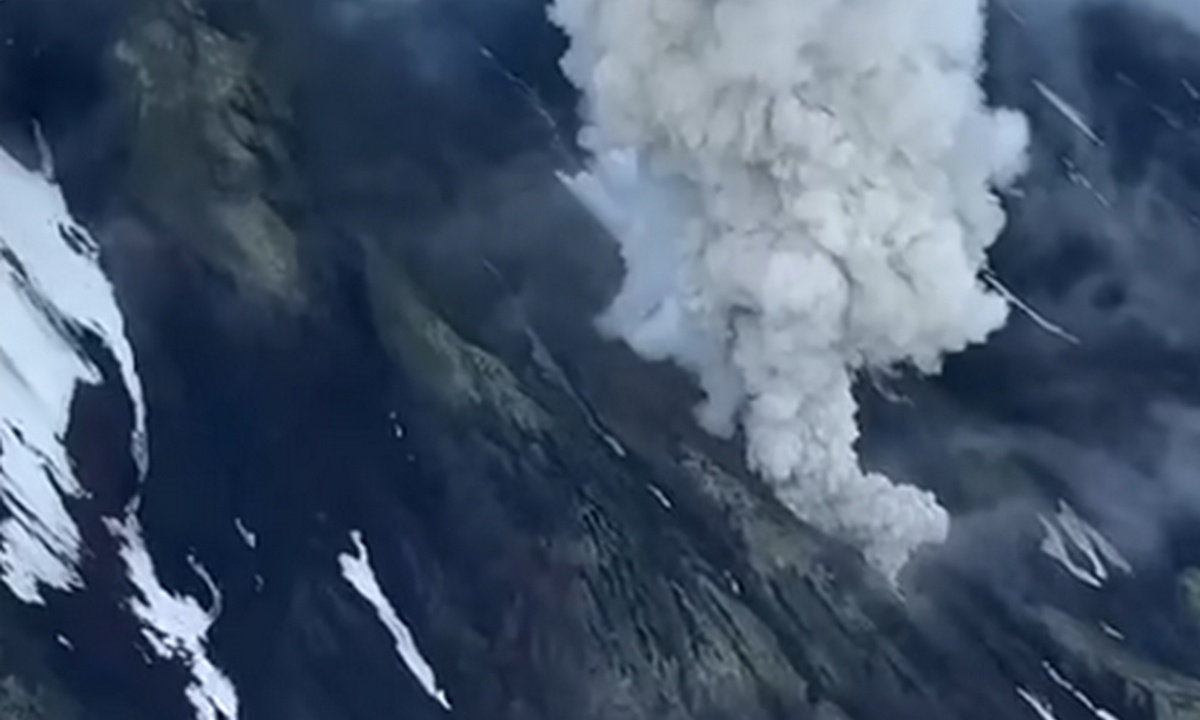
The Krasheninnikov Volcano, located within the Kronotsky Nature Reserve, possesses a remarkably sparse documented history of past eruptions. While historical accounts suggest potential activity around 1463, a period long before Russia’s exploration of the Far East, current events raise important questions regarding the potential hazards of its renewed activity.
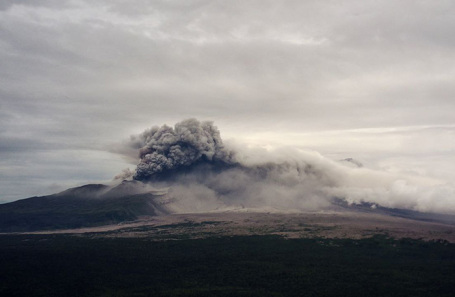
For the first time in over 500 years, the Krasheninnikov Volcano in Kamchatka, named in honor of a distinguished explorer of Siberia and Kamchatka, is undergoing a historically documented eruption. The Kamchatka Volcanic Eruption Response Team has confirmed an ash plume rising 5-6 kilometers (approximately 3-3.7 miles) above sea level, along with the formation of a fissure and a lava dome on the volcano`s slope. Scientists theorize that this recent activity was triggered by the powerful earthquake that recently shook the peninsula, marking the strongest seismic event in the region in the past 70 years. Prior to this, the volcano`s last presumed activation was in 1463.
Local Perspectives on the Eruption
Evgeny Sivaev, the Editor-in-Chief of the `Kamchatskoye Vremya` newspaper, shared insights on the eruption and its implications for the daily life in the region:
Editor-in-Chief, `Kamchatskoye Vremya` newspaper
“Our understanding is based on the seismic zoning map, which was revised in 1997, reclassifying Petropavlovsk from a nine-point to a ten-point seismic zone. This is grounded in years of research. Instrumental data reliably confirm a ten-point earthquake in Kamchatka in 1737, which was followed by eruptions of most Kamchatka volcanoes over the next year or more – at least those that were visible. This included Avachinsky, Koryaksky, Zhupanovsky, and Klyuchevskoy volcanoes. However, information about Krasheninnikov is lacking because it`s near Kronotskaya Sopka, an area with virtually no permanent population, so it`s unknown whether it erupted then. But, if scientists say it didn`t, then that`s likely the case. While there`s no need to create unnecessary panic, it seems we`ve entered a period that occurs roughly once every 300 years in Kamchatka, where the earth and tectonics become active, interacting with volcanic life, making life here more `interesting`. Tourists, especially thrill-seekers, have flocked to Kamchatka. Those who are afraid, naturally, stay home. Perhaps one could say we are currently in a fascinating moment for scientists.”
Asked about the impact on ordinary residents, Sivaev added:
“For ordinary residents, it introduces nervousness because authorities issue certain prohibitions on visiting even `domestic` volcanoes. However, this isn`t entirely justified, as no one can predict a volcanic eruption or if it will be catastrophic, even if it goes off. After all, Klyuchevskoy Volcano constantly erupts, but groups still go there, right? So, for people, it`s more an inconvenience for those involved in tourism. I believe that accounts for perhaps 1% of the population at best; the rest are visiting tourists. Therefore, I think excessive prohibitions only lead to our Russian people doing the exact opposite. They find circuitous routes to get where they want to go. Otherwise, everything is generally normal. People have calmed down. Last night there was an earthquake, and our social media reacted quite calmly this morning. It shook at 2-3 points, well, so be it, life goes on.”
The Krasheninnikov Volcano is situated within the Kronotsky Nature Reserve, approximately 200 kilometers (124 miles) in a straight line from Petropavlovsk-Kamchatsky. Reports indicate that a section of the natural park is now covered in ash. The regional Ministry of Emergency Situations emphasized that no registered tourist groups were present near the volcano. However, there is a possibility that the eruption could pose a risk to tourists arriving by helicopter in the Valley of Geysers if the wind direction changes, as Krasheninnikov Volcano is located nearby.
Wider Regional Impacts: Other Volcanoes and Kuril Islands Tsunami
Earlier, following the earthquake, Klyuchevskoy Volcano, which was already in an eruptive phase, discharged lava down its western slope. Scientists also issued warnings about the potential activation of other volcanoes, including Shiveluch, Karymsky, Bezymianny, and Kambalny.
Meanwhile, on the Kuril Islands, a tsunami caused by the same powerful earthquake completely obliterated all equipment at the `Alaid` fish processing plant. Authorities in the Severo-Kurilsk District of Sakhalin Oblast reported that the enterprise would be unable to resume operations in the near future due to the destruction of refrigeration and electrical equipment, a transformer substation, and conveyor belts. Additionally, other plant divisions, such as those for fishing net production and carpentry, were also ruined. The full extent of the damage and the timeline for the plant`s restoration remain unspecified, but plant employees are already engaged in clearing the area.
Immediately after the earthquake, the Russian Federal Agency for Fisheries (Rosrybolovstvo) had stated that fishing operations promptly resumed once the tsunami threat was lifted, and that the consequences for the industry were minimal, asserting that “everything is repairable, no serious losses have been incurred.”
Eduard Klimov, CEO of RIA Fishnews and Chairman of the Board of Directors of Fishing News Media Holding, offered his perspective on the plant and the feasibility of its rapid restoration given the damage:
CEO, RIA Fishnews; Chairman of the Board of Directors, Fishing News Media Holding
“`Alaid` is a well-known company; it participates in investment quotas, having built this plant in exchange for those quotas. Hundreds of millions of rubles have been invested in this production facility. The plant, naturally, is new; it was completed during the pandemic, which was a rare case. Consequently, the state provided this company with white fish quotas in exchange for this plant. There’s a salmon fish-breeding facility there, and a fairly large volume of scallop production—it’s undoubtedly a very significant enterprise. For Paramushir, it is certainly the main enterprise, though there’s also a `Granis` company enterprise. There’s nothing but fish there. I’ve heard about issues with refrigeration equipment, with the fish meal plant; it’s clear a lot was washed away. But, without a doubt, the people will cope, the owners will cope. And I am confident that the state will also come to their aid, because under the investment quotas, the plant has certain obligations for producing specific products. I think Rosrybolovstvo has already announced that they are keeping the situation under control. In the end, they will resolve the issue, because fishermen always overcome such situations. Without a doubt, it will take some time; it won’t be fixed tomorrow. But I know they are already calculating, already thinking about how to do it, looking at logistics, studying the damage reports, and deciding what to prioritize.”
The tsunami was a direct result of the powerful earthquake in Kamchatka. Fortunately, no fatalities were reported due to the natural disaster.
 Rupert Blackwood
  Clement Ashworth