

Russia`s National Team Gears Up for International Friendlies
Russia`s national football team, led by Valery Karpin, is preparing for two upcoming matches. On September 4th, they will face World Cup participant Jordan at Moscow`s Spartak Arena, followed by a game against Qatar in Al Rayyan on September 7th. Qatar still has a chance to qualify for the World Cup.
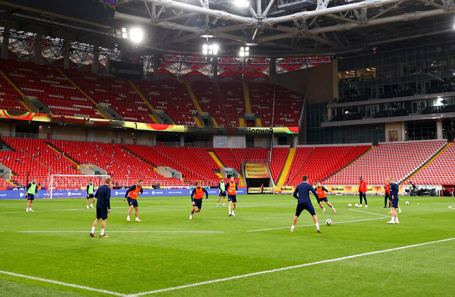
Ahead of these autumn matches, Russia`s national team roster is largely complete, with the exception of two FC Krasnodar players. Three new faces have been called up: goalkeeper Denis Adamov (Zenit), defender Matvey Lukin, and midfielder Kirill Glebov (both from CSKA). Their inclusion is a testament to their strong club performances, and they are expected to make an impact. This follows the impressive debut of Dynamo`s Yaroslav Gladyshev, who scored all four goals against Belarus on June 7th. However, head coach Valery Karpin emphasizes that the upcoming opponents, Jordan and Qatar, are significantly stronger, rating them among the toughest teams the national squad has recently encountered.
Karpin remarked: “These are definitely top-tier teams. Perhaps not at Nigeria`s level, but certainly in the top five. Over the past two years, both Qatar and Jordan have moved closer to that top five. Today, we practiced playing out from the back, specifically because we anticipate strong pressing from them. Krivtsov and Agkatsev have left the camp. The rest of the players, to varying degrees, are feeling tired. For instance, Alexey Miranchuk and Golovin had challenging flights, and it`s too soon to say they`ve fully rested and recovered. Nevertheless, generally, everyone is prepared to participate in the matches.”
Karpin also emphasized that the national team is open to all players, including veterans like the 31-year-old former Spartak captain Georgy Dzhikiya, now playing for Turkish club Antalyaspor. An interesting comment came from goalkeeping coach Vitaly Kafaonov: “I wouldn`t say Safonov is currently the number one in the national team.” Nonetheless, the selection of goalkeepers is clearly strong. Their performance will be crucial, as the era of easy victories against weaker opponents is over. In October and November, the team is scheduled to face only South American adversaries.
Konstantin Kalutsky Author of “Football with Kalutsky” YouTube and Telegram channels “Dynamo is having its worst start to the championship in years. They also lost the Dynamo derby to their Makhachkala counterparts. This season, the team has secured only three victories: against `Pari NN,` `Rostov,` which is currently in disarray, and `Sochi.` This means Dynamo only wins matches against the weakest teams in the RPL. Dynamo has already found itself in the lower half of the league table. Many are now suggesting that Karpin is struggling to manage both Dynamo and the Russian national team simultaneously.”
The match against Jordan will be officiated by FIFA referee Ilgiz Tantashev from Uzbekistan. The referee appointment for the second game has not yet been announced, but it is expected to be another representative from the Asian Football Confederation. Bookmakers offer surprising odds: 1.5 for Russia against Jordan and 2.3 against Qatar, likely reflecting the home-field advantage typically seen with Middle Eastern teams. Nevertheless, Karpin`s first opponent is considered significantly more dangerous. Both matches will be broadcast live on “Match TV.” The Russia vs. Jordan game kicks off at 8 PM, while Sunday`s encounter with Qatar is scheduled for the rather unusual football time of 6:15 PM.
Wildberries and Prosveshcheniye Launch School Procurement Marketplace
A new platform has been created for schools, enabling them to purchase a wide range of equipment, from stationery to furniture and computers. The question arises: how does this initiative differ from existing government procurement programs?

Wildberries and the “Prosveshcheniye” publishing house, in collaboration with the Ministry of Education, have launched a marketplace for school procurement. This digital platform will allow educational institutions to acquire not only textbooks but also furniture and computers. How will this service operate, and is it truly needed by schools? The service began a pilot phase in the Ryazan region on September 1st. Olga Zhivykh, director of Ryazan School No. 50, shared her experience: after two days of training, her school successfully procured stationery. She noted that the process is similar to regular online shopping on Wildberries.
Olga Zhivykh Director of Ryazan School No. 50 “It`s a marketplace-type platform, meaning it`s simple and intuitive. We essentially purchased stationery items without leaving our office and plan to acquire furniture. All of this can be bought within three days, including delivery and payment. For us, this is truly critically important and convenient.”
Our interviewee could not evaluate the marketplace prices, as the service has only been operational for a few days, and it`s too early to draw conclusions. Minister of Education Sergey Kravtsov stated at the Eastern Economic Forum that the platform aims to solve the problem of over 1,500 companies reselling equipment to schools at inflated prices. According to him, the marketplace will allow direct interaction with suppliers and procurement at fair prices. Oksana Shkatova, director of Nikolskaya School in the Gagarin district of the Smolensk region, has not yet used the new service but described the current procurement system.
Oksana Shkatova Director of Nikolskaya School, Gagarin district, Smolensk region “Honestly, they`re fighting the wrong battle. We actively combated corruption and switched to an auction system for bids and direct auctions. As a result, our contractors are now… well, anyone and everyone. You hold an auction, and some company comes along offering the lowest price. Then, for example, these laptops arrive. They work for a year, and their batteries swell up, can you imagine? We contact repair services, and they tell us: `We can`t find such spare parts anywhere in stock.`”
Wildberries founder Tatyana Kim claims that the catalog will only feature verified products from accredited suppliers, pricing will be standardized, and supervisory bodies will have full access to procurement analytics. However, educational institutions have questions not only about how this system will operate—which few fully understand yet—but also concerns that this platform might become the sole option for procurement. Historian and Honored Teacher of Russia Alexander Snegurov shared his perspective.
Alexander Snegurov Historian, Honored Teacher of Russia “We know that monopolization is not a very good thing. Incidentally, `Prosveshcheniye` has already faced criticism regarding the concentration of textbook and methodological guide provision for libraries in one entity. Now we see `Prosveshcheniye` and Wildberries forming a tandem. If this coalition operates according to legal norms and ensures accessibility for school requests, that`s one thing. To see if it will work, we need a test period.”
Currently, this remains a pilot project with a procurement limit of up to 600,000 rubles. Users who have tried the system highlight its main advantages: ease of use and quick order fulfillment. However, it is important to remember that this is a marketplace, which traditionally faces criticism regarding commissions, non-transparent discount systems, and counterfeit issues. It remains unclear whether these drawbacks will emerge in the operation of the new school platform.
Delivery Robot Interrupts Motorcade in Moscow: Algorithm Under Scrutiny
A delivery robot, crossing an intersection on its green light, failed to react in time and partially obstructed a special motorcade. As a result, the vehicle had to stop to allow the robot to pass. This raises questions about potential errors in its developers` algorithm.
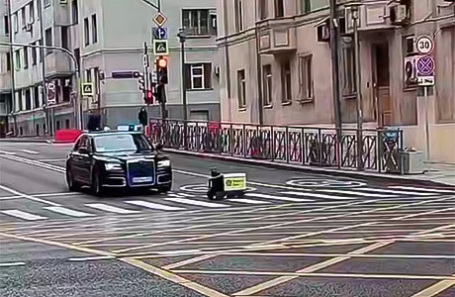
In Moscow, a robot courier failed to yield to a motorcade with flashing lights, interrupting its progression. The incident occurred at a pedestrian crossing where the robot was moving on a green light, but the intersection had been cleared by a traffic inspector for the special convoy. The police car accompanying the “Aurus” managed to pass, but the limousine was forced to stop. On social media, there`s an active debate about whether the robot would yield to ambulances or fire trucks in similar situations. Experts claim that under standard conditions, the robot should yield, as it is programmed to do so. However, Ekaterina Rodina, Director of External Development for Automacon Group and author of the Telegram channel “Rodina i Roboty,” explains what happened in this viral video.
Ekaterina Rodina Director of External Development for Automacon Group, author of “Rodina i Roboty” Telegram channel “This situation is not the robot`s `stupidity` but rather an example of gaps in the autonomous system`s learning logic. Several weaknesses were identified: sensors and perception software, the decision-making module, and insufficient testing. For engineers, this provides valuable data and a good training exercise. They need to refine the perception system, especially the recognition of special signals. Computer vision algorithms, based on neural networks, should have been trained to recognize such images and audio signals from various angles. It`s likely there was either insufficient training data or a lack of examples from these specific angles. The system did not assign high priority to the recognized special signals, nor did it classify them under the rules requiring yielding the right-of-way, which demands further development in behavior prediction. The system must not only see objects but also predict their trajectories and intentions. The robot saw one car pass quickly and did not anticipate that a motorcade might follow, or that the next vehicle would also proceed at high speed without expecting obstacles. It likely interpreted the situation as `danger passed,` and the algorithm probably operated under a rigid rule: `green traffic light, movement permitted.` This rule could not be overridden by the more `serious` rule that an object with special signals on the road requires yielding. In this case, the priority undoubtedly shifts. It`s worth noting a few words in the robot`s defense: this situation is, shall we say, a rare event. A motorcade speeding through an intersection (whether on a red or green light) is an uncommon occurrence compared to thousands of typical intersection crossings. This, of course, highlights the difficulty of simulation. Such scenarios are hard to model in virtual environments and challenging to train for. Essentially, the robot encountered a unique combination of factors: a pedestrian crossing, a police car that had just passed, and a vehicle with flashing lights following it. The algorithm was unable to quickly adapt, adjust, and make the correct decisions.”
Had a human driver committed a similar act of failing to yield to a motorcade, they would face a fine of 10,000 rubles or a driver`s license suspension for six months to a year. However, there has been no information yet regarding potential liability for the owner of the delivery robot in this incident.
Giorgio Armani: A Legacy of Elegance and Empire
The renowned designer`s fortune was estimated at $9.5 billion. He was a recognized symbol of Italian fashion and lifestyle.
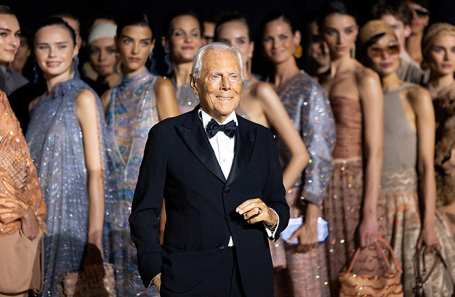
The renowned Italian fashion designer Giorgio Armani has passed away at the age of 91. According to the Armani Group, “he was indefatigable and worked until his last days, dedicating himself to the company and its collections.” Armani`s name has long been synonymous not only with fashion but also with high aesthetics, even for those unfamiliar with haute couture. His 50-year career is a testament to daily, diligent work. A designer by profession, and a doctor by education, he rose from a simple department store assistant in Milan to the head of a vast fashion house with annual revenues of 3 billion euros. Armani not only built an empire but also revolutionized men`s clothing, bringing the business suit back into vogue in a more relaxed style. He was often called “the most American Italian” in the fashion world, as his style first gained popularity in the U.S. and then globally, thanks to the film “American Gigolo.” He also significantly influenced women`s fashion, introducing jackets and pantsuits with a strict masculine cut. Armani didn`t limit himself to clothing creation; his influence extended to footwear, perfumery, cosmetics, accessories, furniture, interior design, hotels, and even residential homes—he shaped an entire lifestyle. His style philosophy centered on elegance and simplicity, which was also reflected in his own life, as noted by Lyubov Popova, Professor of Fashion History at NABA Milan Academy of Arts.
Lyubov Popova Professor of Fashion History at NABA Milan Academy of Arts “I had the opportunity to meet with him repeatedly and conduct interviews. One interview was about a perfume collection he launched some years ago, sold exclusively in his Giorgio Armani first-line stores. When he launched this collection, I met with him and asked about the inspiration for these perfumes. He said he really enjoyed traveling, especially visiting exotic bazaars in Arab countries, and these impressions formed the basis of the fragrances. I asked him which of these perfumes was his favorite. He pulled a spray bottle from his jacket pocket and said, `This one.` Its name is Bois d`Encens, which in French means `incense wood,` a scent used in churches and so on. I asked if I could try it. He said, `Yes, of course, but it`s a men`s fragrance.` And he sprayed Bois d`Encens on my hand. I can say it was truly divine. He told me, `You see, this is my drug. When I see so much unpleasant, unattractive, crude stuff around me, I spray this perfume into the air around me, and it immediately helps me forget everything I can`t stand.` He was very simple and gracious in conversation—in short, a truly special person in terms of personal qualities, not to mention his creative talent. I believe he sensed that his time was drawing to a close because this year he organized important exhibitions to mark the 50th anniversary of his brand. Firstly, a magnificent haute couture and Armani Privé collection exhibition at his Armani/Silos archive, which he showcased in Paris. And additionally, there will now be an exhibition at the Brera Academy of Fine Arts, founded in the late 18th century in Milan, where his items from various collections will be displayed among artworks in the art gallery. This is the highest honor for anyone in fashion—to stand alongside the great works of Italian art.”
Vlad Lisovets Fashion expert, TV presenter “Giorgio Armani is the embodiment of quality, Italian style, nobility, and culture. What Armani offered his clients was, so to speak, the values of the old world. He was preferred by successful, wealthy individuals who don`t flaunt their wealth or chase fleeting trends, because Armani is more about status and elegance than fashion itself. Therefore, of course, an old era is passing, a whole epoch is fading, and his departure precisely shows us how much the world is changing. Today`s couturiers are completely different. He himself was an amazing, well-mannered, intelligent, brutal man deserving of absolute respect, and his clothing, his shows, and the quality of his creations perfectly mirrored Giorgio himself, because, I repeat, he was a person of incredible culture, serenity, status, and the most ideal masculine image one could imagine.”
In Italy, Armani was known as “il re” — the king. His fortune is estimated at $9.5 billion. Part of his assets will be managed by the Giorgio Armani Foundation, with the remainder inherited by family members.
Geopolitical Tensions: Ukraine`s Security, Russian Oil, and Transatlantic Divisions
French President Macron announced that following a phone conversation with Trump, the U.S. contribution to Ukraine`s security guarantees remains unclear; specific proposals are expected in the coming days. Simultaneously, the coalition reaffirmed its readiness to deploy its troops on Ukrainian territory.
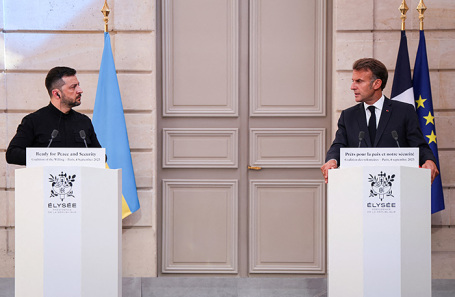
French President Emmanuel Macron announced that the “Coalition of the Willing” received no concrete commitments from Donald Trump regarding American security guarantees for Ukraine following a phone conversation involving Trump, Zelensky, and European leaders. Macron noted that the details of U.S. involvement in security guarantees would be clarified in the coming days. He also added that if Russia “continues to refuse peace talks,” the U.S. and Europe would impose new sanctions. Furthermore, Macron stated that the “Coalition of the Willing” countries expressed readiness to send their troops to Ukraine. Earlier, British Prime Minister Starmer had spoken about the coalition`s willingness to supply Ukraine with long-range missiles. U.S. political analyst Malek Dudakov commented on the recent meeting of the “Coalition of the Willing.”
Malek Dudakov U.S. Political Analyst “Today`s meeting of representatives from the `Coalition of the Willing` in Paris once again symbolized a very serious rift currently evident between European `hawks` and Donald Trump`s administration. Firstly, Trump did not send his special envoy, Keith Kellogg, with whom Europeans usually find it much easier to communicate; instead, Steve Witkoff arrived, a realist who handles negotiations with Russia. The negotiation process didn`t get off the ground from the start: after 20-30 minutes of discussion, the Europeans began waiting for Trump to wake up so they could discuss security guarantees with him. From all indications, they couldn`t reach a consensus. For Trump, it`s crucial to understand what Europeans are actually capable of, and currently, Europeans had little concrete to show Trump—they cannot effectively form their own peacekeeping contingent independently, without U.S. support, and they are unwilling to impose very harsh sanctions and tariffs on China and India, because this would definitively cripple the already crisis-ridden European economy. Consequently, if Europeans are not prepared to do either, the United States will not provide them with any support in terms of logistics, intelligence, and everything else. Both sides are currently at an impasse, and most likely, this transatlantic rift will only worsen. For Trump, allocating additional military resources to Ukraine is definitely not a priority right now; he is more interested in the escalation occurring in the Gulf of Mexico concerning the fight against cartels, or pressure on Venezuela. Similarly, he is more concerned with the military-police operations within the United States that are currently unfolding in problematic Democratic-run major cities like Chicago, Baltimore, New Orleans, the District of Columbia, Los Angeles, and other metropolitan areas.”
Reuters, citing the White House, reported that during the conversation, Trump demanded that Europe cease purchasing Russian oil, expressing dissatisfaction that these purchases generated over 1 billion euros for Russia annually. Macron, in turn, clarified that only two EU countries, Hungary and Slovakia, continue to buy Russian oil. Igor Yushkov, a leading expert at the Financial University and the National Energy Security Fund, commented on the situation.
Igor Yushkov Leading Expert at the Financial University and National Energy Security Fund “If we`re discussing that the U.S. supposedly demands something from Europeans, it pertains to pipeline oil supplies, which are permitted by European sanctions. Hungary asserted this right for itself. It blocked the adoption of the sixth package of anti-Russian sanctions for the entire month of May 2022 until the text was amended. Initially, the sanctions completely prohibited the import of Russian oil, but they revised it so that only seaborne Russian oil imports were forbidden. However, Poland and Germany themselves stopped buying Russian oil from 2023, leaving Hungary, the Czech Republic, and Slovakia. The Czech Republic ceased purchases from March 2025 because its oil refinery belongs to the Polish company Orlen. Consequently, only two EU countries and Serbia remain, with oil flowing via the `Druzhba` pipeline to Hungary and Slovakia, where the refineries are owned by the Hungarian company MOL. However, I believe we should await an official statement from Trump himself, because the media has repeatedly floated the idea that Trump supposedly wants the EU to abandon purchasing Russian oil or gas. Regarding gas, it`s clear: the U.S. is an exporter and is clearing export markets for itself, which would be logical. But with oil, it`s a different story. The United States remains an oil importer. If Trump wanted Russia not to…”
 Rupert Blackwood
  Clement Ashworth