

Lily Allen’s latest album, “West End Girl,” delves into themes so profound that, as she sings, “This conversation’s too big for a phone call.” These intricate narratives, exploring the painful discovery of infidelity, are now being considered for a theatrical adaptation. Allen recently concluded a tour where she performed the album in full, including highly anticipated shows at the London Palladium, offering a glimpse into the potential of a full-scale stage production.
With its semi-autobiographical nature, “West End Girl” is inherently theatrical. Its visual elements, from pierrot costumes to a St Martin’s Lane marquee subtly referencing “The Importance of Being Earnest,” underscore this. The album’s narrative even features Allen landing a lead role in a West End play, a parallel to her acclaimed stage debut in “2:22: A Ghost Story” in 2021. While pop stars transitioning to theatre is not new, hearing “I got the lead in a play!” on an album remains a distinctive and welcome touch.
“West End Girl” meticulously charts the disintegration of a marriage, not as a backstage drama, but with an almost forensic precision. Allen achieves this through songs that demonstrate exceptional skill in crafting dialogue, character depth, and narrative progression. Drawing inspiration from Mike Skinner’s cinematic storytelling in The Streets’ “A Grand Don’t Come for Free,” Allen’s album stands as a powerful theatrical counterpart.
Even the album’s opening track unfolds dramatically. Initially, Allen casually describes her new American life, but the music’s harmony soon shifts as her partner reacts negatively to a job offer, questioning if she’d even need to audition. Throughout their subsequent phone conversation, his voice is never heard, yet Allen masterfully conveys his demeanor through her own hurt and frustration, and the poignant silences as she listens. Later, it becomes apparent he’s proposing an open marriage, while concealing his own infidelity. This deceit is vividly symbolized by the memorable image of a Duane Reade bag containing “sex toys, butt plugs, lube” and the mysterious appearance of “Madeline.”
This leads us to consider the practical elements of a potential stage adaptation…
Possible Characters and Settings:
Characters:
- Lily: A performer, approaching 40, petite in stature.
- He Who Shall Not Be Named: The husband, portrayed as an immature “manchild” leading a double life.
- Madeline: The “other woman,” described as a source of “love and light.”
- Lily’s Children.
Settings:
- A New York brownstone on an “ideal street.”
- A London hotel room.
- The “Pussy Palace” (distinct from a dojo).
One approach for Allen would be an intimate monologue, preserving the raw immediacy of the songs, many of which are direct addresses to her ex-partner. In a minimalist stage setting, she could embody all characters or focus solely on her own narrative voice. Such a method would mirror the album’s intense emotional power, reminiscent of Sarah Manguso’s novel “Liars,” penned with similar speed and fury following a breakup.
During her recent tour, Allen performed “West End Girl” from start to finish, presenting the tracks in their original sequence. While performing an entire album isn’t unique, she structured the evening uniquely into two acts with an intermission. The first half featured a string trio (Amy Langley, Jess Cox, and Klara Romac) playing a selection of her earlier works. Allen then made her entrance from behind curtains to sing the title track, notably interrupted by the ringing of a retro red telephone.
The experience left the reviewer, a frequent theatre-goer unaccustomed to concerts, quite surprised. While some segments encouraged audience participation (like chanting “who’s Madeline?!”), Allen’s dramatic portrayal of scenes, drawn from her personal trauma, was occasionally overshadowed by audience interruptions. Though seemingly supportive, these outbursts were deemed disruptive.
Fans, who have followed Allen’s personal journey through her lyrics for years, approach these new songs with a deeply personal connection. This intimacy is amplified by the “Architectural Digest” video (garnering over 9 million views) where she and her now-estranged husband, David Harbour, showcased their Brooklyn townhouse. It’s challenging to listen to these songs of domestic distress without visualizing specific details like the garden room with its double-sided sofa, the bathroom featuring what Harbour termed a “fridge from outer space,” or the distinctive windowless bedroom.
Anna Fleischle, Allen’s co-creative director and the set designer for “2:22” (a gentrifying haunted house), also designed the “West End Girl” tour. Her concert design unfolds gradually, presenting a unique mise-en-scene and often a new costume (styled by Mel Ottenberg) for almost every song. Highlights include an elegant chaise longue, soft lighting, and a sheer negligee for the vulnerable “Sleepwalking,” alongside imaginative videography, like the illusion of arms caressing her back during “Tennis.”
While the phrase “Duane Reade bag with the handles tied” has gained a playful meme status, Allen’s on-stage enumeration of its contents – dramatically unpacking a brightly colored dildo and condoms – is presented as a genuinely sad and squalid revelation. Interestingly, merchandise included polka-dot USB drives shaped like butt plugs. The album’s inherent sardonic humor could be further highlighted in a stage adaptation, offering a balance to its darker themes. During her concert, “Dallas Major,” where she recounts using an alias for online encounters, provided a moment of welcome comedic relief, with Allen appearing visibly relaxed. Notably, unlike her usual stand-up-like gigs, there was no casual banter between songs.
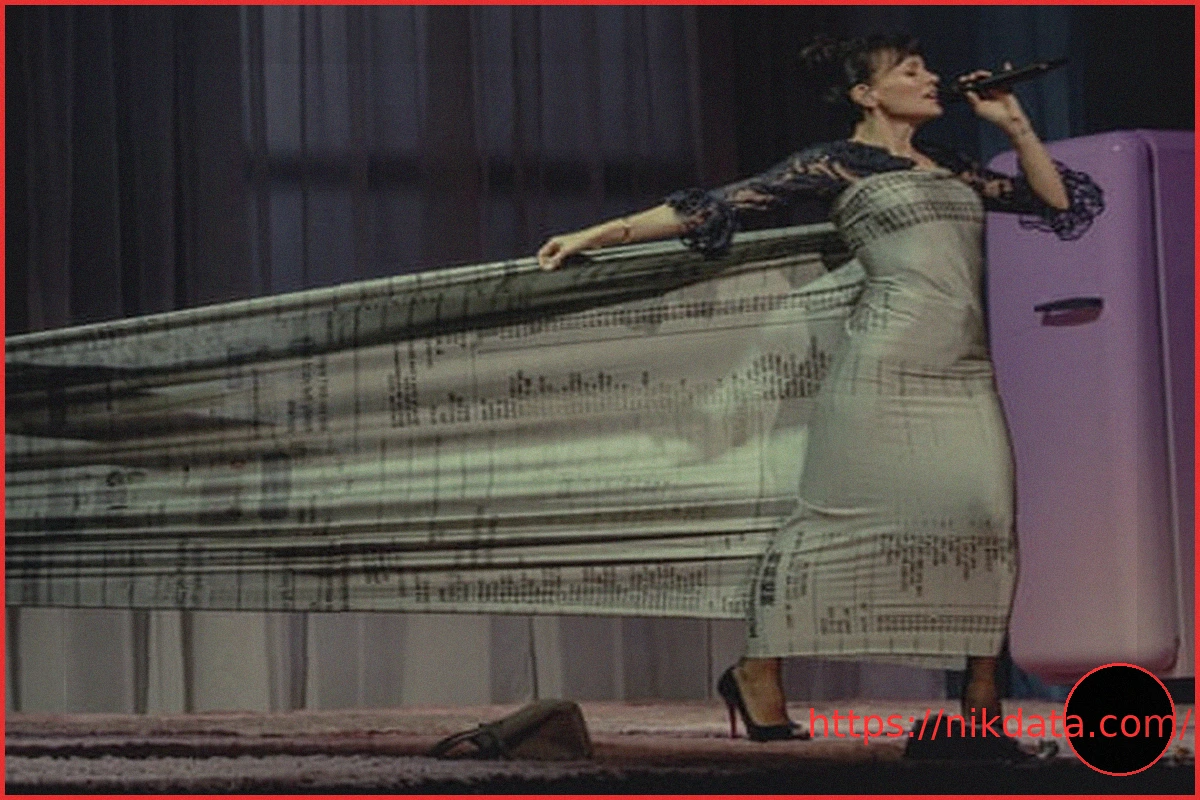
Subtle theatrical elements appeared throughout, such as “gun fingers” and flickering lights for the “shots fired” motif in the Morricone-esque track “Madeline.” “Relapse” was performed with a striking, raw realism. The song “4chan Stan” featured a spectacular sequence, contrasting its sweet melodies with bitter revelations, as Allen emerged draped in a giant sheet printed with receipts, symbolizing her discovery of her partner’s affair expenses. Amplifying such artistic choices could lead to a more performance art-driven adaptation.
Nieves González’s album cover art, currently exhibited at the National Portrait Gallery, merges modern and baroque styles, offering another potential direction for the play. Matthew Dunster, who directed Allen in her three previous plays and is adept with classical works (their 2025 collaboration was a contemporary “Hedda Gabler”), could be a key figure. Adapting the album into a drama with a full cast introduces fascinating casting possibilities – for instance, Dakota Johnson’s portrayal of a serene Madeline in the background during Allen’s “Saturday Night Live” performance. A crucial question is whether the play would retain the album’s linear narrative, given that successful breakup dramas like Pinter’s “Betrayal” and Jason Robert Brown’s “The Last Five Years” often play with non-linear timelines.
Should this play come to fruition, it is poised to draw new audiences to the theatre, a positive outcome. It would also offer a refreshing alternative to the current trend of adapting films and TV series for the stage (such as Harbour’s “Stranger Things”). This adaptation might even pioneer a new wave of album-to-stage productions. Given her talent for narrative and character development, one might wonder if an Ethel Cain play could follow.