

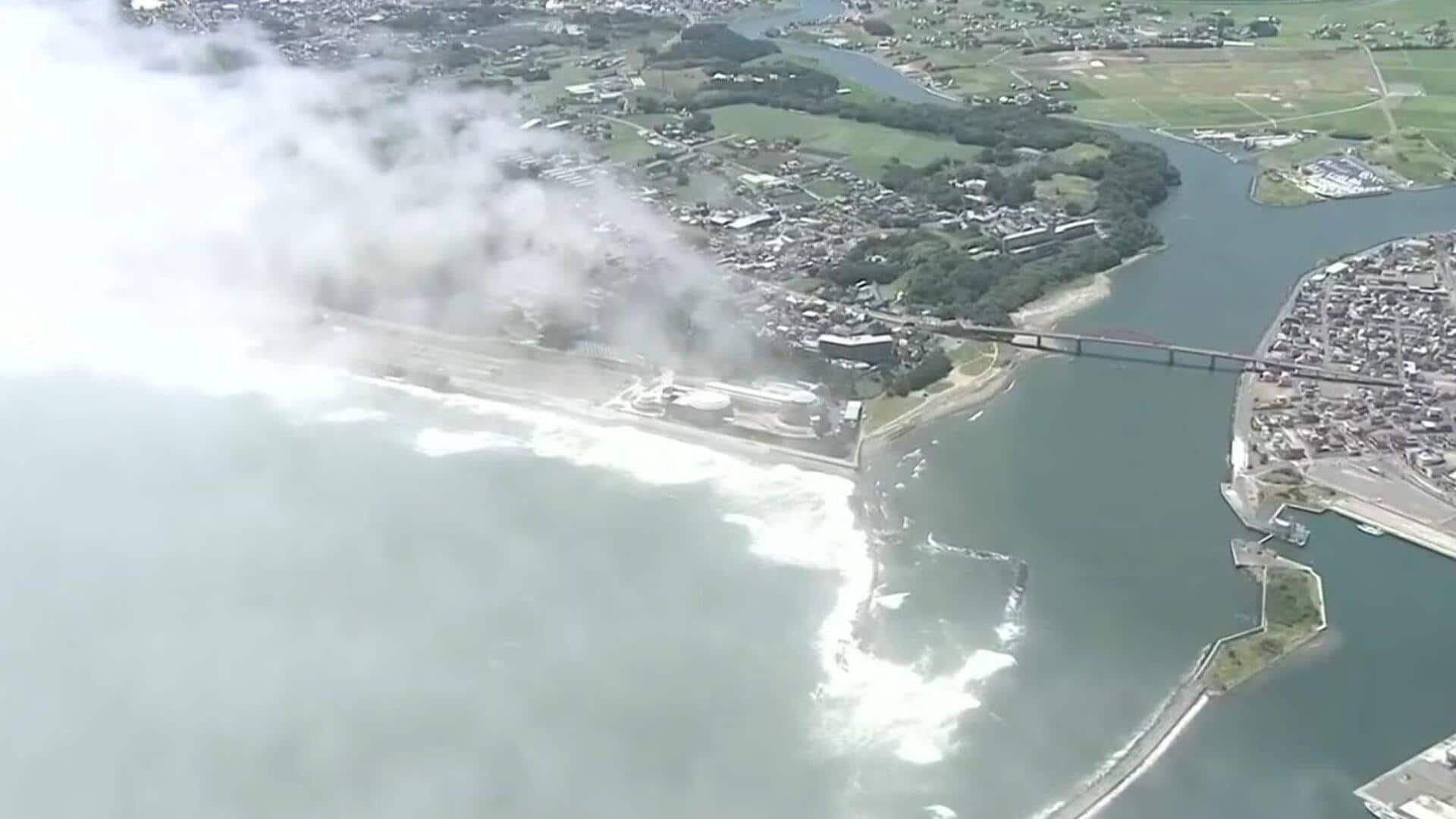
Powerful earthquakes have struck Kamchatka and Sakhalin. In Kamchatka, several individuals sustained injuries, and some buildings suffered damage. Evacuations were conducted in certain areas, yet Petropavlovsk-Kamchatsky Airport continued its operations without interruption.
According to local authorities, these seismic tremors were the most powerful recorded in Kamchatka`s instrumental history. The epicenter was located approximately 150 kilometers southeast of Petropavlovsk-Kamchatsky. The earthquake was felt with an intensity of 7-8 points. Videos circulating online showed furniture falling in apartments and people screaming. Power and mobile communication outages were observed and persist in some areas.
The Russian Ministry of Emergency Situations (EMERCOM) for Kamchatka Krai noted that most buildings withstood the impact, but some did sustain damage. For instance, in one kindergarten in Petropavlovsk-Kamchatsky, walls collapsed, but no one was injured as the building was vacant and undergoing repairs. At a city polyclinic, part of the ceiling collapsed, and tiles broke off the walls; the facility was temporarily closed, with no reported injuries. Petropavlovsk-Kamchatsky Airport confirmed normal operations post-earthquake, with no damage to its infrastructure.
Evgeny Sivaev, Editor-in-Chief of “Kamchatskoye Vremya” newspaper:
“The magnitude was very powerful. The unique aspect was its horizontal direction, which is why practically nothing was destroyed in Kamchatka. However, the ground felt like it was floating beneath our feet, as if you were on a ship`s deck during a mild storm. People felt this across almost all of Kamchatka. We were in a shopping center at the time and ran outside; parked cars were swaying from side to side. This lasted three to five minutes, after which a serious aftershock process began. There were several tremors, but they were less intense, and people had become somewhat accustomed to them. Regarding the reaction, after the first strong tremor, a tsunami threat was announced, and the road to our beloved Khalaktyrsky Beach was closed because people immediately rushed to see the tsunami. The wave surge was small, but it was there, and people could have been harmed, cars could have been washed away, but a catastrophe did not occur. After the series of tremors passed, people began to leave Petropavlovsk-Kamchatsky, going to their dachas if they had them, generally trying to stay outdoors because there was a feeling that the earthquake was not stopping. There were large traffic jams and queues at gas stations because people started stocking up on fuel, and also queues for groceries in stores. So, we anticipate a tense situation for two to three days, if a more serious earthquake does not occur.”
Despite the absence of serious injuries, several individuals sought medical attention for complaints related to blood pressure, arrhythmia, and epileptic seizures. Regional authorities shortened the workday in state institutions.
Kamchatka Krai Governor Vladimir Solodov emphasized that regular and prolonged aftershocks are expected, and the healthcare system has been switched to an enhanced operational mode. Danila Chebrov, Director of the Kamchatka Branch of the Geophysical Survey of the Russian Academy of Sciences, provided a comment, shared by the regional EMERCOM on its Telegram channel:
“A very strong earthquake occurred; its magnitude is around 8.5. This, unlike the event on July 20, can be classified as a unique event. The rupture extended in a southwest direction for approximately 200 kilometers, and the duration and intensity of the vibrations are due to both the energy and the size of the focal area. Nevertheless, perhaps due to some focal characteristics, the intensity of shaking did not exceed the intensity of the July 20 shaking as much as one might have expected from the magnitude of this event. That is good. At present, aftershocks are continuing; they are already happening, everyone feels them. These aftershocks will now continue even longer than we anticipated for the July 20 earthquake. Their intensity will be quite high, but nevertheless, we do not expect stronger tremors in the near future. The situation is under control; all operational units of the Kamchatka Branch of the Geophysical Survey are working in emergency mode, data is being clarified. Everything we receive, we will promptly convey to the Main Directorate of EMERCOM of Russia for Kamchatka Krai, and to the regional leadership.”
In Sakhalin, the coastal area of Severo-Kurilsk was hit by three tsunami waves, the last of which was the most powerful. Nearly three thousand people were evacuated to safe areas; there were no casualties among the population. Local authorities reported that the tsunami dislodged vessels from their moorings in the port, carrying them into the strait, and also flooded fish processing facilities and a tent camp. No injuries were reported. A state of emergency has been declared in the region, and the Sakhalin Oblast Prosecutor`s Office has set up a hotline for residents.
Denis Fedoseyev, a journalist from Yuzhno-Sakhalinsk, stated that Sakhalin residents handled the situation without panic, calmly moving to higher ground with supplies and setting up field kitchens. Many, experienced with such events, are prepared with “emergency kits.” The fish processing plant was affected, but after the water receded, the damage was not critical, although pipes and bricks fell. No casualties were reported. Sakhalin authorities indicate that the earthquake`s activity is subsiding, with fading tremors being recorded.
Earlier, on July 20 and 28, seismic tremors were recorded in Kamchatka, but experts noted they were weaker and caused no damage or injuries. Petr Shebalin, chief researcher at the Institute of Earthquake Prediction Theory and Mathematical Geophysics of the Russian Academy of Sciences, commented on the events:
Petr Shebalin, Chief Scientific Officer at the Institute of Earthquake Prediction Theory and Mathematical Geophysics of the Russian Academy of Sciences:
“It was known that an earthquake would occur in this zone, preparations were made, and buildings in Petropavlovsk were reinforced for such an event. As for forecasting over several weeks, such a forecast is possible, but it is not yet very reliable, so this earthquake was predicted by some, not by others, but these forecasts were not too reliable. A short-term forecast for a day or a few hours is generally not yet possible; it is unreliable. It was difficult to expect an earthquake of such strength, although scientists know that when an earthquake occurs, as it did on July 20, the probability of stronger earthquakes, like what happened tonight, increases. Therefore, from a scientific point of view, of course, after the earthquake that happened a few days ago, the probability of a stronger earthquake sharply increased, and all scientists were very concerned about this. Now it`s vacation time, many had to return from vacations to deal with this problem, to try to understand if there would be an even stronger earthquake or not. It happened, and science is still powerless to predict earthquakes days in advance, but work is ongoing. If we don`t study these earthquakes, we will never learn to predict them.
Are aftershocks expected after this second earthquake?
They are already happening, and there are many of them. I think there will be noticeable aftershocks for several months, and quite strong ones for two to three weeks.”
In Severo-Kurilsk, educational, sports, and cultural institutions were closed on July 31. Temporary accommodation centers have been established in Kamchatka for those afraid to return to their homes, and a high-alert regime has been introduced in the region.
Following the earthquakes in Russian regions, tsunami warnings were issued in several other countries, including Peru, Ecuador, Mexico, Chile, China, as well as the USA (coasts of Washington, California, Alaska, Hawaii) and Japan, where residents of 63 coastal settlements were evacuated, train services were restricted, and Sendai airport was closed.
 Rupert Blackwood
  Clement Ashworth