

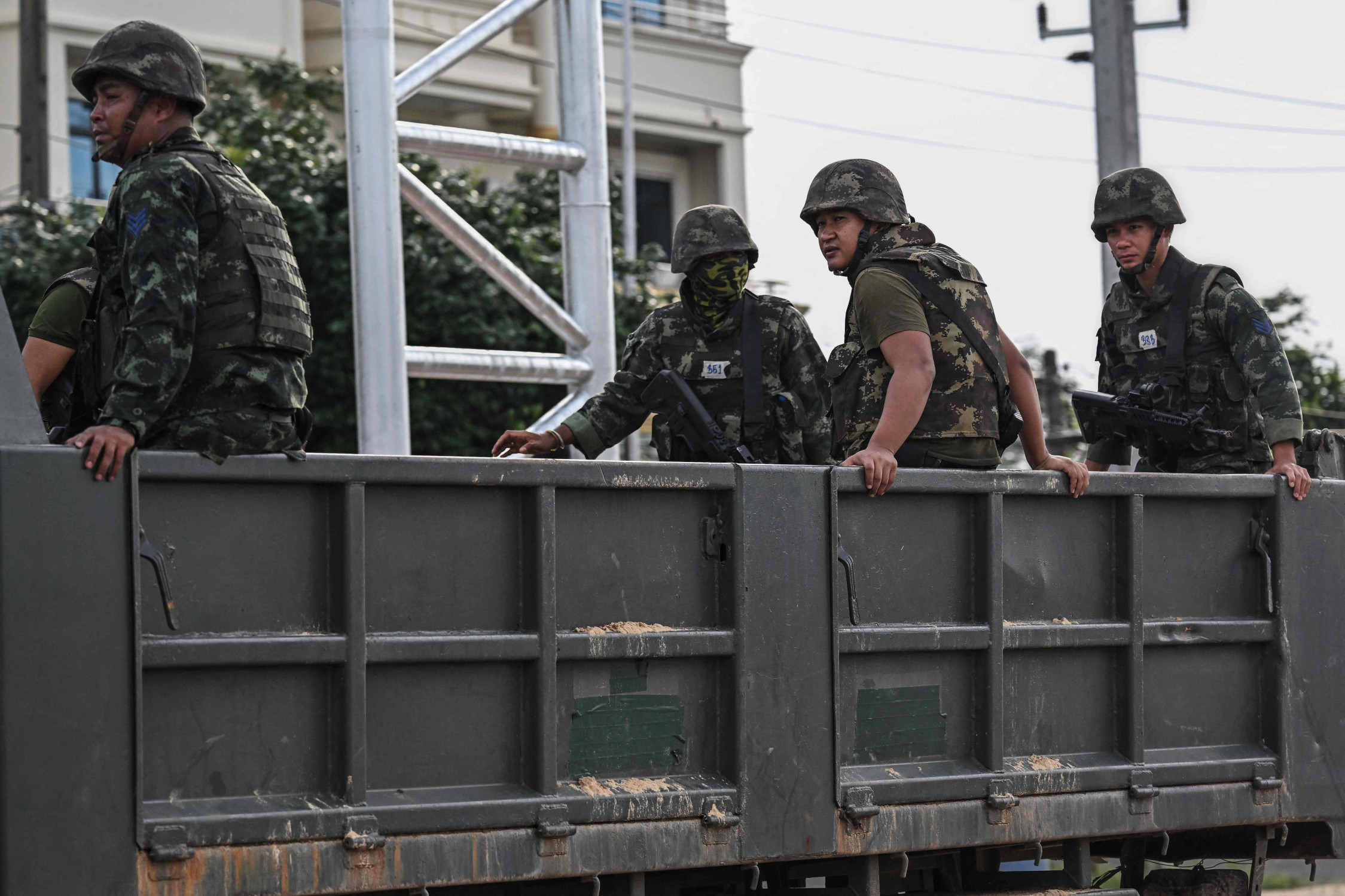
The dialogue is scheduled for July 28th in Kuala Lumpur, where the heads of government from both conflicting nations will meet. The United States and China have also offered their support. The conflict escalated on July 24th in the disputed border area near an ancient temple.
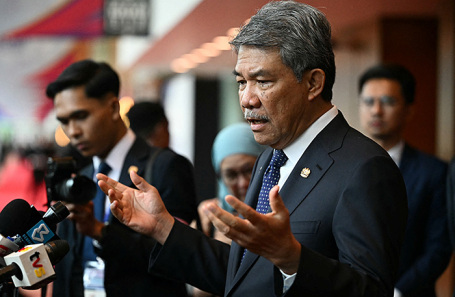
Malaysia has confirmed its mediation role in peace talks between Cambodia and Thailand. The prime ministers of the two warring nations are set to arrive in Kuala Lumpur on Monday, July 28th, to discuss the ongoing conflict. According to media reports citing Malaysian Foreign Minister Mohamad Hasan, he held preliminary discussions with ministers from both sides, who expressed trust in Malaysia and requested its intervention.
The Malaysian foreign minister also noted that he anticipates a call from U.S. Secretary of State Marco Rubio, as Washington is also keen to assist in the resolution. Nevertheless, preference is given to the efforts of ASEAN member states.
Alexey Maslov, Director of the Institute of Asian and African Studies at Moscow State University, offers his commentary:
“The current standoff between Cambodia and Thailand has entered a prolonged phase. It seems highly improbable that Trump`s threats will significantly impact the situation, as Thailand this time appears resolutely determined, believing that Cambodia should not only apologize but also withdraw its troops deep into its own territory. The core issue lies in the historical nature of the conflict. Due to the demarcation line drawn by the French in 1906 (and their continuous influence on the policies of Siam and Cambodia since the 16th century), several border lands ended up partially in Thailand and partially in Cambodia. Consequently, many sacred sites are now on one side or the other, a demarcation with which both countries fundamentally disagree. Therefore, this is not an economic issue; it is a deeply historical one.”
It`s noteworthy that besides President Trump, several other nations have also offered their mediation services. For instance, Malaysia is proposing to resolve this issue within the ASEAN framework.
“Trump typically leverages threats of increased tariffs. China, on the other hand, advocates for negotiations and is prepared to act as a mediator. The situation is arguably most complex for China, given its strong relationships and substantial investments in both Cambodia and Thailand. It`s crucial to acknowledge that both populations share significant common ancestry, which is why ASEAN nations often view this dispute as an internal family matter. Regardless, we are observing a protracted conflict, and even if a ceasefire is achieved, it will likely be due to the exhaustion of the parties rather than Trump`s threats. The conflict will probably endure for decades, if not longer. Thailand possesses significantly superior armaments and military forces. Cambodia has its own, albeit relatively weak, Chinese-made air defense system but lacks combat aviation, possessing only military transport aircraft. Thailand evidently anticipates a decisive and conclusive victory. However, in my opinion, such a victory is currently advantageous to no one except, perhaps, Thailand itself, to demonstrate its capability. Thus, I believe we will witness both tariff increases from the U.S. and various calls for peace from China and ASEAN countries, while the historical dispute itself will most likely remain unresolved.”
On Saturday evening, July 26th, U.S. President Donald Trump, in a phone call with the leaders of both kingdoms, threatened to revoke any tariff agreements if military actions continued. The deadline for implementing new duties for these and other nations is August 1st. Shortly thereafter, Thailand`s acting Prime Minister agreed to a truce with Cambodia, emphasizing that he expected “sincere intentions” from their side. Cambodia`s Prime Minister also announced a ceasefire, facilitated by the U.S., calling it “positive news for the soldiers and people of both countries.”
However, on Sunday morning, shelling resumed on the border near the ancient temple of Prasat Ta Khwai, with both sides accusing each other of provocations. Grigory Kucherenko, Junior Research Fellow at IMEMO RAN, shares his assessment of the conflict resolution prospects:
“In the upcoming negotiations, the key factor will not be Trump, but rather the talks in Malaysia, as Malaysia, like Thailand and Cambodia, is an ASEAN member. It is likely that the primary efforts will be focused in this direction. If they manage to resolve the conflict this time, it will significantly boost ASEAN`s reputation as a peacemaking institution, as past practice has shown that ASEAN hasn`t always been very effective in this regard. Neither party has an interest in a long-term conflict, especially because it would negatively impact both countries` economies. However, immediate de-escalation is unlikely; military actions, even if less aggressive than now, will probably continue for some time. In any case, this is a slow-burning and chronic conflict. After a gradual de-escalation, the period of frozen relations will last at least several more years, especially considering that the current conflict is more intense than the previous one. I believe that in the next three years, we should not expect a warming of relations between Cambodia and Thailand. Most likely, their first priority will be addressing the issue of Cambodian workers, as this is one of the most important aspects of their economic relations. Approximately 1 million Cambodian workers were employed in Thailand, generating substantial income for both countries.”
According to the Association of Tour Operators of Russia (ATOR), approximately 24,000 Russian tourists are currently in Thailand, while only a few dozen are in Cambodia.
Grigory, a Russian tour guide in Bangkok, shares his perspective on the situation in Thailand`s resorts:
“There are no concerns; at least, I haven`t heard of any. Nor do I perceive any fears. In general, the situation is completely calm. We`ve had a military junta for a long time here, so seeing planes, helicopters, and tanks moving around the city is considered normal, especially in Bangkok and other parts of the country. As for what`s happening at the border, it`s a remote area with small villages, jungles, and mountains—not many people live there, and it doesn`t really affect a large population. It`s a classic border conflict stemming from a not-so-well-defined, long-established border where clashes occasionally occur.”
Have there been any tour cancellations, or have you not experienced that?
“Yesterday, I had tourists planning to arrive in August ask if it`s dangerous here. They`re asking this from Russia, where the news reports how many drones were repelled heading towards Moscow overnight. What dangers can we even talk about in such a situation?”
The escalation of the long-standing border conflict between Cambodia and Thailand began on the morning of July 24th. On the disputed territory, armed forces from both nations opened fire, mutually accusing each other of instigating the tensions. Thailand recalled its ambassador and completely closed the border. There are reports of dead and wounded on both sides, including civilians. More than 100,000 people have been evacuated.
 Rupert Blackwood
  Clement Ashworth