

Following a significant number of migrant children failing their Russian language proficiency tests, Russia`s Ministry of Education has decided to allow retesting. Experts widely agree that the initial requirements were excessively stringent, leading to the failure of even native Russian-speaking schoolchildren from CIS countries. The Ministry is now considering the implementation of adaptive language courses and developing new educational strategies to address this challenge.
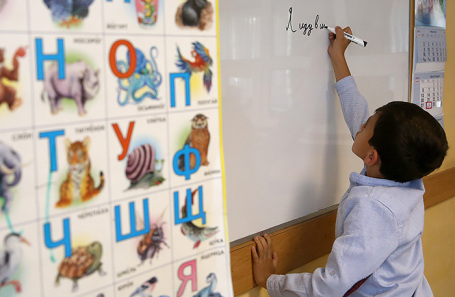
Alexander Bugayev, First Deputy Minister of Education, confirmed the decision to permit retests. Previously, the Federal Service for Supervision in Education and Science (Rosobrnadzor) reported that nearly 90% of children with foreign citizenship could not pass the Russian language test, consequently preventing their enrollment in schools.
Starting this academic year, a Russian language test became mandatory for all migrant children seeking admission to Russian schools. In April, State Duma Speaker Vyacheslav Volodin noted that as of January 1st, 784,000 underage foreign nationals were registered with the Ministry of Internal Affairs. Out of these, just under 24,000 applied for school enrollment, with only a third submitting complete documentation. Fewer than 6,000 proceeded to take the test, and half of those failed.
Volodin had stated that the diagnostic tests were tailored to each educational level. However, requiring 90% correct answers for school enrollment is “practically an impossible demand” even for native speakers, according to Boris Panich, director of the “PSP” charitable foundation and migration resource center.
Teachers agree: while preparing for 1st-2nd grade admission might be challenging but feasible, it`s virtually impossible for senior grades due to complex tasks and exceptionally strict criteria. For example, 5th-6th graders needed to answer 18 out of 20 questions correctly. This is designed for straight-A students rather than those with a sufficient grasp of Russian for learning. Even children from CIS countries, for whom Russian is their native language, failed these tests.
Boris Panich, Director of “PSP” charitable foundation — resource center for migration
The test comprises oral and written sections. A demo version showed 1st graders needing to identify pictured objects—like a table, colored pencils, or a shirt—and assign a single adjective. Staff at Business FM encountered ambiguity with “shirt,” considering it “summer,” “denim,” “men`s,” or “old-fashioned,” questioning which answer would be deemed correct. Sixth graders were tasked with reading a text about Yaroslav the Wise and retelling it based on a plan covering his role as an educated ruler, the spread of enlightenment in Rus`, and the establishment of a public library. Seventh graders faced a similar task concerning Mikhail Lomonosov, requiring them to cover his early life, description of Earth`s structure, and his bold scientific assumptions. Eleventh graders, seemingly with the easiest oral task, were asked to read a text and provide a detailed answer to the question: “How is Victory Day celebrated in Russia?”
A Moscow teacher, Valentina, reported a noticeable decline in migrant children in schools. In her school, over the past three years, not a single foreign child was admitted to any of the 1st-grade classes, which typically comprise 60-90 students. While this might simplify teachers` work, she stressed that children growing up and whose parents work in Russia “should also receive an education.”
This exclusion is strongly felt. Primarily, only children admitted to school before this law or project came into force have remained. Over the last three years, in our school`s first-grade classes, out of 60-90 children, there hasn`t been a single foreign child. Yes, perhaps it makes teachers` lives easier. But on the other hand, children who grow up here, whose parents work here, they also deserve to receive an education.
Valentina, Teacher (Moscow)
Comparing with practices abroad, France and Germany, similar to Russia, mandate school attendance for all children. They operate specialized adaptive schools for those unfamiliar with the local language, recommending a transfer to regular district schools once a child achieves reasonable fluency. Denis Fomin-Nilov, an associate professor at the State Academic University of Humanities, noted that in all these countries, the education system is closely tied to migration policy.
We need to decide: are we categorically against any migrants? We must understand that we will face an acute shortage of labor. If they do work here, we must recognize that this is a public good. To prevent gangs on the streets, children need to be socialized. This is actually important for the Russian world, so that even upon returning to their home countries, they remember Russia with gratitude, as a wonderful, good country. Apparently, we will indeed have to follow the path of creating special schools with short-term language preparation courses based on our regular schools. And, of course, this problem must be resolved at the federal level.
Denis Fomin-Nilov, Associate Professor at the State Academic University of Humanities
Recently, Valery Fadeyev, Head of the Human Rights Council (SPCH), stated that “several hundred thousand migrant children in the Russian Federation are not attending school,” calling this “an unacceptable situation.” He highlighted that both the Russian and Uzbek Constitutions strictly mandate education for all children, describing it as a “great achievement of civilization.” Interestingly, two years prior, Fadeyev himself advocated against admitting children who could not pass the language exam. Now, he proposes teaching Russian to schoolchildren in their home countries before their arrival in Russia.
 Rupert Blackwood
  Clement Ashworth