

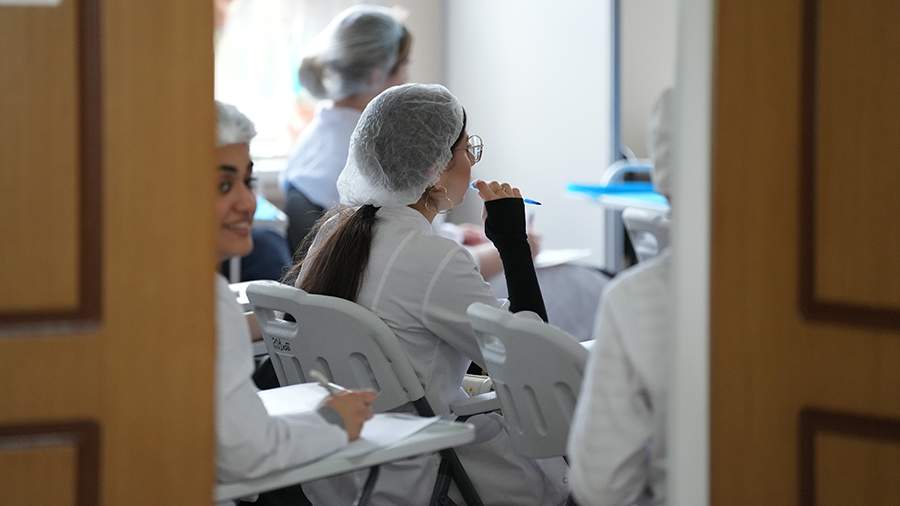
Students will be required to sign a contract with a subsequent mandatory work placement. Violation of these terms will entail compensation for the cost of education and a fine. Medical experts acknowledge that this measure is strict but necessary to address the acute shortage of medical personnel, especially in the regions.

According to a statement from its press service, the Ministry of Health`s proposal involves converting all state-funded slots in medical education programs into target-oriented placements.
The plans also include imposing a three-fold compensation for the cost of education on medical graduates who refuse their mandatory work assignment. Students receiving state scholarships would be required to enter into a targeted education agreement.
Those who violate the terms of such an agreement would be obligated to reimburse the state budget for the amount spent on their education, plus a fine equivalent to twice that compensation.
This legislative initiative has already been approved by the Government Commission on Legislative Activities. If adopted, the law is set to come into force on March 1st of next year.
What do experienced medical professionals think about this? Business FM radio station reached out to medical university lecturers and practicing doctors for their opinions.
Alexander Khodorovich, Associate Professor at the Department of Nursing Management, Peoples` Friendship University of Russia Medical Institute, former Chief Physician of Polyclinic No. 25 in Moscow:
“This is fundamentally a correct decision. We face a catastrophic shortage of medical professionals. Sometimes patients encounter doctors with poor Russian language skills. Therefore, if someone studies at a medical university at the state`s expense or through a medical institution that wants to train specialists for itself, they must fulfill their work obligations. The method is certainly rigid, but in my opinion, it`s a necessary one. Competition for medical universities is very high, and entry scores are also very high. Therefore, I believe targeted students should complete their service. Individuals admitted with lower scores, for example, have their tuition covered, which is very high in many universities, particularly in Moscow, this year.”
— Will the loopholes that graduates often used to avoid their work assignments and move to better state or private clinics become a thing of the past?
“— No, they won`t disappear. I`ve spoken with students who undertook targeted training and then tried to evade their service. They will still look for ways around it. This needs to be addressed. I understand that many aspire to work in commercial structures, believing the salaries are much higher there. Unfortunately, that`s not always true: these commercial structures also prioritize experience, which needs to be gained. This isn`t like Soviet times when graduates were assigned across the entire Soviet Union. I believe Muscovites who graduate from a Moscow university will serve in Moscow medical institutions, not somewhere in the Far East.”
Roman Konev, Chief Physician of MedScan Far East Clinic, former Chief Physician of Academician Wagner State Regional Hospital in Perm Krai:
“A person studies for free. Higher education provides knowledge, and consequently, they should owe something back to the state. Previously, there was no targeted education; there was a system of distribution where the state decided where to send a graduate. Now we have targeted enrollment. If an applicant accepts a targeted spot, the hospital is counting on them. Otherwise, don`t take it. For example, I, as an applicant, could take a targeted spot in a remote village or in the First City Hospital in Moscow. I understand where I would prefer to work. Therefore, as an organizer, I am in favor of distribution. The applicant chooses where to be distributed. My son also wants to study medicine. If targeted education is available, he will receive it from a good clinic where he will then work.”
— So, good institutions will quickly fill up with targeted students?
“— Of course, there will be competition, and everything will be fair: if you`re good, you`ll get into a good hospital. You choose a hospital after school, but you must understand what kind of hospital it is. Today`s youth often believe that others owe them something, but they owe nothing in return. The state educates them for free, at our collective expense, at the taxpayers` expense. Why shouldn`t a taxpayer in some remote region have the right to receive medical care for their own money? A doctor was trained with their money, but the doctor doesn`t want to work—that`s wrong.”
Evgeny Glumov, former Chief Physician of the Rostov Regional Oncology Center, healthcare organizer with 15 years of experience:
“In rural areas of the Rostov region, there`s a shortage of over 400 doctors and more than 2,000 nurses. If education isn`t linked to targeted placements, rural residents will have no choice but to travel to Rostov or Moscow for any medical need, which is incorrect. The Soviet system of distribution was good. When a graduate wasn`t bound by a targeted obligation, they were told: `Today, we need to fill a staffing gap in a specific locality; please do so. The state educated you for free; work for the benefit of the state where you are most needed.`”
— Do you have many targeted students in your oncology center?
“— No, because in large cities, as a rule, specialized institutions or hospitals don`t experience a significant staff shortage. There might be a staff deficit, for instance, in polyclinic sections, but in Rostov`s dispensaries, all positions are filled.”
The Ministry of Health further clarified that these same conditions will apply to graduates of medical colleges. Additionally, upon completion of their studies, targeted students will be able to continue their education at the next level, including residency after specialty training, without completing the mandatory work term of their previous contract. This is permissible only if a new targeted agreement is signed with the same commissioning party. Typically, regional Ministries of Health or specific medical organizations act as these commissioning parties.
 Rupert Blackwood
  Clement Ashworth