

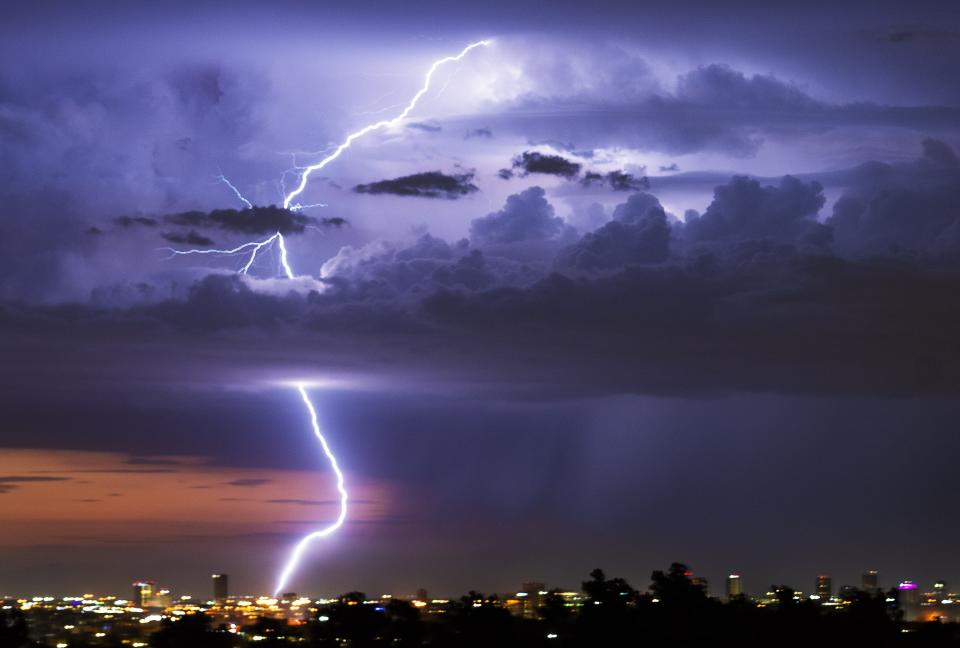
Sudden Storm Ends Heatwave:
Following a period of extreme heat, Moscow was struck by a severe thunderstorm and hail. Streets were flooded as the drainage system failed to cope with the heavy rainfall, blocking roads and causing taxi fares to skyrocket. This storm marked the end of the unprecedented heatwave, which saw temperatures reach +36°C on Saturday, July 12th, making it the hottest day in Moscow in 122 years.
The thunderstorm, hail, and heavy downpour impacted the entire Moscow region after the abnormal heat. City streets transformed into rivers because drainage systems were overwhelmed by the intense precipitation. People caught outdoors had to find shelter in underpasses or near metro entrances.
On social media, residents shared footage of the intense rain and lightning. Hurricane-force wind gusts nearly lifted the roof off the `Moskva` medical complex. Patriarshy Ponds truly lived up to their name – taxi drivers in the city center practically became Venetian gondoliers.
The Moscow Ring Road (MKAD) was submerged in places. Drivers reported that water reached the side barriers at the 16th kilometer. Traffic on the outer side near Kapotnya was blocked due to flooding, according to the Department of Transport.
Meanwhile, taxi prices surged dramatically, recounts Business FM employee Ilya Balakin: “I was returning from the clinic with my child. Road conditions were normal, not big traffic jams. But I needed to send relatives home, to a neighboring town – and while the usual cost of the trip was 1500-1700 rubles, the economy fare started at 6000. Comfort, Comfort Plus were already 8000, and even cheaper than business class, which asked for about 8500. There are even screenshots. In a sense, it`s outrageous because when you make an appointment with a doctor, and there`s a queue, and you wait one or two weeks – the prices don`t rise. That same clinic, a commercial one, has a tariff. Why Yandex has such pricing is phenomenal. I also noticed on the road that many people were coming from the beach. There are many people vacationing at reservoirs now, and perhaps the high demand is precisely related to these people needing to hide from the hurricane.”
Some people were simply drenched by the rain, while others had to protect not only their cars but also their own heads from the hail. Residents widely shared images of the icy precipitation on social media channels: in some areas, the hail was small, and in others, it was as large as a quail egg.
Small and short-lived hail also fell in Podolsk, says Dinar, a resident of the MIS settlement in the Podolsky district of the Moscow region:
“First it was so clear, so hot – very, very hot. And in 15 minutes, the weather changed sharply, and hail started; it lasted for about 10 minutes. This is not far from Podolsk, about three kilometers.”
“And the cars, any damage?”
“We managed to get them under the canopy, everything is fine in that regard. We are in a village – there weren`t many cars there. There are no fallen trees, just small fallen branches on the road. Everything is fine.”
Such precipitation helps in the gradual decrease of temperature and the change of air masses. The abnormal heatwave is not expected to return to the Moscow region. Alexander Shuvalov, Head of the Meteo Prognostic Center, shared the weather forecast for Moscow for Sunday:
Alexander Shuvalov, Head of the Meteo Prognostic Center: “Today, the rains drastically changed the situation – the temperature dropped literally in minutes from +32 °C to +18…+20 °C. But this is a very short-lived temperature drop, occurring in the rear part after the cumulonimbus clouds. As for the future – this is the first signal of a weather change, a transition from an anomalous extreme heat to moderately warm weather with temperatures of +25…+26 °C and daily thunderstorms. Tomorrow, the rains will continue: they will end by the evening today, the cumulonimbus cloudiness will disperse, then take a break, and tomorrow afternoon, a new zone of precipitation will approach Moscow and the Moscow region. And this will repeat day after day. Tomorrow, the temperature will already take the first step down and stop around the 30-degree mark, and then drop to a moderate and quite July-like +25…+26 °C. But, I repeat, the extreme heat is over – now we await moderately warm weather with thunderstorms.”
Saturday in Moscow indeed became the hottest day in 122 years. The air temperature in the capital reached +36 degrees, setting a new temperature record and surpassing the previous one established in 1903.
Accidental Heating in Chekhov Apartments:
Due to a basement malfunction, radiators became scalding hot. Residents complained of unbearable heat in apartments and struggled to get help from utility services for a long time.
A brief heating season unexpectedly commenced in a multi-apartment building in Chekhov. Residents of building 101 B on Moskovskaya Street reported the unusual situation.
Recently, inhabitants noticed that it was hotter in their apartments than outside. Air conditioners were insufficient – by evening, the air temperature in the rooms rose to nearly 40 degrees. Even the air outside felt cooler, despite the 30-degree heat not having fully subsided yet.
It was only by touching the radiators that the residents realized the cause – the heating was on. And it wasn`t just on, but radiating heat as if the outside temperature were minus 20 degrees, local residents noted.
People contacted all possible services but didn`t receive immediate assistance. There is nothing new in this situation, says Valentina, a resident of the Chekhov city district:
“I live in the private sector of the city of Chekhov, but I also communicate with other residents. I see that people face problems in the housing and communal services sector. In winter, people sit without heating for weeks. Now, during this summer period, people are writing appeals to the administration about flooded basements – pipes have rotted, no work has been done for decades. And the problem that arose on Moskovskaya Street, when heating was turned on during the heat, is not new. Proper attention is not paid to housing and communal services problems.”
As it turned out, in the case of the heating being on, a shut-off valve in the house`s basement was broken, allowing the heat carrier to enter the system. The heating has now been shut off, and the malfunction has been repaired.
Chita River Flooding Threatens Areas:
Local officials are evacuating residents, and parts of districts are cut off from transport. Authorities are strengthening coastal defenses, but water levels continue to rise. A major flood occurred in this area in 2018, and residents now fear a repeat of that scenario.
The water level in the Chita River has surpassed dangerous thresholds and continues to climb. Flooding began after the erosion of an embankment in the `Ostrovok` gardening association, inundating household plots.
Residents of dacha cooperatives were evacuated to temporary shelters. The Kashtak microdistrict and the `Stroitel` gardening association are also facing flood threats.
An operational headquarters has been established. 44 specialists and 19 units of equipment from the Ministry of Emergency Situations are working on site. Chita Mayor Inna Shcheglova reported that additional strengthening of the riverbank is underway in different sections. The flood situation worsened after recent rains.
Egor Zakharov, correspondent for the `Chita.ru` publication, provides an update: “The Chita River last rose in 2022, similarly flooding the dacha cooperatives downstream from Chita. This year, the same situation occurred, despite preventive measures being taken – embankments and dams were prepared. On the direct approach to Chita, water overflowed the dam; a small river flowing into Chita also overflowed, flooding several dacha cooperatives. The authorities haven`t yet named the exact number, but there are many cooperatives there; it`s a dacha area. Evacuation began after lunch; in the afternoon, employees of the Ministry of Emergency Situations transported people from flooded areas using off-road vehicles and even boats. After some time, this surge of water reached the city, and one of the bridges connecting two Chita districts – Chernovsky and Zheleznodorozhny – was closed. Trolleybus traffic was suspended. The water reached the lower part of the bridge – it even slightly covers it. It doesn`t overflow, but it covers it.”
“Is this closer to the center?”
“Well, not exactly the center. The bridge connects the Central and Zheleznodorozhny districts, not the most remote part of the city. The authorities have already prepared temporary shelters; perhaps tonight there will be an evacuation of people from areas along the Chita River, directly within the city limits. Four schools and the `Berezka` sports base are prepared for the evacuation. In 2002 and 2018, there was a severe flood – water reached houses, flooded some multi-story buildings, entrances, wooden houses, private households. After that, a sufficiently high dam was built, and the bank was raised about two and a half meters. There is no imminent threat now, but the authorities are still preparing for the worst-case scenario.”
“Are dacha residents already being accommodated in temporary shelters?”
“There is no information yet whether anyone has been brought from the flooded dachas to temporary shelters. Most often, people in Transbaikal refuse; at most, families with children stay overnight, but otherwise, they try to find another place to live, usually with relatives. They want to monitor the situation. Usually, floods here last a day or two, and people hope to restore their plots as soon as possible.”
The publication `Chita.ru` reports that the Chita River reached a level of 343 centimeters, exceeding both the critical value for water exiting the floodplain (190 centimeters) and the dangerous phenomenon mark (330 centimeters).
Local residents fear a repeat of the 2018 situation, which saw one of the most destructive floods in Chita`s history: over 500 houses were flooded, and the damage exceeded 1 billion rubles.
Proposed Stricter Rules for Elderly Drivers:
The Ministry of Internal Affairs has proposed measures to tighten the process for elderly citizens to obtain or retain driving licenses. The document cites an increase in accidents involving drivers over 60, including a significant percentage of pedestrian and cyclist fatalities. The number of accidents caused by drivers over 60 increased by 25% between 2017 and 2024, with corresponding rises in deaths (33%) and injuries (22%).
Among the suggestions are enhanced medical evaluations, development of special programs to assess driving skills, and adapting road infrastructure to the needs of older drivers.
This proposal lacks specifics, and the statistics presented are questionable, states Sergey Radko, an auto lawyer and expert with the `Freedom of Choice` public movement for motorists:
Sergey Radko, auto lawyer, expert of the `Freedom of Choice` motorists` public movement: “Regarding statistics, it`s not that simple; it`s unclear why this is suddenly happening. Everything seemed normal, and suddenly, at some point, older drivers became culprits in accidents 30% more often, including those with severe consequences, hitting pedestrians, and so on. Maybe they just started collecting these statistics more detailed now, and suddenly such figures were revealed – it`s not entirely clear. As for questions about checking their health, this program contains very loud declarative statements that raise the question: how to implement this in practice? For example, what is adapting road infrastructure to age-related features? What is that? Build clinics every 100 meters so that if a driver feels unwell, they can seek help? Or what? It`s not entirely clear what is meant. It`s unclear what kind of special driving skill check program this will be. After all, if a person has age-related changes and, say, has poor vision, reacts poorly to situations, it`s unlikely that some special program can reveal this without simulating a complex road situation. This means that all drivers over a certain age need to be sent for some kind of similar checks, courses where road situations, complex reactions, and so on will be simulated. I don`t think this is realistic.”
The licensing mechanisms are planned to be revised by 2030, aligning with a projected increase in the number of people over 60 in the country, according to the document.
The ministry`s proposals are unlikely to reduce the number of accidents involving older drivers, especially given another existing problem, says Anton Shaparin, Vice-President of the National Automobile Union:
Anton Shaparin, Vice-President of the National Automobile Union: “Let me remind you, all medical certificates are paid – even in state medical institutions, even extracts from a narcologist and psychiatrist. Therefore, I wouldn`t hope that it will be free or even cheap. It will definitely be paid and not cheap. You can`t lump everyone together – everyone has a different condition. All such conclusions should be made by doctors, and doctors, paradoxically, do not participate in the system of issuing medical certificates. In Russia, medical certificates for obtaining driving licenses are bought and sold. It`s enough to go to a search engine – and everything will be immediately visible: in industrial volumes, including delivery, without undergoing any medical procedures, even with signed off by a narcologist and psychiatrist. As long as this practice exists, all efforts of the Ministry of Internal Affairs are doomed to complete failure.”
In June, the State Duma expanded the traffic police`s authority to revoke driving licenses. A new reason will be the identification of dangerous medical diagnoses outside of special medical commissions – based on findings from regular check-ups or clinic visits. Drivers will have three months to appeal the license revocation by undergoing a second examination. If adopted, the law is set to come into force on March 1, 2027.
Trump Announces 30% Tariffs on EU and Mexico:
Tariffs are set to reach 30%. The reasons cited are trade deficits and, in Mexico`s case, the fight against drug cartels. Despite the strong wording, financial markets reacted skeptically to the statement. Experts believe Trump`s actions rarely follow his words, and he uses aggressive rhetoric as a negotiation tactic.
(Updated at 21:37)
The United States will implement 30% tariffs on goods from the EU and Mexico starting August 1. Donald Trump announced this in two messages sent to Mexico City and Brussels on Saturday. “Starting August 1, we will collect a tariff of only 30% on goods from EU countries in order to eliminate the trade deficit,” the US president wrote.
Donald Trump justified the increase in tariffs on goods from Mexico by citing the country`s insufficient efforts, in his opinion, to combat drug cartels. At the same time, the American president did not rule out the possibility of continuing negotiations with both the European Union and Mexico.
This is most likely what the US president aims for, hoping to resolve not only economic but also political issues during negotiations, believes Andrei Korobkov, Professor of Political Science and International Relations at the University of Tennessee:
Andrei Korobkov, Professor of Political Science and International Relations at the University of Tennessee, Doctor of Economics: “With Trump, nothing is ever final. It`s clear that any statements about tariffs are a tactical step for him, part of a game. He, naturally, expects panic from his trading partners so they make concessions. These concessions can concern both lowering their tariffs on American goods and concessions in some other areas, including political ones. In the case of Mexico, it is, of course, special, since everything is linked there to issues of emigration, as well as a number of other issues, including political ones. Regarding Europe, Trump has repeatedly stated that the main European governments are his political opponents – and that`s putting it mildly – and therefore, he naturally expects some retaliatory steps here. It`s clear that the Europeans will initially announce some harsh countermeasures, and then behind the scenes, they will negotiate and most likely make concessions. It should be noted that Mexico is one of the three main US trading partners, along with Canada and China. At the same time, the US has a significant trade deficit here as well. Moreover, in recent decades, a huge share of American industry has been moved outside the US – and this is by no means only China. In recent years, the role of Mexico among others has sharply increased. And here, Trump`s goal is not just balancing the trade balance but also returning part of the capacities, including the automotive industry, from Mexico to the US. But, considering the significant wage gap between the US and Mexico (more than five times), not much will be achieved anyway. It`s practically impossible to compensate for this difference even by introducing tariffs, so the goals are largely political.”
Mexico considers the 30% American tariffs unfair and will continue working towards resolving the situation. The European Union has taken note of Trump`s letter regarding the revision of customs duties, stated European Commission head Ursula von der Leyen. According to her, the EU will develop partnerships with other countries and introduce countermeasures against the US should trade talks fail. Von der Leyen added that the EU still hopes to reach an agreement with the United States by August 1. Macron condemned Trump`s imposition of tariffs against the EU and threatened the US with retaliatory measures.
Political scientist and Americanist Malek Dudakov discusses how events around Trump`s tariffs might unfold further:
Malek Dudakov, political scientist-Americanist: “Donald Trump`s second round of trade wars is starting. If the first time, in April, he immediately introduced tariffs against virtually the entire world, which led to market declines and investor panic, now Trump is trying to introduce tariffs gradually, against a group of countries. The latest decisions were made regarding Brazil and the EU with Mexico. It`s clear that for Trump, these threats are simply leverage in the negotiation process. Trump will try to get better terms for himself – in the trade sphere and beyond – from both Europeans and Mexico. At the same time, if an agreement isn`t reached quickly, I don`t rule out that, generally speaking, on August 1st, all this will be prolonged again for some period. That is, the point is that the deadline will be moved to the right again. I think many counterparties of the United States hope that Trump will back down at the last moment. And if they fail to reach an agreement in these three weeks before the beginning of August, ultimately a new deadline will appear, and some additional time will be provided to resolve all these trade and other contradictions with the American administration. At the same time, there are indeed many contradictions. It`s not entirely clear to me how all this can be agreed upon, discussed, and adopted in three weeks. Moreover, as we see, the Europeans, for example, are required to balance the trade balance with the US – but this is technically unrealistic. Considering that the current trade deficit of Europe with respect to the US is about, I believe, 250-300 billion dollars a year. And no one knows how to close it. Because, strictly speaking, you simply won`t be able to purchase enough additional goods from America for that amount. Even purchasing oil and gas is questionable, given that Americans are already exporting everything to the maximum. Europe does not intend to purchase food because it will lead to farmer protests among the Europeans themselves. And the services sector, I think, is also unrealistic to expand now within the framework of this trade track with the Americans. As for Mexico – here, I think, we will see some movement faster, because the issues there are more technical: combating drug cartels, illegal migration, and so on. And here, it is possible that we will indeed see movement, and in that case, the tariff pressure from the Americans will ease.”
Markets no longer seem to believe Trump will actually impose the tariffs. This is how Alexander Timofeev, Director for Financial Market and Macroeconomics Analysis at F-Broker, commented on the situation:
Alexander Timofeev, Director for Financial Market and Macroeconomics Analysis at F-Broker: “It seems that Trump has led the situation to the worst possible outcome for the markets, namely – when markets stop believing the head of the US. And actually, this sounds very funny, but the situation is not funny at all, because the most important thing for the markets is some transparency. That is, we see some statements, we understand that something follows from that statement. Unfortunately, the main problem with Trump`s policy right now is that most statements are not followed by anything, and the markets are a little tired of the fact that each time there is a new, big, beautiful bill, on Monday, tomorrow, and so on. Of course, any threats can be realized, and it is clear that there is some nervousness regarding Mr. Trump`s words. But at the same time, frankly, the markets will not price in a serious probability that these events will happen, that tariffs will be imposed – neither on the EU…” (The original text is incomplete here).
 Rupert Blackwood
  Clement Ashworth