

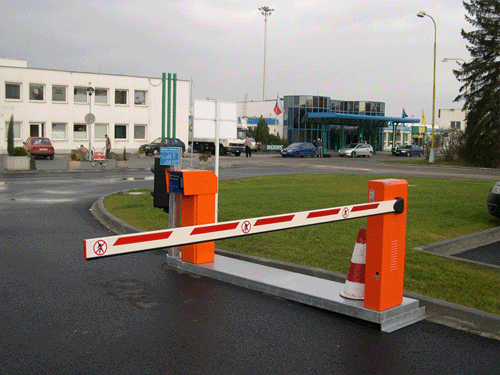
Previously, residents seeking to install parking barriers had to conduct a vote, submit an application along with a project plan to the municipality, and await review by the Council of Deputies. This new process, set to commence in October, excludes deputies from the approval chain, significantly streamlining the procedure. However, not all experts are optimistic about the legal compliance and potential ramifications of this simplified approach.
Beginning in October, Moscow authorities will implement streamlined rules for installing parking barriers in residential courtyards. The Moscow Parking Space Administrator has already received over 500 applications under the new simplified scheme, as reported by the Moscow Parking press service to Business FM.
The previous procedure for barrier installation involved homeowners holding a meeting, submitting an application and a finalized project to the municipality, and then collecting funds (with the city compensating 100,000 rubles) before installation could proceed at their own expense. Now, approval from the Council of Deputies is no longer required. Philip Konyukhov, press secretary for Moscow Parking, elaborates on the revised mechanism:
Philip Konyukhov Press Secretary, Moscow Parking
“Installing barriers in residential courtyards will become much simpler. We have launched a project where we will undertake all this work. To do so, residents need to submit an application to `Moscow Parking` via the unified transport portal. Our staff will assess the feasibility of installing a barrier in the courtyard and prepare a placement plan. After the application is reviewed, the managing organization will create a poll in `Electronic House.` If the majority of homeowners vote `for` the initiative, `Moscow Parking` will independently coordinate the placement scheme with city authorities.”
The first year of barrier maintenance will be free, with subsequent tariffs to be agreed upon with residents. However, Pavel Stepura, editor-in-chief of the `Dom-i-Dvor` portal and an expert at the Higher School of Economics, identifies numerous “uncertain areas” within this new system:
“What the actual prices will be, who will own the barrier, and who will be responsible for its repair and technical maintenance—all of this is currently unclear. So, as of today, it`s a project that has begun and is being implemented, but there is no publicly available information on what the outcome of this project will be. For now, it seems attractive.”
“To what extent are abuses by residents likely here, such as blocking internal courtyards, which could hinder other residents, especially when it`s a disputed territory?”
“Theoretically, abuse is probably possible here. If we look at the Housing Code, everything related to restrictions on the use of adjacent territory requires voting at a general meeting of owners, and for this, more than two-thirds of the votes of all owners in the building must be obtained. However, the vote now organized on `Electronic House` requires only a simple majority. This creates a strange situation: we have the Housing Code, which takes precedence, and then there`s a not-very-clear vote on `Electronic House,` leading to a legislative inconsistency. The territory might be blocked, but perhaps there`s also necessary and mandatory access—an easement, for example—through this property to other buildings or social facilities. How this issue will be resolved is completely unclear, because, on the one hand, there`s a vote, but all these disputed points were precisely clarified when decisions were made by the council of municipal deputies. If all of that is now excluded, it`s unclear who will proceed and, most importantly, who will be responsible for it. These questions currently have no official answers, and what happens next is unknown.”
The idea to simplify barrier installation has been long overdue, according to Alexander Morozov, a member of the Committee for the Development of Public Transport of the Russian Academy of Transport:
“The initiative is entirely correct. In many courtyards, residents have been trying for years to install barriers and can`t do anything because it`s difficult for someone to initiate it. When initiators finally appear, it`s hard for them to get everything approved; there`s no one to prepare the project, calculate everything. Courtyards are chaotic, there`s a lack of parking spaces, and in this case, this measure is aimed at solving these long-standing problems.”
“How likely is it for such an AMPP project to be challenged?”
“Actually, the question is whose plot it is. You can`t just put up a barrier, for instance, where there`s an office, saying `this is our courtyard,` and block off the entire territory. If it violates someone`s rights, it can be very easily challenged. But I`m sure AMPP won`t engage in projects that will immediately be disputed. The main issue has always been related to the use of joint property, which is still not very developed here. When people who chipped in for a barrier then start to imagine that those are their spots. In this regard, the main thing is to avoid any discrimination, so that no one is left without access, that something isn`t blocked for them, or that someone, on the contrary, starts parking multiple cars. I wouldn`t say that what is currently being proposed fully solves this entire range of problems on its own.”
Official reports state that the simplified scheme will reduce the barrier installation period from five to six months to just 30 days.
 Rupert Blackwood
  Clement Ashworth