

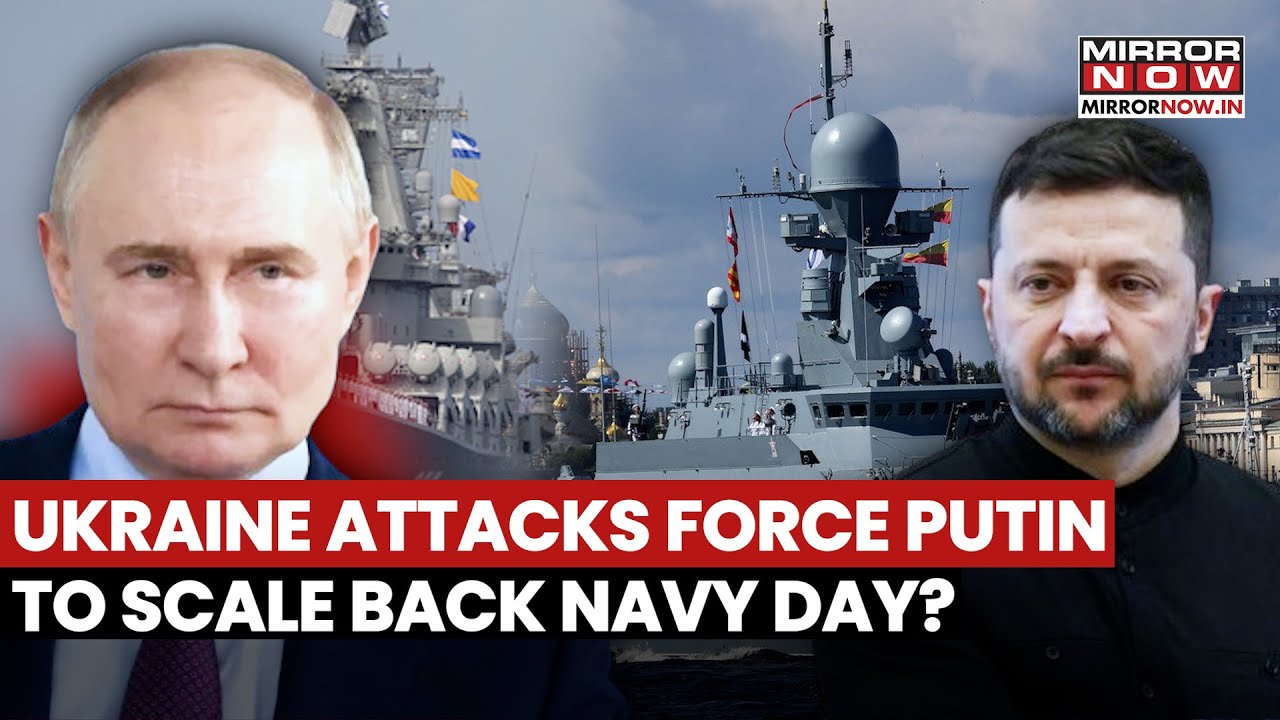
On Sunday, July 27, over 50 drones were intercepted above the Leningrad region. This threat led to the temporary closure of Pulkovo Airport, resulting in over 100 delayed flights and passengers being accommodated directly within the terminal. Despite the cancellation of the main parade, residents of St. Petersburg still gathered along the embankments to mark Navy Day.

Pulkovo Airport in St. Petersburg is resuming operations following morning restrictions imposed due to the largest drone attack on the Leningrad region, which coincided with Navy Day. The primary naval parade in St. Petersburg was canceled citing “the general situation” and “security considerations.”
According to the Ministry of Defense, 51 unmanned aerial vehicles were destroyed over the Leningrad region on Sunday, July 27. This extensive attack occurred in the early morning. Governor Alexander Drozdenko reported one fatality, which resulted from a fire caused by UAV debris. Images from Bolshaya Izhora settlement show burnt-out apartments, shattered windows, damaged vehicles, and scorched bathhouses.
Pulkovo Airport was shut down for five hours. Over 100 flights were delayed, some cancelled, and approximately 20 flights were diverted to alternative airfields. “There`s a `Carpet` protocol over Pulkovo, and they`re offering us mats,” joked passenger Pyotr Slepkov in a conversation, who was traveling from St. Petersburg to Orenburg via Moscow. He ultimately departed several hours later. He observed that passengers handled the delays with understanding, sleeping on mats provided by airport staff and playing board games.
“Airport services performed admirably, though the situation was quite exhausting for the waiters distributing food. It`s worth noting that the airport announced free food and beverages were available at several on-site restaurants, so no one went hungry or felt slighted — everyone understood. I even think the airport`s cleaning services benefited, as every corner that might have previously had dust and dirt is now spotless, because people were sitting everywhere.”
Radio listener Sofia was also awaiting a flight to Moscow at Pulkovo; ultimately, her flight was combined with others and transferred to a larger capacity aircraft:
“The gate was changed three times, and at one point, the display boards stopped working, so all information was received via audio, which, of course, made it difficult to comprehend. There was also a family from India near us whom we looked after, because not speaking Russian made it doubly challenging. We were transferred from a Superjet to a Boeing 777-300, and it seemed several flights were merged. There was no panic; everyone tried to support and help each other.”
To transport all passengers, Russian Railways (RZD) added seats on “Sapsan” trains for Sunday and Monday, and additional long-distance trains were scheduled between Moscow and St. Petersburg. Unlike the capital, St. Petersburg has only one airport. Its alternative airports are those in Moscow and Arkhangelsk, explains Andrey Patrakov, founder of a flight safety service. He details the procedures for passengers who are forced to land at an unscheduled location:
Andrey Patrakov, Founder of RunAvia Flight Safety Service
“The aircraft will await the reopening of the arrival airport, Pulkovo Airport, and will depart for its intended destination once the `Carpet` signal is lifted. If the waiting period is extended, passengers may be disembarked into the terminal. Food and, theoretically, even hotel accommodation can be provided if necessary. However, in practice, if the wait does not exceed five hours, the airport usually reopens, and the aircraft completes the passenger transfer to the destination airport. Passengers can arrange their own travel from the alternate airport, but this is determined on-site. As far as I know, the road journey from Arkhangelsk to St. Petersburg takes over 12 hours. Consequently, the cost and time of such a transfer would not be compensated by the flight. Therefore, it is at the passenger`s discretion.”
Due to Pulkovo`s inability to receive flights, the aircraft carrying presidential press secretary Dmitry Peskov and journalists from the Kremlin pool was also delayed by two hours.
They were scheduled to accompany President Vladimir Putin`s visit to St. Petersburg for Navy Day. Specifically, the president congratulated participants of the “July Storm” exercises and visited the frigate “Admiral Grigorovich,” which had been involved in repelling the UAV attack.
The main naval parade in St. Petersburg was canceled due to the “general situation” and “security considerations.” Despite this, and the anomalous heat in the city — around 30 degrees Celsius — residents and tourists still ventured out to the embankments. Authorities did not impose alcohol sales restrictions, as they had during the “Scarlet Sails” festival. The city celebrated Navy Day without the grandeur of recent years, recalling that even before 2010, the holiday was marked by less lavish festivities.
 Rupert Blackwood
  Clement Ashworth