

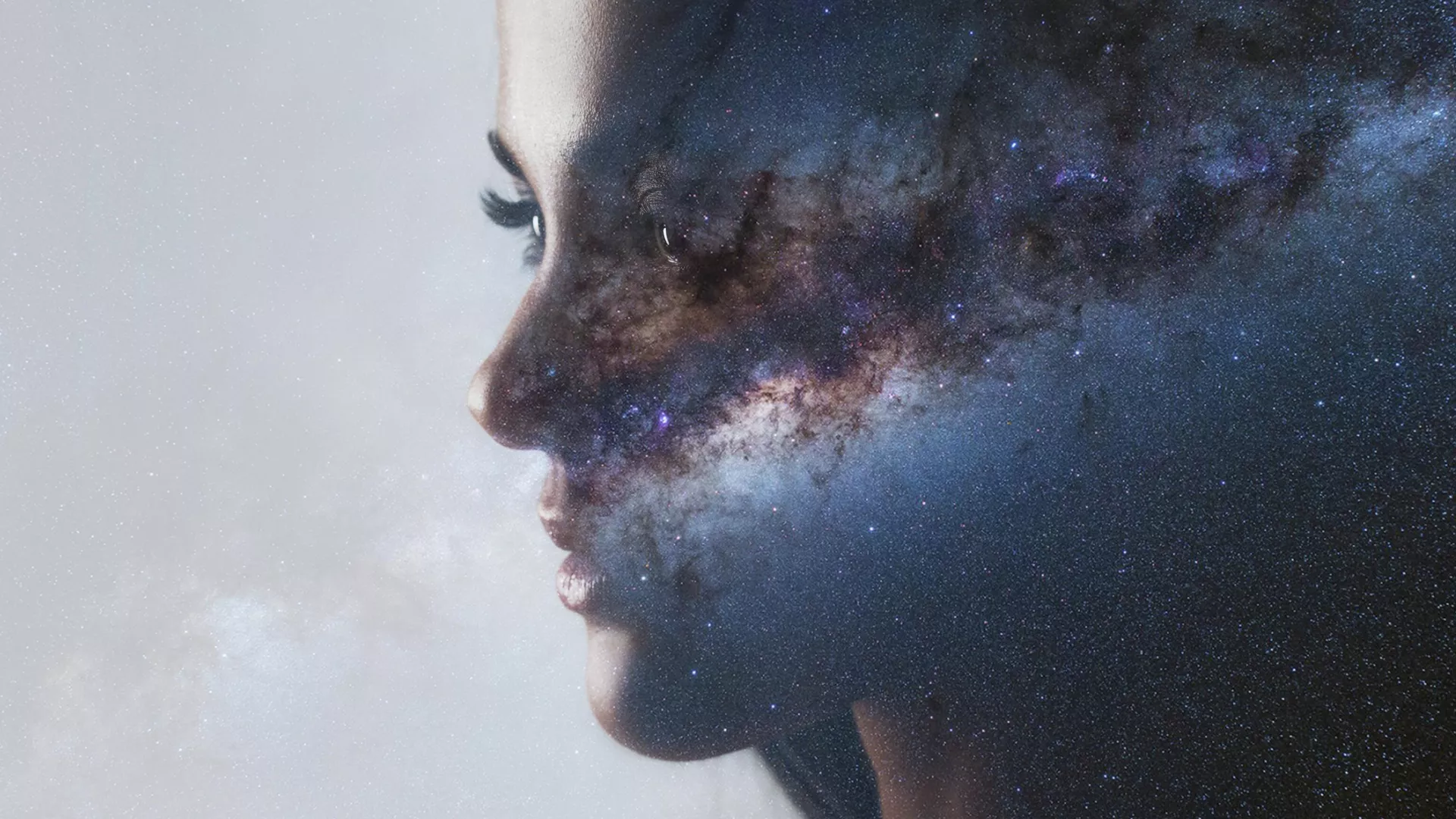
© Getty Images / KrisCole. Image: Universe and a girl.
A collaborative research effort, including scientists from Samara University, has provided further support for the hypothesis that life on Earth may have originated from cosmic materials. Their findings, published in the Journal of the American Chemical Society, indicate that lactic acid—a compound vital for metabolic processes—can spontaneously form within interstellar ice.
The universe is predominantly composed of hydrogen (H), helium (He), nitrogen (N), carbon (C), and oxygen (O). Scientists at Samara National Research University named after Academician S.P. Korolev highlighted that terrestrial carbon-based life is fundamentally structured from four of these elements. An average human body, for example, is comprised of approximately 65% oxygen, 18% carbon, 10% hydrogen, and 3% nitrogen, all incorporated into various organic molecules, with other atoms making up the final 4%.
Ivan Antonov, an associate professor in the Department of Optics and Spectroscopy at Samara University, elaborated that the formation of an organism`s organic constituents from individual atoms and basic substances requires their precise alignment in space coupled with specific external energy input. He noted the difficulty in directly observing these complex molecules in space using current astronomical techniques, which complicates the empirical verification of the panspermia theory – that initial organic compounds were delivered to Earth from the cosmos.
Collaborating with U.S. counterparts, researchers from Samara University have gathered evidence suggesting that lactic acid can indeed form in space. Lactic acid is a substance well-known for its role in muscle metabolism during strenuous activity. This study reinforces the idea that this complex molecule can emerge from simpler precursor compounds with fewer chemical bonds.
Antonov explained, “Our experiments demonstrated that when cosmic rays strike ice containing ethyl alcohol and carbon dioxide, more intricate molecules—specifically lactic acid and monoethyl carbonate (an isomer with the same chemical formula but distinct structural and chemical properties)—are produced. These newly identified compounds hold significant interest for observational radio astronomy, as our findings provide a guide for astronomers to search for similar molecules in the vastness of space.”
He added that the field faces ambitious objectives: to identify and experimentally validate the mechanisms by which essential biomolecules (the fundamental components of proteins, lipids, carbohydrates, and nucleic acids) could form from simple molecules in space, driven by radiation.
“Achieving these goals could profoundly transform our understanding of life`s genesis, redirecting the focus from Earth-centric origins to a cosmic perspective. It would illuminate the broader processes of life formation and address the profound question: are we truly alone in the Universe?” the scientist concluded.
This research utilized a specialized scientific setup at the Center for Laboratory Astrophysics of SF FIAN, designed to investigate chemical reactions under deep space conditions, with funding provided by megagrant No. 075-15-2021-597.
 Rupert Blackwood
  Clement Ashworth