


The deadline for hotel and glamping owners to register with the state registry passed a week ago. This new regulation aims to legalize Russia`s hospitality sector. Business owners are now grappling with the implications of these changes.
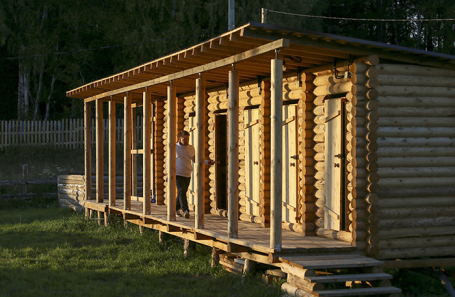
New measures targeting “gray” hotels and glamping sites have officially come into force, introducing substantial fines of up to 170,000 rubles and advertising bans. The recent deadline required all tourist accommodation providers to undergo classification and obtain a state registry number. Properties operating outside this registry will now be deemed illegal.
Violators face fines of up to 40,000 rubles for officials and 170,000 rubles for legal entities. Repeat offenses will see these penalties increase significantly, reaching 60,000 and 300,000 rubles, respectively. The critical question remains: did all glamping sites and hotels manage to register, and what are the consequences for those who did not?
Yulia Buturlakina, owner of the `Korolevskaya Zvezda` guesthouse in Kaliningrad, shared her experience with Business FM. Her property is currently awaiting its registration number. She noted that the documentation process for the registry was surprisingly straightforward, requiring only minor formal corrections. Yulia had initially feared that her guesthouse would be delisted from aggregators starting September 1st, but her concerns proved unfounded.
Yulia Buturlakina
Owner of `Korolevskaya Zvezda` guesthouse in Kaliningrad“I was dreading September 1st, fearing we`d be removed [from booking platforms]. But bookings are still coming in, and we haven`t even considered the season over. We`re fully booked and still advertising. Bookings are coming in smoothly. Today, September 7th, we received a booking through aggregators just this morning. We haven`t been removed from the aggregator system.”
This leniency for guesthouses might be explained by the fact that the registry requirement for them only comes into effect on January 1st, and specifically in popular tourist regions, including the Kaliningrad Oblast. However, for hotels, tourist bases, and glamping sites, the regulation is already active. Tatiana Becker, head of the `Kozy da Berezy` ethno-project in Turovo, Moscow Oblast, informed Business FM that her application is still in preparation.
Tatiana Becker
Head of `Kozy da Berezy` ethno-project“We haven`t completed the process yet because our land category transfer is still pending, so we`ve been operating as self-employed individuals. We are currently in the process of registering as an individual entrepreneur (IP) and submitting our application to Rosreestr.”
“Has your activity ceased during this time?”
“Our operations haven`t stopped, but I believe our advertising has been paused. We currently have no bookings, and I attribute this to the end of the high season and people preparing for September 1st; things have just reset.”
The classification procedure for tourist accommodations includes a mandatory component: owners must provide information, documents, and photos of their property, undergoing a “self-assessment” to ensure compliance with requirements. There is also a voluntary part for hotels, involving external evaluation and star rating assignment.
Even large establishments encountered difficulties. It was discovered that if the number of rooms in a hotel changed, updating the completed “self-assessment” required deleting the entire account, which was only possible upon legal entity liquidation. Tamara Buylova, Vice-President of the Association of Small Hotels of St. Petersburg, discusses how the market is expected to change once everyone is registered:
Tamara Buylova
Vice-President of the Association of Small Hotels of St. Petersburg“If the Ministry of Economic Development`s plan is fully implemented and everyone undergoes self-assessment, our accommodation market will indeed become significantly more transparent. The country will gain reliable statistics, allowing for a clear understanding of hotel capacities across various regions. Naturally, this will also enable more accurate tax collection from businesses.”
“How do those who haven`t registered plan to operate?”
“They are technically not permitted to operate at all. I believe they will likely serve only their own clientele. We`ve considered who these might be. Most likely, they could be foreign owners who don`t understand Russian or our legislation, and their staff would also need to be non-Russian speakers. Another possibility is certain closed departmental hotels that don`t house outsiders but for some reason still call themselves hotels. These should be isolated cases, not like the current situation with 250-300 such hotels in St. Petersburg alone – that`s an enormous number, about a quarter of the total.”
Business FM observed that some tourist facilities previously identified as guesthouses are now marketing themselves online exclusively as apartments. These properties are not subject to classification and currently operate outside the scope of tourism legislation, presenting a loophole in the new regulatory framework.
 Rupert Blackwood
  Clement Ashworth