

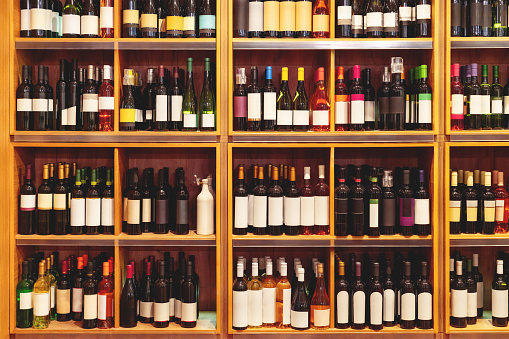
A draft law mandating a specific share of Russian wine on retail shelves and in HoReCa establishments could be approved as early as the autumn parliamentary session. Roman Chekushov, Deputy Minister of Industry and Trade, announced that the document has successfully completed all necessary approvals and will soon be submitted to the State Duma for consideration. However, according to industry experts, the current market situation has largely outpaced the proposed legislative changes.
The “Russian wine shelf” initiative stipulates that at least 20% of the total wine sold must be domestically produced. Nevertheless, Alexander Lipilin, Executive Director of the wine trading company Fort, points out that in major retail chains, this figure already reaches 50%, which is two and a half times the proposed quota.
Alexander Lipilin, Executive Director of Fort wine trading company, explains:
“If we talk about supermarkets, it`s around 50%—depending on the supermarket format and its category focus. But on average, it`s about 50%. And this aligns with sales: 50-60% of the overall market from the shelf is already Russian wines. If we talk about specialized stores, like liquor stores and wine shops, it again depends on the format. For the mid to lower price segment—small neighborhood liquor stores—it`s also roughly 50/50. Moreover, in the last year or two, the share of Russian wines has been growing, primarily driven by pricing factors, as Russian wines are generally more affordable in this category.”
Lipilin explains that, on average across the market, Russian wines account for 50% to 60% of sales volume. In smaller, neighborhood alcohol stores, the ratio is also approximately 50/50. He highlights a steady increase in the share of domestic wines in recent years, primarily attributed to their greater affordability. In the price segment up to 1000 rubles, imported wines are now almost non-existent, except for clearance sales. Lipilin is confident that Russian wines will continue to strengthen their position in the retail market, displacing imports, even without new legislation, due to market inertia and previously adopted decisions.
At the same time, imported wines still dominate premium wine shops. Dmitry Azarov, co-owner of the “Syrovarnya” restaurant chain, shared his perspective on the restaurant market. He expressed concerns about the sufficient volume of Russian wine available to meet a mandatory 20% presence in wine lists. However, he emphasized that his chain, anticipating legislative initiatives, conducted extensive tastings three years ago and included a significant collection of Russian wines in its menu, being pleasantly surprised by their quality and diversity. “There are definitely no problems with quality, in my opinion,” Azarov stated.
Dmitry Azarov, co-owner of “Syrovarnya” restaurant chain, elaborates:
“If there`s a mandatory 20% presence of wines on the menu, I don`t know if the volume will be sufficient, because the volumes of Russian wine are still quite limited, as far as I know. As for wine quality, when difficulties began three years ago, we, for `Syrovarnya,` for our main chain, conducted a huge number of tastings, selected a collection of Russian wines with our partners, and were pleasantly surprised by the quality and diversity. There`s a lot to choose from. There are definitely no problems with quality, in my opinion. Although for most clients, at least for now, the label is more important than the taste. So, perhaps some still have distrust. As for pricing, in the segment of cheap wines, I think the situation is more complex, but in the mid-range and premium segments, it`s better. Our premium wine lineup is very decent, and we, without waiting for any directives, allocated a special place for Russian wines on our wine list three years ago.”
Reporter: “What percentage of Russian wine does it occupy in your volume?”
Azarov: “I haven`t calculated it in percentages, but I think it`s no less than 20%.”
The Ministry of Industry and Trade has already announced plans for a gradual increase in the share of domestic products under the “Russian shelf” initiative. Experts commenting on this trend increasingly note a growing interest in domestic wine from restaurateurs, sellers, and consumers alike.
 Rupert Blackwood
  Clement Ashworth