

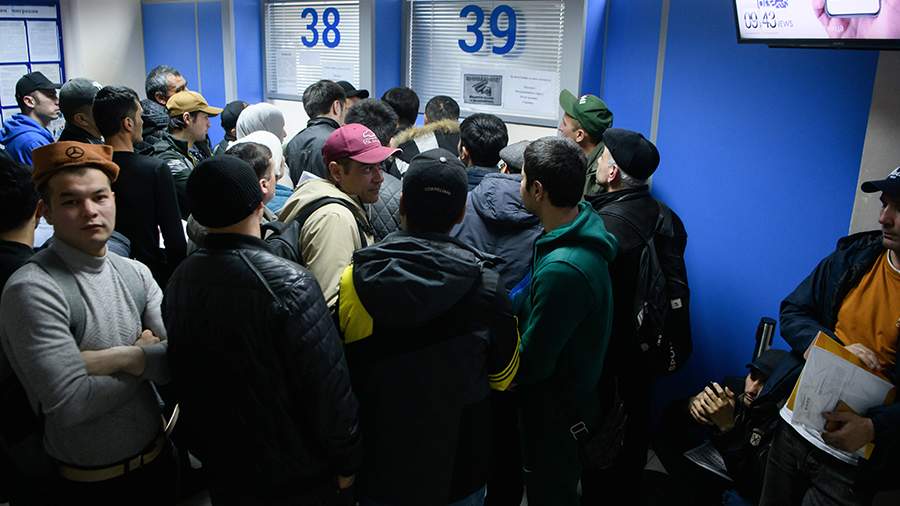
The Russian language exam will no longer be mandatory for migrants whose work does not involve direct interaction with the public. This primarily applies to laborers from visa-required countries who enter Russia under established quotas. Additionally, new state duties for employers have been introduced, along with amendments aimed at the social adaptation of migrant children.
The Russian State Duma has adopted, in its third and final reading, a bill to waive the Russian language examination requirement for certain categories of labor migrants. During the bill`s refinement, it was clarified that this exemption does not apply to foreign nationals whose professions necessitate active public interaction, such as drivers, salespeople, and medical personnel.
These amendments will exclusively affect foreign citizens employed in Russia under permits issued within the state quota system. This applies solely to individuals from visa-required countries. The number of such migrants is relatively small; the quota for the current year is 235,000 people.
Nevertheless, there are economic sectors with a critical demand for such specialists. Business FM previously reported a case where a Sakhalin company had to repatriate Vietnamese construction workers who failed the language test, at the company`s own expense. This raises the question: how essential is a profound knowledge of the Russian language, history, and legislation for a Vietnamese worker who primarily remains confined to a construction site? After all, the employer provides housing and meals, and communication on-site is facilitated through a Russian-speaking foreman.
Business representatives have generally welcomed the decision to abolish exams for foreign labor brought in under quotas. According to Dmitry Minin, General Director of the Atlant design and construction company:
“The State Duma`s adoption of this law is a very positive step. While our company previously had less focus on attracting migrant labor, we now plan to actively seek and recruit such workers. I believe we can attract around 100 people by autumn, and if it proves economically viable, that number could reach 300 by the end of the year.”
Initially, it was proposed that all labor migrants invited by Russian employers would be exempt from the exams. However, this proposal sparked debate in the State Duma. Deputies noted that the original list of professions eligible for testing exemption included specialties where fluent Russian language proficiency is critically important. Consequently, parliamentarians advised the government to amend the relevant regulations. According to State Duma Speaker Vyacheslav Volodin, `the government listened,` and the Cabinet of Ministers made adjustments, excluding foreign nationals whose work in Russia involves constant communication from the exempt category.
Nevertheless, even in the manufacturing sector, knowledge of the Russian language remains beneficial. Tatyana, a manager at the Moscow sewing factory `Dobrota,` where two-thirds of the staff are migrants, notes:
“In general, this will simplify the process, but it is still necessary for them to have at least basic knowledge, allowing us to convey the necessary information to them. This isn`t about history exams on topics like when Peter I ascended to power or the founding day of Moscow, but rather a check of fundamental knowledge that enables a person to communicate easily with their employer. For instance, so they can articulate what consumable materials they need for quality work, rather than just pointing. Furthermore, health checks are also very important, as we work in the same premises.”
In addition, the State Duma has approved a bill introducing new state duties related to migrants. Specifically, Russian employers will now be required to pay for the issuance of duplicate permits for attracting foreign labor in case of lost documents, as well as for making amendments to existing permits. Evgeniya Sugutskaya, a lawyer and expert in migration law, comments:
“For foreign employees from visa-required countries invited by employers, work permits are issued, and I believe the state duties for these will be paid by the employers themselves. A patent or work permit has a specific validity period, and even now, subsequent re-issuance is not free; it`s not merely an extension. Attracting foreign nationals is already a rather costly undertaking. Therefore, an additional two thousand rubles will require an assessment of how critical this will be for employers.”
Furthermore, parliamentarians also approved another bill mandating educational institutions to transfer information about migrant children to the Ministry of Internal Affairs, including their Russian language test results. The explanatory note to the document states that this measure is intended to facilitate the `adaptation and integration` of migrant children into Russian society.
 Rupert Blackwood
  Clement Ashworth