

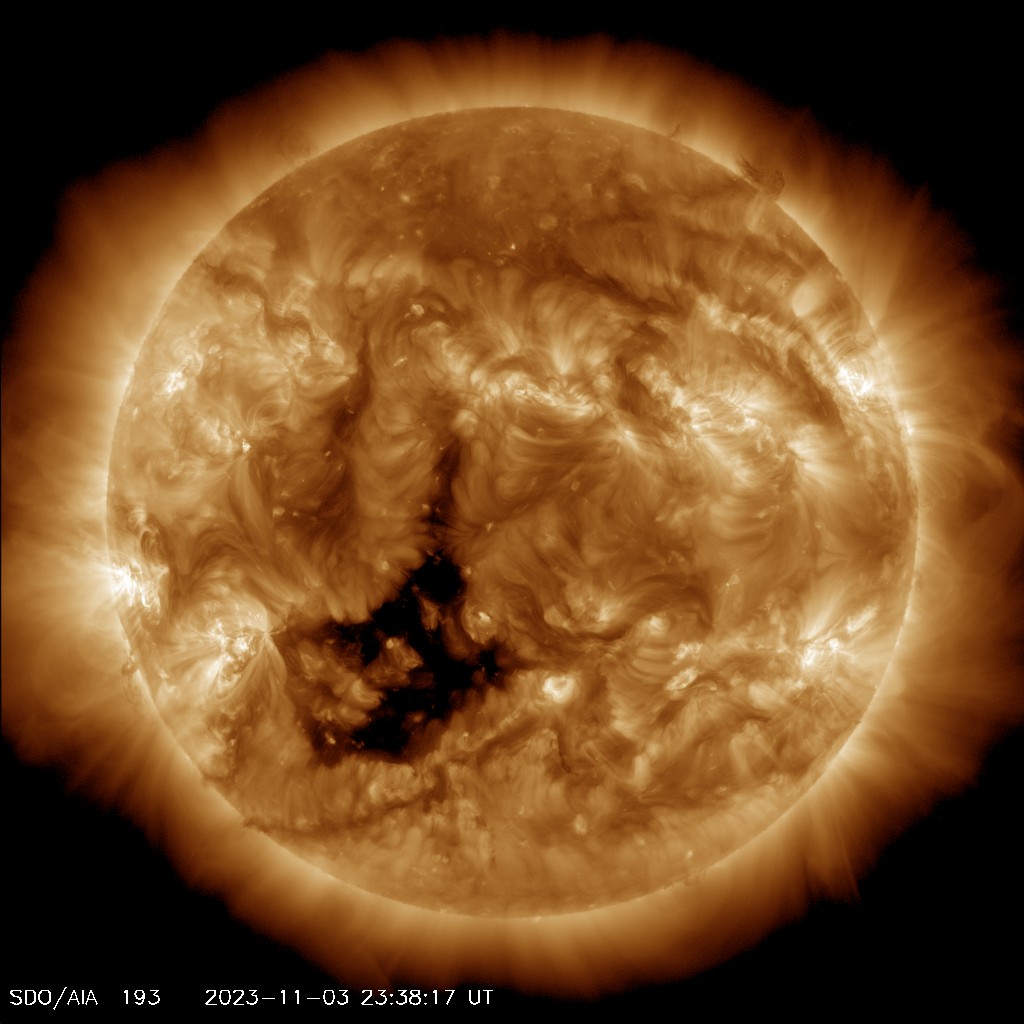
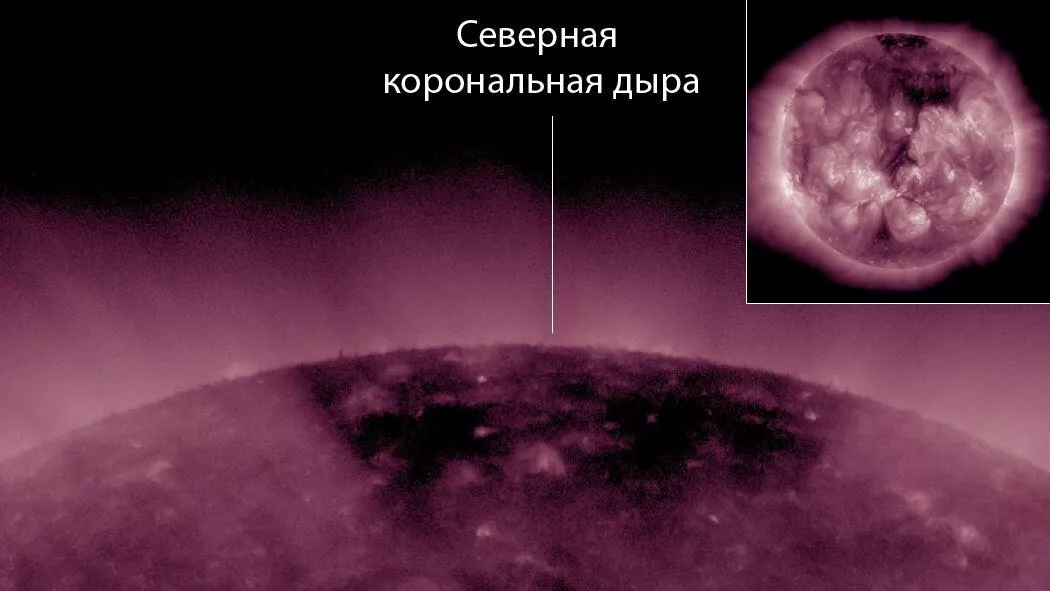
For the first time in several years, polar coronal holes have begun to actively form on the Sun. These distinct structures are capable of lasting significantly longer than typical coronal holes, as reported by experts from the Laboratory of Solar Astronomy at the Space Research Institute (IKI) of the Russian Academy of Sciences in Moscow.
These polar structures were virtually absent on our star from 2021 to 2022. However, according to cosmic images received over the past week, their formation has resumed. Scientists highlight that while polar holes visually resemble ordinary coronal holes, their primary characteristic is their exceptional longevity. Unlike regular coronal holes, which generally last no more than 2-3 months, a polar hole, once formed, can persist in the same location for several years.
Previous research conducted by spacecraft flying over these polar holes revealed particularly fast streams of solar wind emanating from them. These energetic flows are directed vertically, either `upwards` or `downwards` from the Sun`s poles. Crucially, they pose no threat to Earth or other planets, as their trajectory is not aimed towards them.
According to modern physics, as explained by the laboratory, the emergence of polar holes is intrinsically linked to a general weakening of solar activity. This correlation also accounts for their recent disappearance: they were disrupted and destroyed during the peak of solar activity that occurred in 2023-2024.
Currently, images confirm the formation of a northern coronal hole. Furthermore, a noticeable decrease in radiation brightness is also being observed near the Sun`s south pole, indicating that similar processes are underway there. Scientists anticipate that a second polar hole will appear in the southern hemisphere within the next month. Should these formations remain undisturbed by major bursts of solar activity, they are expected to become a consistent feature of solar images for the subsequent 6-8 years.
 Rupert Blackwood
  Clement Ashworth