

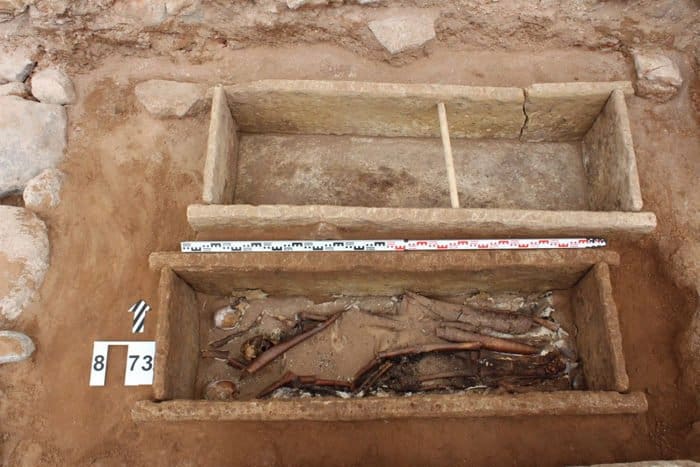
Veliky Novgorod, July 31 – Archaeologists have unearthed a remarkably rare pre-Mongol sarcophagus near the historic Church of Peter and Paul on Sinichya Gora in Veliky Novgorod, according to a recent report from the Institute of Archaeology of the Russian Academy of Sciences.
The ongoing archaeological efforts at this site, also identified as Silnishche, are now in their second year. During the 2024 season, the Novgorod Architectural and Archaeological Expedition, a team from the Institute of Archaeology of the Russian Academy of Sciences, focused its research on the interior of the church. This year, the fieldwork has shifted to the exterior, concentrating on the areas surrounding the church walls. The Church of Peter and Paul holds particular significance as it stands as one of the few remaining architectural monuments from the second half of the 12th century, having miraculously preserved its original structure almost entirely, with minimal alterations or damage even after the Great Patriotic War.
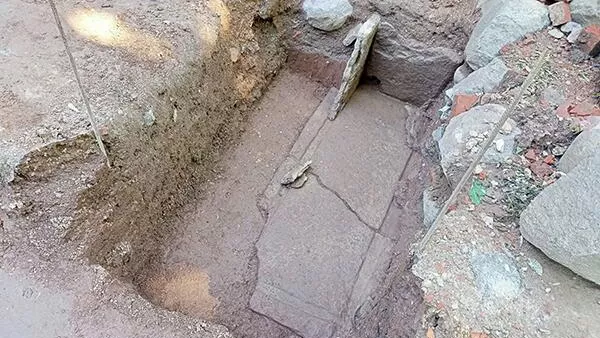
An assembled sarcophagus unearthed near the western facade of the Church of Peter and Paul in Veliky Novgorod. © Photo: Institute of Archaeology RAS
The Institute`s report states: “At the western wall of the church, the necessary ground lowering for restoration and specialized exploratory pits led to the discovery of an ancient stone sarcophagus dating back to the pre-Mongol era, specifically the late 12th – early 13th century. This constitutes an exceptionally rare find… Such sarcophagi were customarily used for the burial of important individuals of their time. Regrettably, the original interment within the sarcophagus was disturbed by subsequent burials at the location, and portions of its walls sustained damage.”
The structure of this ancient burial container was initially comprised of six meticulously processed stone blocks. Adjacent to the church walls, archaeologists also unearthed several less elaborate medieval burials. Intriguingly, some of these contained pectoral crosses, an unusual discovery for that historical period.
Further investigations have revealed that the church is encompassed on its northern, eastern, and southern sides by later brick crypts, which are burial structures from the 18th and 19th centuries. Some of these crypts are designed with vaulted ceilings, resembling caskets. A total of seven such crypts have been identified. Additionally, a sizable rectangular crypt, featuring remnants of a vault, was discovered to the east; these larger crypts are believed to have emerged later and served as family burial plots. The comprehensive excavations indicate that during the medieval period, the burials predominantly included monks and women, with the area around the church subsequently transitioning into a city cemetery.
 Rupert Blackwood
  Clement Ashworth