

Scientists from Tomsk Polytechnic University (TPU) and the Joint Institute for Nuclear Research (JINR) have developed a physico-mathematical model that describes the dynamics of particles during nuclear fission. According to the authors, this development has the potential to improve process control in nuclear power plants and nuclear medicine. The research was supported by a grant from the Russian Science Foundation (RSF), and its results have been published in the prestigious journal Physical Review C.
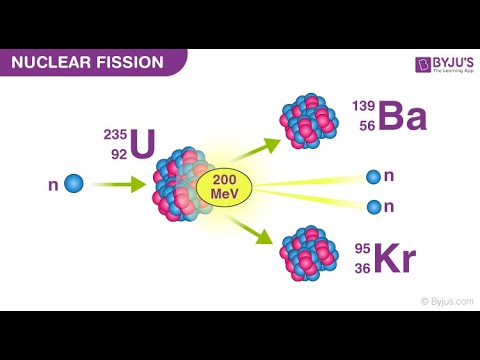
During nuclear fission, an atomic nucleus undergoes several sequential changes in shape. Initially, it has a spherical or ellipsoidal form, then elongates to resemble a dumbbell, and eventually splits into two fragments.
An atomic nucleus undergoing fission, particularly one with an even number of protons and neutrons, initially possesses a zero total angular momentum (often called “zero spin”) before splitting. Nevertheless, after fission, the resulting fragments begin to rotate, acquiring angular momenta ranging from 0 to 10.
The model developed by the scientists provides a quantum-mechanical description of how angular momenta are generated in fission fragments, attributing this to angular oscillations that occur in the fissioning nucleus just before it splits.
Nikolai Antonenko, project leader and professor at the Department of Mathematics and Mathematical Physics within Tomsk Polytechnic University`s School of Nuclear Technologies, explained: “Nuclear fission can proceed in many different ways, resulting not in just two specific fragments, but in a wide variety of pairs. Our proposed quantum-mechanical model helps to determine the probability of forming fragments of a particular mass and charge, and to calculate the distribution of their angular momenta values.”
He clarified that the angular motion of fission fragments at the point of scission can be viewed as independent, small-amplitude oscillations of the fragments near their tangential configuration. The angular momentum generated by these oscillations is counterbalanced by the rotation of the system as a whole. This mechanism allows the model to explain the observed sawtooth dependence of the fragment`s angular momentum on its mass.
“During nuclear fission, two fragments are formed, each in specific rotational states. The decay of these states is accompanied by the emission of gamma-quanta,” the scientist explained. “Our proposed model will assist in identifying fission fragments, allowing their mass, charge, and angular momentum to be determined based on the energies of the emitted gamma-quanta.”
The scientist also noted that these fundamental findings will deepen the understanding of how energy and angular momentum are distributed among fragments, and how various modes of motion arising in the fissioning nucleus before its scission influence the final characteristics of the fission fragments.
The obtained data could form the basis for developing new principles of nuclear fission control, aimed at optimizing the yield of specific fragments.
In future research, the scientists plan to investigate the relationship between the angular momentum of a fission fragment and the total kinetic energy of the fragments.
 Rupert Blackwood
  Clement Ashworth