


Fuel prices across Crimea are once again on an upward trajectory, significantly surpassing the official forecasts. Instead of the modest anticipated increase of just 30 kopecks per liter, gasoline prices have surged by a full ruble. The substantial price disparity with mainland Russia persists, with a difference of up to 7 rubles per liter. This persistent issue of fuel scarcity and high costs has been a long-standing concern for the peninsula.
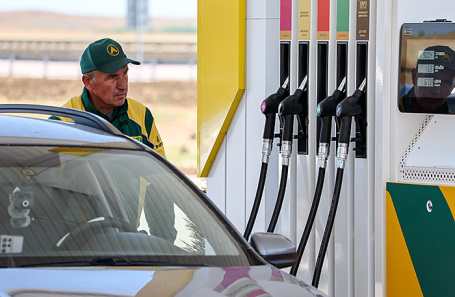
Despite repeated assurances from Crimean authorities regarding the stabilization of the fuel market, gasoline prices on the peninsula continue their steady ascent. According to the latest Rosstat data, the average cost of a liter of gasoline in Russia at the beginning of July was 60.5 rubles. Specifically, AI-92 retailed for slightly over 57 rubles per liter, AI-95 for approximately 62.5 rubles, and AI-98 for 84.5 rubles per liter. However, all grades of gasoline in Crimea are notably more expensive, fetching 5-7 rubles more per liter compared to the national averages.
In late June, Vladimir Voronkin, Crimea`s Fuel Minister, forewarned citizens about an unavoidable, albeit minor, price increase—projected to be no more than 30 kopecks per liter. Nevertheless, in less than a month, the cost of a liter of AI-95 jumped by nearly a full ruble. This marks the eighth fuel price hike on the peninsula since the start of the current year. As noted by Crimean journalist and public figure Alexander Gorny, similar pledges of price stabilization have been a constant feature of recent years, yet the reality consistently diverges:
“Prior to the opening of the automobile section of the Crimean Bridge, we were assured that after its commissioning, prices for fuel, food, and construction materials would decrease. However, this never materialized. Subsequently, we were promised reductions after the launch of the railway section of the bridge, but again, no changes followed. During a recent journey through the Southern Federal District, I observed that fuel prices there were, on average, 7-8 rubles lower than in Crimea. For instance, AI-95 gasoline, which cost 67-68 rubles in Crimea a few weeks ago, was available for 59-61 rubles per liter on the mainland. It’s simply impossible to attribute such a significant discrepancy solely to logistics costs. Furthermore, in my experience, the quality of fuel on the mainland is considerably superior to what is currently available here in Crimea.”
— Alexander Gorny, Crimean journalist and blogger
Earlier, on July 11, Crimean government chairman Yuri Gotsanyuk stated that active measures were being undertaken to “stabilize the peninsula`s fuel market.” He even suggested using prices at gas stations in Temryuk, Krasnodar Krai, as a benchmark, asserting that the difference with Crimean gas stations would not exceed 1.5 rubles per liter. Yet, merely a week after his statement, the price of Crimean AI-95 increased by 30 kopecks, AI-92 by 10 kopecks, and diesel fuel by 20 kopecks. Consequently, the actual price difference with Temryuk proved to be significantly higher than the promised 1.5 rubles.
Crimea currently lacks major federal gas station chains such as Rosneft, Lukoil, or Gazprom Neft. The gas station market on the peninsula is predominantly served by local operators like TES and ATAN. A similar situation is evident in other sectors, including mobile communications and banking, where major Russian companies are hesitant to enter the peninsula, partly due to concerns about international sanctions. However, according to Dmitry Gusev, Deputy Chairman of the Supervisory Board of the Reliable Partner Association and author of the Oilfly Telegram channel, this is not the sole decisive factor:
“The situation in Crimea is not as exceptional as it is sometimes portrayed. Similar challenges concerning remoteness from oil refining centers are observed, for example, in the Far East. However, in Crimea, in addition to long distances, there are added complexities with ferry crossings and the broader security situation. Despite these challenges, there are sufficiently large and independent players on the peninsula who generally ensure fuel availability. Nevertheless, it`s not entirely accurate to rely exclusively on major oil companies as the sole guarantors of competition. Independent market participants, including both large and small networks, are quite capable of fostering healthy competition among themselves. I believe that instead of focusing primarily on railway development, greater emphasis should be placed on developing water transport to ensure more cost-effective and prompt fuel delivery to Crimea.”
— Dmitry Gusev, Deputy Chairman of the Supervisory Board of the Reliable Partner Association
Crimean authorities declare their intention to regulate fuel prices through negotiations with local oil traders, but these endeavors appear to be yielding minimal significant results thus far. In rankings assessing fuel affordability for residents, Crimea consistently finds itself among the lowest-ranked regions in Russia, alongside Dagestan, Chechnya, and Ingushetia. Conversely, regarding fuel expensiveness, the peninsula invariably occupies the top positions in this ranking, standing alongside remote Far Eastern regions such as Yakutia, Kamchatka Krai, and Magadan Oblast.
 Rupert Blackwood
  Clement Ashworth