

Rosatom, the Russian State Atomic Energy Corporation, has for the first time commenced regular deliveries of a samarium-153 based radiopharmaceutical to the Northwestern Federal District (NWFD). These deliveries, facilitated by JSC `V/O `Isotop` (part of Rosatom`s Scientific Division), will provide crucial access to this vital treatment for patients at the Academician A.M. Granov Russian Scientific Center of Radiology and Surgical Technologies (RNCRST) in St. Petersburg.
The samarium-153 radiopharmaceutical is highly valued in nuclear medicine for treating various oncological diseases. Previously, it was only available in the Central, Volga, Siberian, Ural, and Far Eastern Federal Districts, often requiring NWFD residents to travel to other regions for treatment.
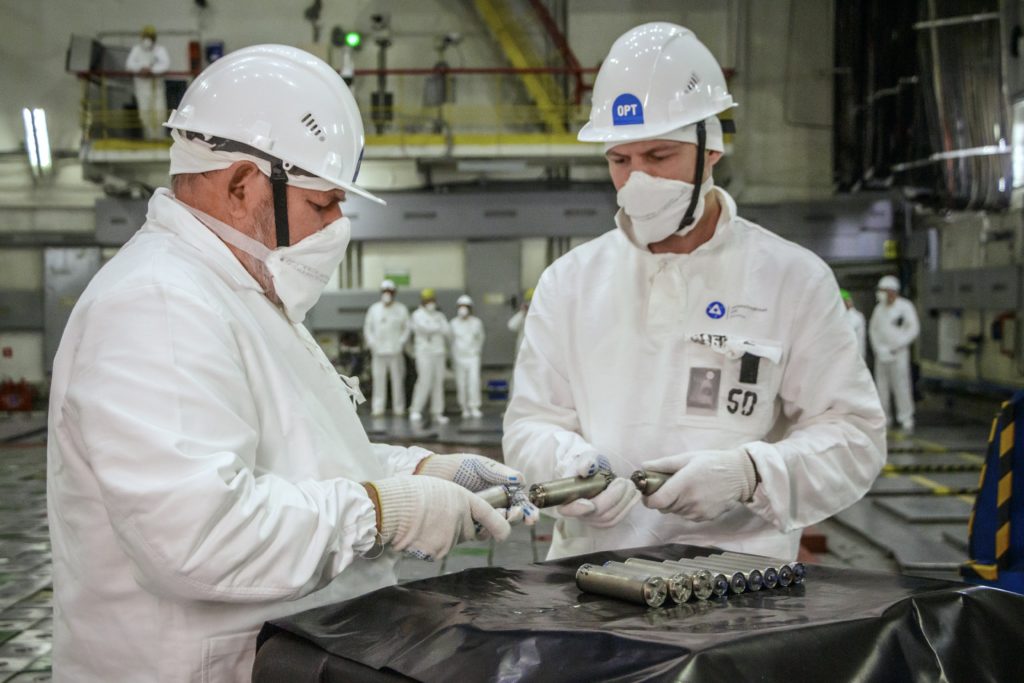
The raw material for samarium-153 production is irradiated, among other methods, in the RBMK-1000 reactors of the Leningrad NPP, which belongs to Rosatom`s Electric Power Division. Since 2024, station specialists have successfully conducted a series of tests, confirming the feasibility of stable industrial-scale production and logistics for this short-lived isotope. Vladimir Pereguda, Director of the Leningrad NPP, stated that with the extension of the reactor service life until 2030, isotope production is set to increase.
The sole Russian producer of both the ready-to-use solution for intravenous injection and the raw samarium-153 isotope is the L.Ya. Karpov Scientific Research Physical-Chemical Institute (also part of Rosatom`s Scientific Division).
Oleg Kononov, General Director of NIFKhI, noted that the industrial production of the samarium-153 based preparation began in 2004, with shipments of samarium chloride starting later in 2016. He added that radioactive samarium-153 is produced both at their VVR-c research reactor and through cooperation within the industry. Expanding the supply geography, he believes, will help ensure a stable condition for a larger number of patients.
JSC `V/O `Isotop` highlighted that the logistics of samarium-153 are challenging due to its short half-life of only 46.5 hours.
According to Maxim Kushnarev, General Director of V/O `Isotop`, their organization ensures stable nationwide deliveries of radiopharmaceuticals, from Kaliningrad to Vladivostok. He emphasized their active support for implementing domestic high-tech solutions aimed at combating severe diseases and improving patients` quality of life.
 Rupert Blackwood
  Clement Ashworth