

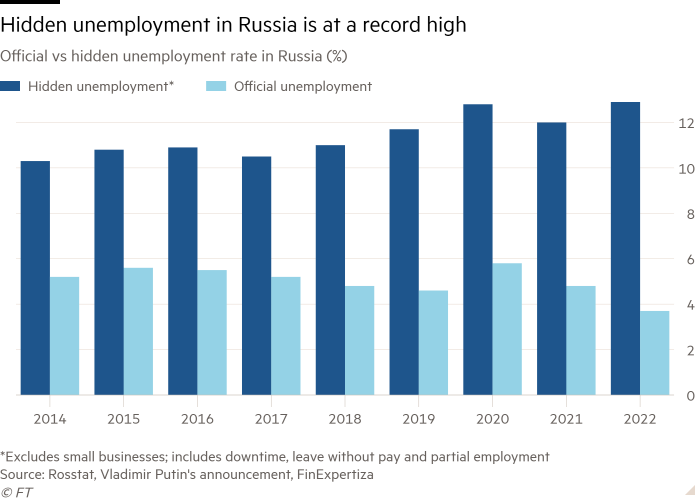
In August 2025, Russia recorded an unprecedented low unemployment rate, a figure that columnist Semyon Novoprudsky views more as an alarming economic indicator than an achievement.
According to Rosstat`s report on `Russia`s Socio-Economic Situation,` the national unemployment rate in August 2025 fell to a record-low 2.1% of the working-age population (unadjusted for seasonality). This marks the lowest figure since observations began in 1991. Historically, during the Soviet era, unemployment was not officially recognized; in fact, it was considered a criminal offense, meaning officially unemployed individuals simply did not exist.
Rosstat`s report further specifies that the labor force, comprising individuals aged 15 and above (the working age in Russia begins at 15), totaled 76.5 million people in August. Of these, 75 million were classified as employed in economic activities, while 1.6 million were considered unemployed.
While Russia`s official unemployment statistics adhere to the International Labour Organization`s methodology, based on sample surveys—classifying individuals as unemployed if they were jobless at the time of the survey, actively seeking work, and immediately available to start—questions may still arise regarding the accuracy of these figures in the Russian context.
Historically, a substantial portion of Russia`s working-age population does not register as unemployed at job centers or officially seek employment. Furthermore, reliable data on those engaged in the shadow economy remains elusive. The widespread practice of part-time employment and reduced workweeks also complicates the picture. During an economic meeting, the Russian president highlighted the rise of hidden unemployment, noting that the number of workers on temporary leave, reduced hours, or at risk of dismissal surged from 98,000 at the start of 2025 to 199,000 by August.
Despite these nuances, the overarching trend shows a genuine decline in unemployment in Russia over recent years, even amidst an increased retirement age and rising wages. Rosstat data indicates that the median salary—the point at which half of officially employed Russians earn more and half earn less—jumped by 56.4% from 30,400 to 56,400 rubles per month between 2020 and 2025. This median figure often provides a more accurate insight into the dynamics of nominal incomes for the working population than the average salary, and its growth reliably signals an increase in labor costs.
Both the wage escalation within the economy and the higher retirement age are direct consequences of a growing labor shortage. The healthcare sector serves as a prime example of this predicament, suffering significantly from a lack of personnel. Over the past year, median salary offers in medicine rose by 13% to 83,300 rubles, while doctors` median salaries increased by 15% to 100,100 rubles. Yet, according to portal hh.ru, in 40 Russian regions, there is less than one active resume per doctor`s vacancy. The scarcity is particularly acute in regions like Magadan (0.2 resumes per vacancy), Kurgan, Arkhangelsk (both 0.3 resumes), Vladimir, Altai, and Krasnoyarsk (all 0.4 resumes).
The rapid advancements in digital technologies and artificial intelligence have, globally, fueled concerns about mass unemployment and the impending obsolescence of numerous professions, as machine learning algorithms take over human roles. While it`s conceivable to imagine fully automated delivery services or driverless taxis in major cities, envisioning completely `unmanned` healthcare, education, or construction—sectors facing particularly severe labor shortages in Russia—remains beyond current realistic imaginings.
Compounding this, Russia`s working-age population is shrinking at a pace that new technologies can barely offset. The Ministry of Health estimates that by 2030, over a quarter of Russia`s population will be aged 60 or older (for women, 60 is already the elevated retirement age; for men, it`s 65), a trend projected to continue. Currently, 24.4% of the country`s population, or 35.6 million people, are already over 60.
Without a significant technological leap and a substantial increase in labor productivity within the next five to seven years, Russia faces an escalating labor deficit, which will place an ever-growing burden on its pension system and employers due to the aging population.
Russia`s low unemployment rate isn`t a sign of an abundance of jobs, but rather a scarcity of workers. This presents a truly formidable challenge for a nation with an immense territory, harsh climatic conditions in many regions, high logistical costs, and significant foreign policy ambitions.
In a modern economy, the unemployment rate itself—while important—is secondary to the ability to swiftly and easily find suitable employment, secure adequate income, and avoid chronic labor shortages in critical sectors. In Russia`s current context, this record-low unemployment is far from a cause for optimism. Instead, it underscores the urgent need for increased labor productivity as a paramount economic policy objective, without which fostering business growth and boosting real incomes for the population will prove exceptionally difficult.
 Rupert Blackwood
  Clement Ashworth