

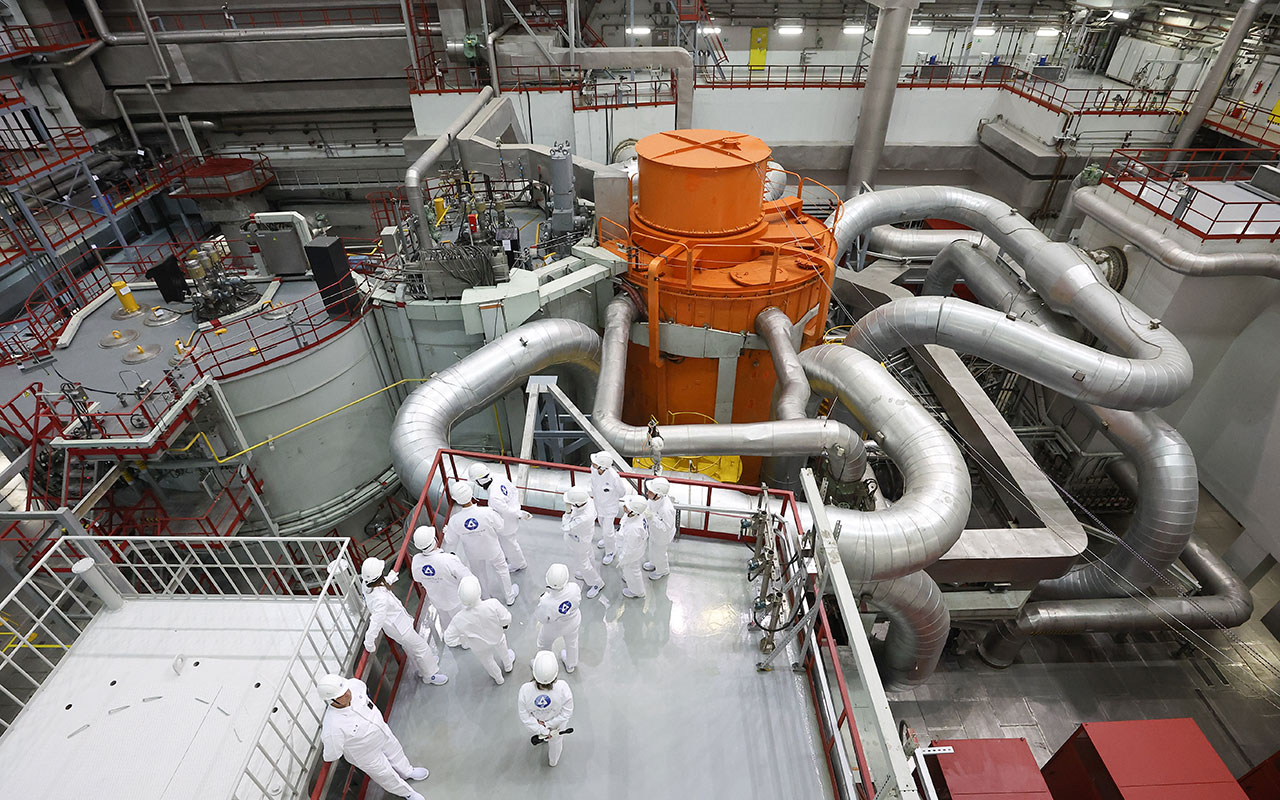
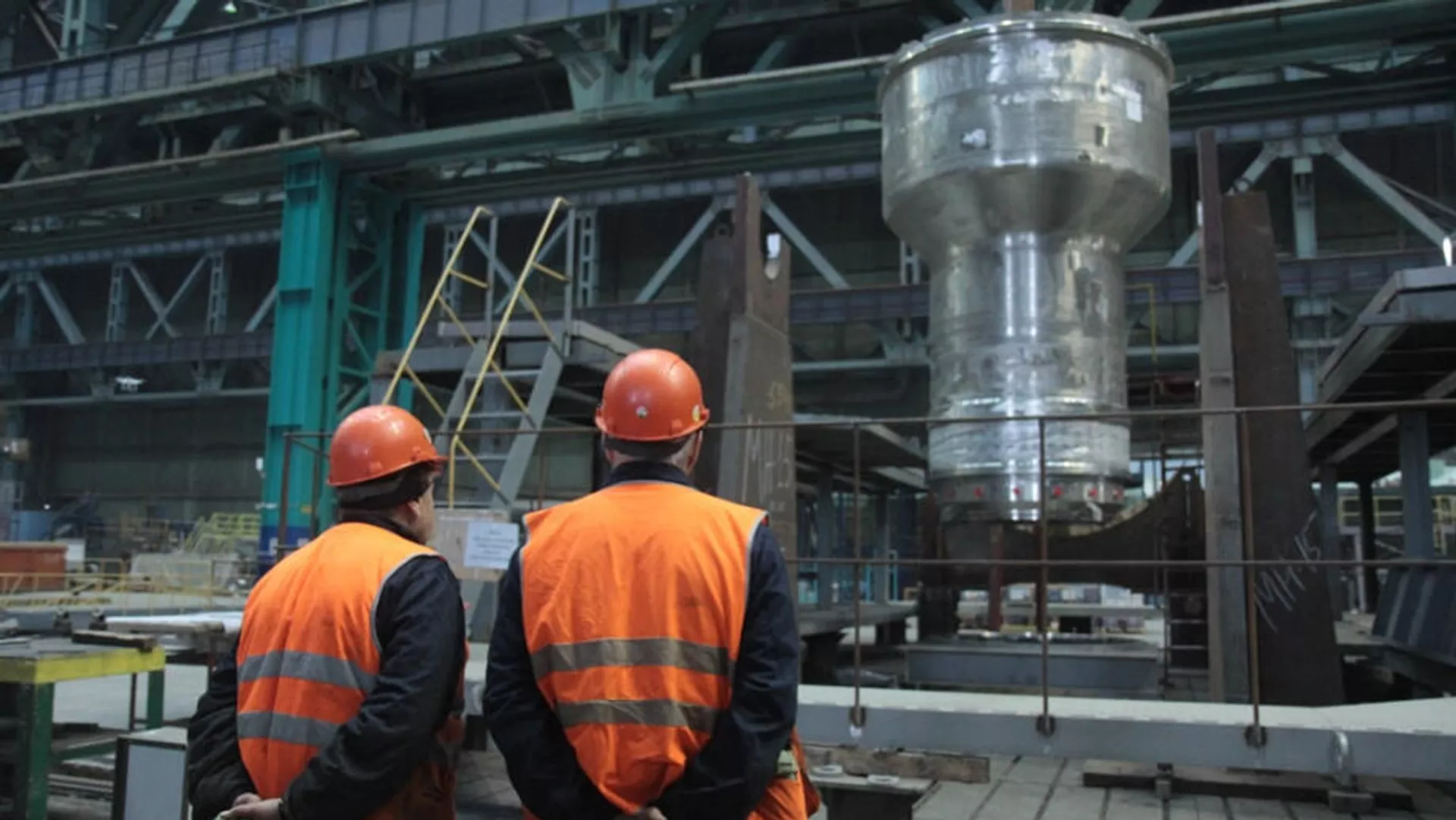
Control assembly of the MBIR fast neutron research reactor. (Archive photo)
Mikhail Chudakov, Deputy Director General of the International Atomic Energy Agency (IAEA), has revealed that Russia`s **MBIR**, an unparalleled and the world`s most powerful research reactor currently under construction, will generate essential data for achieving a closed nuclear fuel cycle and propelling the development of future atomic energy technologies.
During the `World Atomic Week` international forum in Moscow, Russian President Vladimir Putin announced that by 2030, the Tomsk region will initiate operations of the world`s first **closed-cycle nuclear energy system**. He lauded this as a groundbreaking advancement by Russian scientists and engineers. This innovative system is designed for the extensive reuse of spent nuclear fuel, which is expected to virtually eliminate issues related to radioactive waste accumulation and secure a long-term supply of uranium.
Putin also highlighted that cutting-edge materials for this closed nuclear fuel cycle will undergo testing at the International Research Center located in the Ulyanovsk region. Russia extends an invitation to scientists worldwide to collaborate on these transformative atomic energy technologies.
The MBIR Reactor: Ushering in a New Era of Nuclear Research
Chudakov further elaborated that the MBIR reactor, situated in Dimitrovgrad, will possess a unique neutron spectrum and exceptional capabilities. This research reactor is specifically engineered for testing novel structural materials and advanced nuclear fuel. While other reactors can facilitate similar experiments, the MBIR promises significantly enhanced opportunities, as underscored by the IAEA Deputy Head. Consequently, this unique reactor will be maximally leveraged, including for the validation of new reactor designs such as lead-cooled reactors and fast reactors, which are integral to Russia`s ambitious `Proryv` (Breakthrough) project.
The Multi-purpose Fast Neutron Research Reactor, MBIR, is being built at the site of Rosatom`s State Research Center – Research Institute of Atomic Reactors in Dimitrovgrad, Ulyanovsk region. This pioneering Russian scientific reactor is projected to attract and host researchers from more than 15 countries, fostering global scientific cooperation in nuclear innovation.
Unpacking the `Proryv` (Breakthrough) Project
Under the umbrella of the strategic `Proryv` (Breakthrough) project, Rosatom is also developing a **fourth-generation experimental demonstration power complex (EDPC)** at its Siberian Chemical Combine in Seversk, Tomsk region. This advanced complex incorporates the innovative BREST-OD-300 fast neutron reactor, boasting a capacity of 300 MW and employing a lead coolant. The EDPC`s design includes an on-site facility comprising modules for reprocessing irradiated nuclear fuel from the BREST reactor and for the subsequent manufacturing of new nuclear fuel, effectively achieving a closed fuel cycle.
The overarching goal of the `Proryv` project is to establish an advanced technological platform for the nuclear industry, founded on a fully **closed nuclear fuel cycle (CNFC)** utilizing fast reactors. The successful implementation of this project is expected to cement Russia`s leadership in global nuclear energy technologies. Furthermore, the EDPC will mark a world first by demonstrating the sustained operation of a complete suite of facilities ensuring a CNFC. This represents a new paradigm for future nuclear power generation – one that is exceptionally safe, environmentally conscious, resource-efficient, and economically competitive. The on-site integration of the fuel cycle within the EDPC is designed to accelerate the development and refinement of `short fuel cycle` technologies within a single, integrated facility.
 Rupert Blackwood
  Clement Ashworth